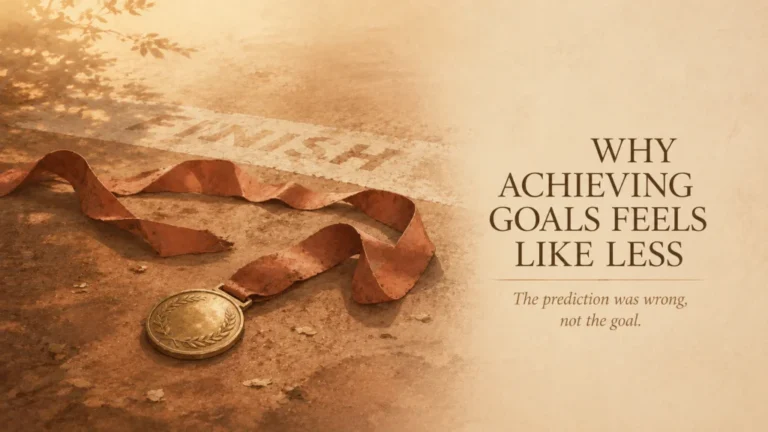
The person who finally has what they worked toward, and still cannot feel settled, is not broken. Over two decades sitting with people at the end of their lives, I saw this pattern more times than I can count: the feeling of enough does not arrive the way people expect it to, and in most cases, it does not arrive at all without understanding why. The research on this is unambiguous and has been for decades. Hedonic adaptation, the documented tendency for human beings to return to a baseline level of wellbeing after positive changes, explains most of what people experience as chronic dissatisfaction. What follows is an overview of where that pattern comes from, why circumstances alone cannot fix it, and what the research suggests actually shifts it.

Never Feeling Satisfied: The Pattern That Kept Appearing
There is something I noticed often enough in those rooms that I stopped calling it unusual. A person near the end of their life would talk through what their years had contained: the career they had built, the house they had worked toward, the relationships that eventually settled, the goals that had driven twenty or thirty years of choices. And then they would say something like, “I thought I would feel different by now.” Not regret, exactly. More like bewilderment. They had gotten what they said they needed. The feeling they had been expecting had not come with it.
What I want to be clear about from the start is that never feeling satisfied is not a character flaw, a sign of greed, or a symptom of ingratitude. It is one of the most consistently documented patterns in happiness research. The experience of acquiring or achieving something and then finding that the feeling fades faster than expected is so reliable across populations that psychologists gave it a name decades ago. Understanding that name, and what it actually means, is the first useful thing anyone can do with this pattern. Because trying to fix something you have misidentified is how people spend years working against themselves without knowing it.
One thing worth naming before going further: if what you are describing is not just a sense of wanting more, but a persistent inability to feel any satisfaction or pleasure at all, combined with other significant changes in mood, energy, or daily functioning, that overlap is worth discussing with a professional. Chronic dissatisfaction is common and addressable. Anhedonia, the clinical term for an inability to experience pleasure, belongs in a different kind of conversation. A therapist or doctor is the right starting point there, not a website.

Hedonic Adaptation: Why the Feeling of Enough Fades
Hedonic adaptation refers to the documented tendency for human beings to return to a relatively stable baseline level of wellbeing after significant positive or negative changes in their circumstances. The promotion, the new relationship, the move to the better city: each of these produces a real boost when it first arrives. Then the boost levels off, and the baseline reasserts itself. This is not a philosophical observation. It is something researchers have been measuring for decades, and the pattern holds regardless of how meaningful or hard-earned the gain was.
The most cited evidence for this comes from a 1978 study by Philip Brickman, Dan Coates, and Ronnie Janoff-Bulman, published in the Journal of Personality and Social Psychology. They interviewed 22 major lottery winners, a comparison group of neighbors living in the same areas, and a group of individuals who had been paralyzed in accidents. On a happiness scale from 0 to 5, lottery winners scored an average of 4.00. Their neighbors scored 3.82. The difference was not statistically significant. More striking: the lottery winners reported significantly less pleasure from ordinary daily activities than the comparison group. The contrast effect of the peak experience had, in effect, dimmed everything ordinary.
What this means practically is that the gains people spend years working toward do produce something real. The boost is genuine. But it fades more quickly, and more completely, than almost anyone anticipates. The baseline pulls everything back toward it. That pull is hedonic adaptation, and it operates whether the gain is a windfall or the result of fifteen years of disciplined work. The mechanism does not distinguish. It adapts.
The Forecasting Error That Keeps the Bar Moving
Hedonic adaptation explains why satisfaction fades. There is a second, related phenomenon that explains why people keep assuming the next thing will finally deliver it. Psychologists Timothy Wilson and Daniel Gilbert identified what they called the impact bias: the consistent tendency for people to overestimate both the intensity and the duration of the positive feelings that future events will produce. When people imagine getting the promotion, finishing the degree, reaching the number in their savings account, or finding the relationship they have been looking for, they predict a level of happiness that the actual experience rarely matches, and that fades faster than the prediction ever accounted for.
The result is a pattern that can run for decades without anyone naming it clearly. The imagined version of the goal produces the feeling. The real version does not, or not for long. So the person concludes that this was not quite the right thing after all, and they redirect toward the next version of enough. This is not weakness or failure to be sufficiently grateful. It is a structural feature of how human beings predict their own emotional futures. The predictions are systematically wrong in the same direction, across virtually every population Wilson and Gilbert studied.
I saw this play out in a specific way over the years. People who had spent their careers postponing meaning until some future condition would arrive often reached the end of those careers carrying real grief, not because the conditions had not been met, but because meeting them had not produced what they had spent years imagining. The gap between the imagined feeling and the actual one is not evidence that something went wrong. It is the impact bias operating exactly as it always does. Naming it does not make it disappear, but it does change what you conclude from it.
Why This Is Not a Character Flaw
Most of what gets written about chronic dissatisfaction frames it as one of two things: either a character defect that needs to be corrected through gratitude practices and attitude adjustment, or a motivational advantage that ambitious people should learn to channel. Both framings miss the more accurate explanation. The wanting brain was never calibrated to register enough. The evolutionary logic is direct: organisms that remained satisfied after meeting basic needs had less reason to keep striving, and less striving meant less survival in environments where resources were uncertain and conditions changed without warning. The persistent sense that there is always more required is, from that perspective, functioning exactly as it was built to function.
This does not make the experience comfortable. And it does not mean that chronic dissatisfaction is simply to be accepted and endured without examination. What it means is that trying to resolve it by telling yourself to be more grateful, or by pursuing the next goal more aggressively, is working against a mechanism that those approaches cannot touch. The mechanism does not respond to willpower or reframing alone. It responds to something more specific, and the research has been reasonably consistent about what that something is.
The frame I found most useful for people grappling with this was something like: the feeling that enough has not arrived is not evidence that you have been living wrong. It is evidence that you are human, and that the architecture of your psychology was built for conditions very different from the ones most people are living in now. That reframe does not resolve anything by itself. But it stops people from compounding the pattern by adding self-judgment to it, which tends to make everything harder without making anything clearer.
What the Research Suggests Actually Shifts It
A 2005 paper by Sonja Lyubomirsky, Kennon Sheldon, and David Schkade, published in the Review of General Psychology, proposed an influential model of what governs long-term wellbeing. They identified three factors: a genetically determined baseline (accounting for roughly 50% of variance in long-term happiness), life circumstances (roughly 10%), and intentional activities (roughly 40%). The percentages are estimates based on available data at the time, not fixed laws, and the model has been debated and refined since. The directional finding has held up: circumstances, including all the things people spend most of their energy working toward, account for substantially less of long-term wellbeing than most people assume.
The reason circumstances account for so little is, again, hedonic adaptation. A new circumstance arrives, produces its boost, and then adaptation absorbs it relatively quickly. Intentional activities resist this process longer, because they require continued engagement and vary in ways that pure circumstance does not. The experience of building something, practicing something, or connecting with someone in a way that requires ongoing attention and effort does not flatten out the way a pay raise does. It asks something from you each time, and that requirement is part of what slows the adaptation.
What this does not mean is that circumstances are irrelevant. Adequate material security, stable relationships, and physical health create real conditions for wellbeing, and the research does not suggest otherwise. What it says is that beyond a reasonable threshold, continued investment in improving circumstances tends to produce diminishing returns, while investment in how you spend your attention and engagement tends not to. The distinction matters because most people have it exactly backward.
The practical difference between the two categories is worth being concrete about. Circumstances are things you arrive at and then inhabit. Activities are things you do, and keep doing, in ways that vary. The adaptation curve looks different for each:
- Circumstances that adapt quickly: salary increases, larger living spaces, upgraded possessions, status markers, comfort improvements. The boost is real. The fade is reliable.
- Activities that resist adaptation longer: practicing a skill that continues to challenge you, building relationships that require ongoing attention, creative or physical work that varies enough to stay difficult, contributing to something outside your own situation. These do not flatten out as fast because they ask something different from you each time.
This is not a list of prescriptions. It is a description of what the research has found actually behaves differently under adaptation. What falls into each category in your own life is something only you can determine, and it is worth being honest about rather than optimistic.
Final Thoughts: What Clarity Can Realistically Do Here
The pattern of never feeling satisfied is not one that understanding alone will dissolve. Knowing about hedonic adaptation does not make you immune to it. Knowing about the impact bias does not stop the next anticipated goal from feeling like it will be the one that finally delivers the feeling. What the research gives you is not an exit from the mechanism. It gives you a more accurate map of what you are actually dealing with, and that changes where you direct your energy.
What I can say from twenty years in those rooms is that the people who arrived at the end of their lives with something resembling peace were rarely the ones who had accumulated or achieved the most. They were more often the people who had, at some point, stopped outsourcing the feeling of enough to conditions that were always going to keep moving. That is not a prescription. It is a pattern. What you do with it depends on what you are actually carrying and which part of this you are trying to get clearer on. For a wider frame around what happiness research actually says, and what it does not say, the happiness quotes and the wisdom behind them covers the broader territory.
Read More on Satisfaction and Chronic Dissatisfaction
Each piece below takes a specific angle on what never feeling satisfied actually looks like in practice, and what the research and experience suggest about it.
| Topic | What It Covers |
|---|---|
| Why am I never satisfied? | The internal experience of chronic dissatisfaction and why naming its structural cause tends to matter more than most coping advice |
| Why achieving goals doesn’t make you happy | The specific gap between imagining an outcome and living inside it, and what happens in that space |
| Is never being satisfied a good thing? | When chronic dissatisfaction drives real achievement and when it causes real damage instead |
| How to feel more satisfied with your life | Evidence-grounded approaches to shifting the experience of dissatisfaction rather than just reframing it |
| Why comparison makes satisfaction impossible | How measuring your life against others keeps the feeling of enough permanently out of reach |
These pieces are designed to be read in whatever order is most relevant to what you are currently working through.
FAQs
💭 Why do I never feel satisfied no matter what I achieve?
Because the brain was never built to register enough. Hedonic adaptation pulls your baseline back toward a set point after any gain, and the impact bias means you consistently overestimated how good the achievement would feel before it arrived. That combination is not a personal failing. It is a structural feature of how human psychology works.
🔄 What is hedonic adaptation and how does it affect happiness?
Hedonic adaptation is the documented tendency to return to a relatively stable baseline level of wellbeing after positive or negative changes in your circumstances. A gain produces a real boost, and then the boost fades as the new situation becomes normal. Research going back to the 1970s shows this happens even with major life changes like winning a lottery.
🩺 Could never feeling satisfied be a sign of depression?
Chronic dissatisfaction and depression can overlap, but they are not the same thing. If what you are describing is a persistent inability to feel any pleasure or satisfaction at all, combined with significant changes in mood, energy, sleep, or daily functioning, that is worth discussing with a professional. The pattern of always wanting more is common and different from anhedonia, which is a clinical symptom that belongs in a different kind of conversation.
🎯 Why don’t big life changes make me as happy as I expected?
Because of the impact bias: people consistently overestimate how intensely positive future events will feel and how long that feeling will last. The imagined version of a goal tends to feel more satisfying than the lived version. This is not a flaw in the goal or in you. It is a well-documented error in how human beings predict their own emotional futures.
🌱 What actually helps people feel more satisfied with their lives?
The research suggests that intentional activities, things that require ongoing engagement and vary over time, tend to resist adaptation better than changes in circumstances. Improving your circumstances accounts for less of long-term wellbeing than most people assume. How you spend your attention matters more than what you acquire or achieve, and that is a harder shift to make because it runs against most of how people are taught to think about progress.
👁️ Why does comparing myself to others make me feel less satisfied?
Because comparison moves the standard continuously, so the feeling of enough can never catch up to it. Whatever you have is measured against someone who has more, and the bar adjusts upward automatically. This is a specific and well-documented mechanism that operates separately from hedonic adaptation, and it tends to compound the problem significantly.