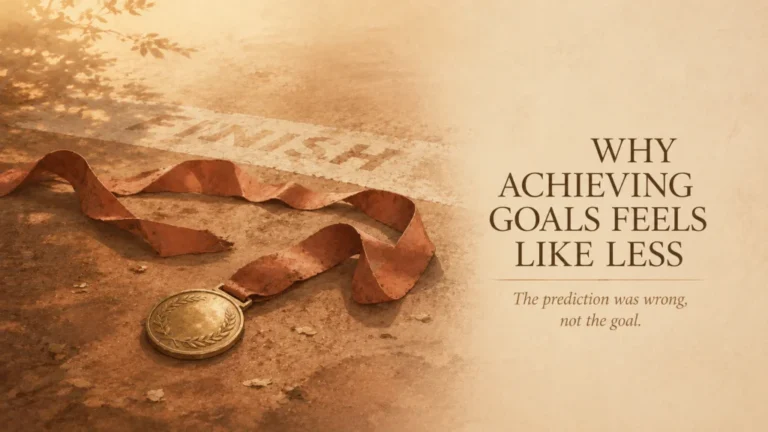
The feeling of never being satisfied tends to arrive quietly, in the gap between what you expected something to give you and what it actually did. It has a mechanism behind it, one that has nothing to do with gratitude or ambition or character. That mechanism is called hedonic adaptation, and understanding it will not make the feeling go away. What it will do is change the story you attach to it. That is not a small thing.

The Pattern I Kept Seeing
The question of why you are never satisfied is one I encountered more times than I expected, and rarely from people who were suffering in any obvious way. It came from people who had built what they set out to build. A career that matched the picture they had once carried around. A relationship that looked, from the outside, like exactly what they had said they wanted. A version of their life that corresponded, more or less, to the destination they had described to themselves years earlier. And then the horizon had moved. Not dramatically. Just quietly, the way it does.
Over two decades in hospice work, I sat with a lot of people who were taking stock of what their lives had contained. The pattern of wanting that I heard described most clearly was not a symptom of deprivation. The people who put it most precisely were the ones who had gotten what they wanted, and found that the satisfaction had simply relocated to the next thing. Not a crisis. Not a failure. Just a persistent, low-level sense that the real satisfaction was somewhere ahead, always slightly out of reach.
From the outside, most of the advice I had heard people give about this experience was wrong in the same direction. It treated the feeling as a character problem. As something to be fixed through better attitudes or greater appreciation. What I came to understand, gradually, is that this is a question about how the brain works, not about what kind of person you are.
Why the Feeling Doesn’t Stay
Hedonic adaptation is the tendency of human beings to return to a relatively stable level of emotional wellbeing after positive events or changes. The raise, the move, the relationship milestone, the goal finally reached: each of these arrives with a genuine emotional response. And then, faster than most people expect, that response fades. The new situation becomes the baseline. The attention moves to what is still absent, or to what comes next.
Research examining major positive life events, including studies of lottery winners and people who experienced significant changes in their circumstances, has consistently found that these events produce less lasting change in wellbeing than people predict beforehand. The emotional response is real. The anticipation is real. The problem is that the brain adapts to positive conditions more quickly than we tend to account for when we are still working toward the thing. What we expected to feel like an arrival tends to feel, after a short while, like a new normal.
This pattern is particularly disorienting with goals, because the effort involved makes the fading harder to accept. I have looked at why reaching a goal rarely delivers what we expected in more depth elsewhere, because it is one of the most common places people encounter this mechanism without having a name for it.
What matters here is that hedonic adaptation is a structural feature of human motivation, not a personal failing. The brain is built to respond more strongly to change than to stable conditions, positive or negative. A consistent positive environment becomes ordinary quickly. The system is less activated by what you have than by what is different, novel, or unresolved. Understanding this does not dissolve the feeling of never being satisfied, but it reframes where the feeling is coming from. It is not evidence of ingratitude. It is evidence of a human brain doing exactly what human brains do.
What the Standard Explanations Get Wrong
Most responses to the never-satisfied feeling, in self-help writing and in the advice people tend to give each other, fall into one of two categories. The first is the mindset framing: if you had more gratitude, if you were more present, if you appreciated what you have, the dissatisfaction would lift. The second is the high-achiever framing: the never-satisfied feeling is actually a strength, the relentless drive of people who are built to keep going. Neither of these explanations holds up very well, and both of them tend to make the person carrying the feeling worse off, not better.
The mindset framing misdiagnoses the cause. Hedonic adaptation does not respond to attitude. It is a process, not a perspective problem. Telling someone to feel more grateful for what they have is not entirely useless advice, but it does not address why the satisfaction fails to arrive, or why it fades when it does. What it tends to do, in practice, is add a layer of self-blame to an experience that already does not feel good. Now the person not only does not feel satisfied; they feel it is their fault for not being grateful enough.
The high-achiever framing is more flattering, but it sidesteps the same question. It suggests the dissatisfaction is fuel. That may occasionally be true in some contexts. It does not explain why the feeling persists even in people who have nothing left they particularly want to achieve, and it quietly frames the feeling as something to be used rather than understood. Those are different things, and the difference matters.
What research in positive psychology has pointed toward instead is that human motivation is structurally more responsive to pursuit, novelty, and comparison than to stable possession. The wanting brain responds to a specific set of conditions:
- Novelty: new situations, new problems, new information. The brain activates differently when something is unfamiliar or unresolved.
- Progress: movement toward a goal, not arrival at it. The feeling of getting closer tends to be more sustaining than having gotten there.
- Comparison: how the current situation measures against what came before, or against what others appear to have. Stable satisfaction is harder to maintain when comparison is active.
- Anticipation: the expected feeling of satisfaction is often more vivid, and more motivating, than the actual feeling once the thing arrives.
These are features of a system built for a context where stability was rare and continued attention to the environment was a practical necessity, not evidence of a character problem. The friction comes when that system runs inside a life that offers considerably more stability than it was designed to sit inside. What gets called chronic dissatisfaction is, in many cases, a mismatch between an old system and a newer set of conditions. Understanding that is more useful than assigning blame for it.
The broader experience of never feeling satisfied spans more territory than the adaptation mechanism alone, including what tends to sustain it over time and what, in practice, tends to shift it.
What This Understanding Actually Does
Knowing the mechanism behind the never-satisfied feeling does not make the feeling go away. I want to be clear about that from the start, because most explanations of this kind are offered as though understanding is the same as solving. It is not. What changes with understanding is the question you are left carrying. Instead of “what is wrong with me,” the question becomes “what does this mean for how I am living.” That is a different question, and usually a more useful one.
In practical terms, what tends to help most is paying closer attention to the experience of working toward something than to the arrival at it, because the brain is more responsive to progress than to possession. It means noticing the gap between what you expected a thing to produce and what it actually produced, without immediately filling that gap with a new thing to want. And it means being honest about the self-blame that tends to attach to this kind of feeling, which is often the most corrosive part of the whole experience.
“What I noticed, across enough of these conversations to stop calling it a coincidence, was that the people most worn down by the never-satisfied feeling were not worn down by the wanting itself. They were worn down by what they had decided it meant about them. The wanting was roughly the same across the room. The verdicts were not.”
The wanting does not go away when you remove the verdict. But the weight changes considerably. The person who reads their dissatisfaction as a mismatch between an old system and a modern life is carrying the same feeling as the person who reads it as proof that something is wrong with them. One of those readings compounds what is already there. The other does not.
One thing worth adding: if the inability to feel any satisfaction has become pervasive, extending into a consistent flatness that affects most areas of your life regardless of what is happening in them, that is worth bringing to a professional. What this describes is a structural feature of motivation and wanting. It is not a clinical diagnosis, and it is not a substitute for one. There is also more on the practical side of this in how to feel more satisfied with your life, for anyone who wants to go further than the explanation alone.
Final Thoughts: The Horizon Was Always Going to Move
The horizon is going to keep moving. That is one of the few things I am confident saying to anyone who has spent time asking why they are never satisfied. Understanding hedonic adaptation does not stop the adaptation. It does not make the next thing you want feel permanently satisfying once you get it. A lot of what people have said honestly about happiness arrives at the same place: the feeling we are chasing and the feeling that actually arrives are not the same experience, and expecting them to be tends to produce exactly this kind of persistent gap.
What understanding offers is smaller than a solution, and I think more honest: a frame for what is happening that does not require you to be at fault for it. Most of the useful things I ever had to offer anyone were somewhere in that space. Not a cure for the feeling. A different relationship to it. The person who understands why satisfaction fades is not exempt from the fading. They just do not have to spend so much of their time convinced that the fading means something is wrong with them. Depending on how long you have been carrying that verdict, that is something close to relief.
FAQs
🔄 Why does satisfaction fade so quickly after I get what I wanted?
This is hedonic adaptation at work. The brain returns to a baseline emotional state after positive events faster than most people anticipate, and the new situation becomes the new normal. The attention then moves to what is still absent. It is not ingratitude. It is how the system is built.
💭 Is always wanting more a sign that something is wrong with me?
Not on its own. The tendency to keep wanting is a structural feature of human motivation, not a character flaw. If it has become a pervasive flatness that does not shift regardless of circumstances, that is worth discussing with a professional. But the basic pattern is not a diagnosis.
😶 Why do I feel empty after achieving a goal I worked hard for?
Because the brain is more responsive to progress toward a goal than to having reached it. The pursuit activates something that the arrival does not sustain. This is one of the more disorienting versions of hedonic adaptation, because the effort involved makes the fading feel especially unfair.
🧠 What is hedonic adaptation in plain terms?
It is the tendency to return to a baseline level of satisfaction after positive changes. You get the thing, you feel the response, and then the response fades and the situation becomes ordinary. Humans adapt to positive conditions quickly, which is why satisfaction tends not to stay where we expect it to.
🌀 Why do I always want more no matter what I have?
The wanting brain responds to novelty, progress, and anticipation more than to stable possession. Once something is possessed and stable, it stops activating the same response, and the wanting tends to move to whatever is next. Understanding this does not stop it, but it changes what you do with the feeling.
😔 Why am I not satisfied with anything, even things I used to enjoy?
When the adaptation pattern extends to things that once brought genuine pleasure, it can feel like something has fundamentally shifted. That experience is worth taking seriously. If it is persistent and widespread, speaking with a professional is a reasonable next step, not because the feeling is a disorder, but because it deserves more than a general explanation.
🤔 Can I learn to feel more satisfied with my life?
There are things that tend to shift the experience without overriding the adaptation mechanism entirely. Paying closer attention to the process of working toward something, rather than only to the arrival, is one. Recognizing the gap between expected and actual outcomes, without immediately reaching for the next thing, is another. None of it eliminates the pattern, but it changes the relationship to it.