
People ask me whether never being satisfied is a good thing, and the honest answer is that it depends entirely on what the dissatisfaction is pointed at. Some of it moves you toward something specific and stops once you get there. The other kind never stops, because the finish line keeps walking away from you at the same speed you walk toward it. I have sat with enough people, near the end of their lives, to know which kind tends to cost more.

The Two People Who Are Often the Same Person
Whether never being satisfied is a good thing is the kind of question people usually want answered with a single word, and I have learned not to give them one. What I can tell you, after two decades of sitting with people near the end of their lives, is a pattern that showed up too often to call a coincidence. The most productive people I met and the least peaceful people I met were frequently the same person. The drive that had built their career, raised their family, kept the house running, and earned them whatever they were proud of had not, at the end of it, bought them any quiet. The productivity had not produced the peace. And in the cases where peace finally did show up, near the very end, it almost never showed up because the productivity stopped first.
That is the part people skip past when they tell you restlessness is just the price of ambition. It is not always a price. Sometimes it is the whole transaction, and the thing you thought you were buying with it never gets delivered. The wanting itself comes in two different shapes, and only one of them tends to leave you somewhere better than where you started.

The Honest Case for Dissatisfaction
There is a reasonable case that dissatisfaction with where you currently stand is one of the more reliable engines of effort a person has. The gap between where you are and where you want to be is not nothing. It is the thing that gets you out of bed when the version of you that already arrived would not have bothered. Research on goal-directed motivation backs this up in a way that matches what I watched play out in real rooms: a clear, specific gap between your current state and a desired state tends to produce more sustained effort than contentment does. People who are mostly fine with where they are do not often build new things.
I sat with a man in his late seventies who had spent forty years building a small manufacturing business from a single rented garage. He told me, with no bitterness at all, that the years he hated himself the least were the years he wanted more than he had. He was specific about it too. He did not want vaguely more money or more respect. He wanted the second location open by a date he had written on the wall of that garage, and he wanted it badly enough to work weekends he never got back. When he got it, the wanting did not disappear. It just pointed somewhere new. That is dissatisfaction doing exactly what it is supposed to do, and it answers more honestly than most people expect. It is the same kind of wanting behind most of the honest reflections on what actually makes people happy that hold up after the first reading, and it is also the kind of wanting that gets confused, often, with the question of why a person feels never satisfied in the first place.
Where Wanting More Stops Helping You
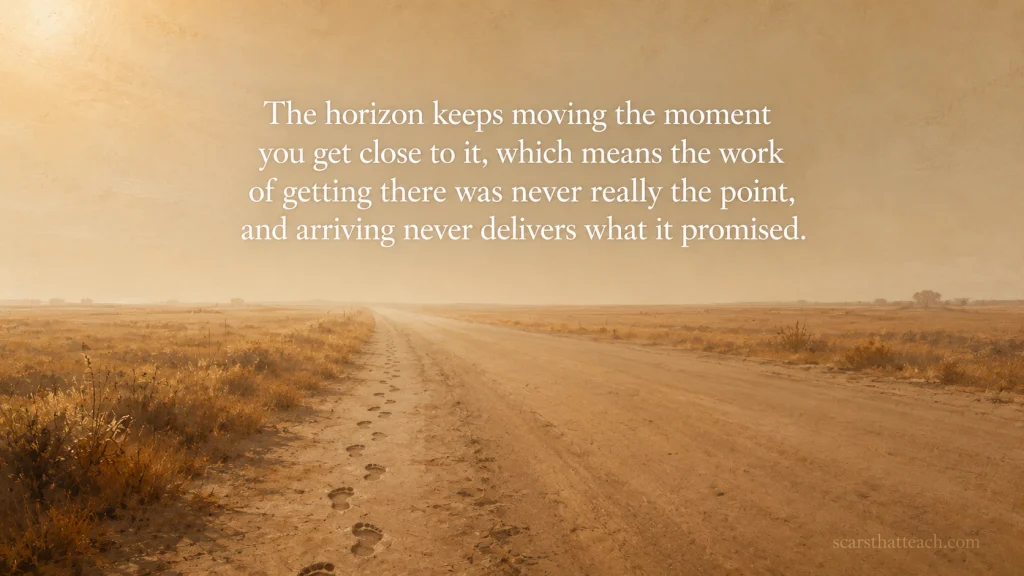
Most of what gets written about never being satisfied treats it as one thing, either a superpower you should be grateful for or a flaw you need to fix. Neither framing is accurate, and the difference matters more than either side admits. Productive dissatisfaction is directional. There is a specific thing being worked toward, and reaching it would actually change something. Chronic restlessness has no destination at all. The horizon keeps moving the moment you get close to it, which means the work of getting there was never really the point, and arriving never delivers what it promised. Research on meaning and direction as the deciding factor lines up with what I watched happen to people who could not name the difference until very late: the ones whose striving was tied to something meaningful tended to hold up better against the wanting, while the ones whose striving was just motion for its own sake burned through one goal after another without ever feeling like they had landed anywhere.
This also tracks with a distinction worth sitting with: intrinsic motivation, the kind that comes from caring about the thing itself rather than what it earns you afterward, holds up better against the kind of adaptation that makes any new achievement feel ordinary within weeks. A woman I knew chased one promotion after another for almost a decade, each one supposed to be the one that finally felt like enough. It never was. Not because she lacked discipline or gratitude, but because the goal had nothing underneath it except the next goal. The common mistake here, and I watched it happen more than once, is assuming the fix is to want less. It is not. The fix is to ask what the wanting is actually attached to, because dissatisfaction with no attachment to anything specific just keeps generating itself.
A few signs tend to separate the two kinds of dissatisfaction once you know to look for them:
- Productive dissatisfaction points at something specific you could describe in one sentence. Chronic restlessness points at “more” without ever naming what more would look like.
- Productive dissatisfaction quiets down, at least for a while, once the specific thing is reached. Chronic restlessness reattaches itself to a new target within days.
- Productive dissatisfaction usually traces back to something you actually value. Chronic restlessness usually traces back to a fear of stillness, or a fear of what stillness would let you notice.
- Productive dissatisfaction leaves you tired in a way that feels earned. Chronic restlessness leaves you tired in a way that feels like you cannot say why.
None of this means you owe anyone an explanation for wanting more out of your life. It means the question worth asking is not whether dissatisfaction is good or bad in general, but what yours is actually doing for you right now, today, in the specific shape it has taken.

Final Thoughts: What the Wanting Is For
I am not going to tell you to be content, and I am not going to tell you to keep chasing. Either one, handed to you by someone who does not know your specific situation, is advice dressed up as wisdom. What I will tell you is that the question is never really never satisfied as motivation versus never satisfied as a problem. It is whether you can name what the dissatisfaction is reaching for, and whether reaching it would actually change anything that matters to you. If you can answer that honestly, you already know more than most of what gets written on this subject bothers to ask. If you are still working through what your own dissatisfaction has been pointed at all these years, that is worth sitting with more closely, and it is the kind of thing I have written more about elsewhere. If what you are actually after is a more practical place to start, I have also laid out a few honest ways to feel more satisfied with what you already have.
FAQs
🎯 Is wanting more always a good thing?
No. Wanting more helps you when it is attached to something specific and meaningful. It stops helping you when the target keeps shifting and nothing ever feels like enough once you reach it.
🔁 Why do I feel dissatisfied even after I reach my goals?
This usually happens when the goal was never really the point, only the next thing to chase. If the dissatisfaction comes back within days of an achievement, it was probably not tied to something you genuinely valued.
⚖️ How do I know if my dissatisfaction is healthy or harmful?
Ask whether you can name exactly what it is reaching for in one sentence. If you can, and reaching it would change something real, it is likely working for you. If it just points at “more” with no shape, it is worth examining more closely.
🧭 Can dissatisfaction be a form of motivation?
Yes, when it is directional. A clear gap between where you are and a specific desired state is one of the more reliable reasons people push through difficult, unglamorous effort.
🌱 Should I try to stop wanting more out of life?
Not necessarily. Less wanting is not really the goal. The more useful question is whether the wanting is tied to something specific you actually value, since that is usually what decides whether it settles or keeps reattaching itself.