Blending two families is sold as a new beginning. What nobody warns you about is the kind of conflict that comes with it, where the usual rules of loyalty, obligation, and love do not apply in the same way they do in biological households. According to a 2026 Pew Research Center analysis, 17 percent of children in the United States live in a blended family most or all of the time. That is millions of adults navigating something that still gets treated as though it should work itself out on its own. Some of what happens in these homes is ordinary friction. Some of it is something else entirely, and it matters to be able to tell the difference.
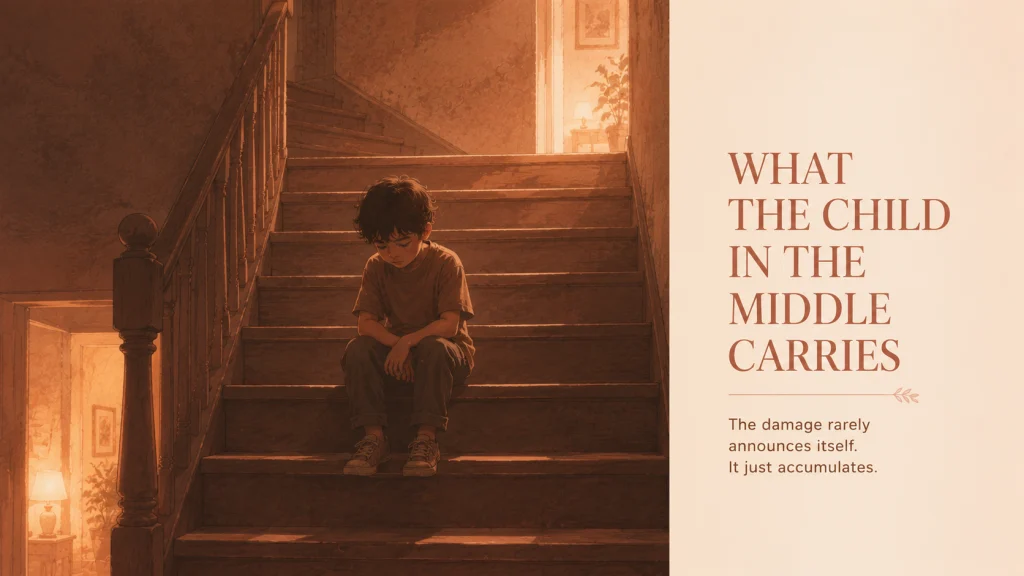
The Room Nobody Planned For
I was once in a hospice room with two sets of children who would never have chosen to be in the same space. They were there because the same man was dying. His first wife’s children sat on one side of the room. His second wife’s children sat on the other. None of them spoke across the invisible line between them. The man in the bed had spent years trying to hold two worlds together, and neither world had ever fully accepted the other. What I watched in that room was not grief exactly. It was the final reckoning of a debt that had been accumulating for a long time without anyone naming it.
That scene stayed with me because of what was not said. Every person in that room was carrying a version of the story in which they were the reasonable one, the one who had tried, the one who had been let down by someone else. In all likelihood, each of them was at least partly right. That is what makes blended family conflict so hard to resolve. It does not usually require anyone to be dishonest, or cruel, or even particularly unreasonable. It requires two families with different histories, different loyalties, and different understandings of what they owe each other to share a structure that nobody designed for the actual complexity of what they were living inside.
What the Numbers Capture and What They Miss
The 2026 Pew Research Center analysis puts 17 percent of U.S. children under 18 in a blended family most or all of the time. That figure does not account for children who have stepparents or stepsiblings in a second household they visit regularly but do not primarily live in. The actual scope is considerably wider than any single statistic can capture. What the numbers cannot tell you is what it costs to be a child raised across two households that were never designed to work together, or what it costs to be an adult who entered one of these arrangements with genuine good intentions and found the structure working against them from the start.
The available writing on stepfamily problems divides into two camps. Academic literature documents the strain in measured, careful language. Stepparent advocacy content, which is abundant online, tends to locate the source of the conflict in the other biological parent, almost always the one in the other household. Both have something accurate to offer. Neither asks what I came to think of as the harder question after two decades of sitting with families at the end of their lives: what do people who are not biologically connected actually owe each other when someone else’s decision brought them into the same family structure?
The instant-love myth is where most of these arrangements first go wrong. Two adults fall in love. They bring their children together. Everyone is supposed to adjust, bond, and eventually resemble something that looks like a family. When that does not happen on the expected timeline, which it rarely does, the instinct is to find the source of the failure. The stepparent is not trying hard enough. The child is being difficult. The biological parent in the other home is deliberately undermining everything. There is almost always enough evidence to support whichever version of that story someone needs to believe. The problem is that the story itself is wrong from the beginning. No amount of effort manufactures a bond that has not had time to form on its own terms.
Triangulation in Blended Families: The Pattern That Rarely Gets Named
One of the most consistent dynamics in stepfamily conflict is what family counselors describe as triangulation. In a co-parenting arrangement, it happens when communication between adults stops flowing directly between the people who need to be talking and gets rerouted through a third person. That third person is most often the child. A biological parent in one home communicates only with the former partner, while the stepparent who may be doing a significant portion of the actual daily parenting is left out of decisions that directly affect their household. It can also work the other direction, with a child who is being used to carry messages, updates, and emotional weight between two homes that cannot communicate directly with each other.
What makes this dynamic so corrosive is that it rarely announces itself clearly. From the outside, it can look like a reasonable preference. Some people simply feel more comfortable dealing with the other biological parent. Some do not see why the stepparent needs to be part of certain conversations. But the cumulative effect on the child who has been positioned in the middle is real, regardless of intent. Children understand, even without being told, when they are being used to carry something the adults around them cannot carry themselves. The loyalty conflict that follows does not need to be deliberately manufactured. It is built into the structure of the arrangement itself.
I saw this enough times across enough different families that I stopped treating it as unusual. Not in any single situation I could describe to you in detail, but in a composite that repeated itself across years of that work. A child who behaves differently depending on which adults are in the room. Warm with one parent, careful with the other. The adults read this as evidence that someone in the other home is running a campaign. What I noticed, more often than not, was that the child was simply exhausted. They had been doing the relational labor between two households that the adults in their lives had not managed to do between themselves.
The Most Common Mistake in Blended Family Conflict
The assumption that the problem has a single source is the most reliable way to stay stuck inside it. One person is being unreasonable. One side is the functional one. If only the ex-spouse would cooperate, or the stepparent would stop overreaching, or the child would stop being pulled in two directions, the family would work. I have never seen it be that clean. The situations that cause the most sustained damage are the ones where every person involved is responding in a way that makes complete sense from inside their own understanding of what is happening, and the situation itself is genuinely unworkable as designed.
A stepparent who feels excluded from decisions about a child they are actively raising has a legitimate grievance. A biological parent who is uncomfortable with a relative stranger’s authority over their child also has a legitimate grievance. A child who struggles to love a stepparent the way they love their biological parent is not failing at anything. A former spouse who worries about the influence of someone they did not choose on their child’s daily life is not automatically acting in bad faith. All of these things can be true at the same time. The conflict does not require a villain. What it requires is a more honest accounting of what each person actually needs, and whether those needs can coexist inside the structure that currently exists.
People working through what it means when a family member becomes genuinely toxic in a blended home sometimes assume the answer is distance. Minimize contact. Protect the immediate household from whatever is coming from the other side. Sometimes that is the right call. But in a co-parenting arrangement, the other parent is not going away. The child who loves people in both households is not going to stop being the point of connection between them, regardless of how many boundaries get drawn. The question is rarely whether to engage. It is how to engage without letting the friction define every interaction that follows.
Here are the situations where ordinary friction tends to cross into something worth taking more seriously:
- A stepparent who has been present and active in a child’s life for years is consistently excluded from decisions about school, medical care, and daily logistics, without any explanation and without the child’s other biological parent being asked to account for it.
- A child returns from the other household in visible distress that clears within a day or two, and direct conversation between the adults is not possible because the communication has been routed through the child themselves.
- A biological parent has communicated to the child, directly or through implication, that having feelings for the stepparent in the other home is a form of disloyalty to them.
- The child has stopped mentioning one household to the adults in the other, not out of deliberate loyalty but because mentioning it produces a reaction they have learned to avoid.
- Every attempt to establish a workable arrangement between the adults collapses because one party treats any accommodation as a concession rather than as something that serves the child at the center of the situation.
None of these situations resolves easily or quickly. And in every one of them, the child is the one absorbing it.
What Blended Families Actually Owe Each Other
This is the question that almost none of the available writing on stepfamilies addresses directly. What do people who are not biologically connected owe each other when they have been brought into the same family structure by someone else’s love?
I do not think the answer is love. Love in a family is not something that can be required of people, and demanding it tends to produce the performance of it rather than the thing itself. What I observed across the years, in the families that were at peace when it mattered, is that the people who had managed the situation best were almost never the ones who had forced a bond. They were the ones who had been honest about the limits of what was naturally there, and had found a way to be decent inside those limits. A stepparent who cannot love a stepchild the way a biological parent does is not broken. A stepchild who cannot love a stepparent the way they love their biological parent is not failing at anything. The question is whether the adults in the situation can be reliable, consistent, and fair, without requiring the emotional temperature to rise to something it has not naturally become.
“The families that carried the least damage out of blended arrangements were almost never the ones that felt the most like a family. They were the ones where the adults had agreed, without saying so explicitly, to be reliable instead of required.”
Reliability is underrated in blended family life because it is less compelling than the idea of connection. But a stepparent who shows up consistently, who does not punish a stepchild for their loyalty to the other parent, who does not require the child to perform warmth they do not feel, is doing something real. The stepparent stepchild relationship, when it works at all, is almost always built on that kind of reliability rather than on the affection that people hoped would simply appear. It may not look like what the word “family” usually promises. But it is not nothing. And at the end of the day, it is more than a lot of people in these situations actually manage. That point comes up again in words people use to describe toxic patterns they lived inside: the most corrosive element is rarely the loudest conflict. It is the slow erosion that happens when the adults in a child’s life consistently ask them to choose.
When “Toxic Stepmother” Is the Right Label and When It Is Not
The phrase carries centuries of weight before anyone applies it to a specific situation. It is embedded in enough stories and cultural shorthand that it has become something people reach for before they have looked carefully at what is actually happening. Sometimes it is accurate. A stepparent who is consistently cruel to a child, who uses their position in the household to punish the child for loyalty to the other parent, or who weaponizes their authority in ways that cause lasting harm is doing something that deserves to be named clearly. Children living inside that deserve to have it taken seriously by the adults around them.
The label also gets applied to situations that are far less clear. A stepmother who is strict. One who is emotionally reserved. One who did not become what the child wished for. One who loves her own children more visibly than she loves her stepchildren. None of those things, on their own, adds up to toxic. The word is doing an enormous amount of work in a lot of situations where a more specific description would be both more honest and more useful.
The stepfamily problems I find most worth examining are not usually located in a single person’s behavior in isolation. They are located in systems. The co-parenting arrangement that holds on paper and collapses in practice. The expectation that everyone will simply adapt without any of the adults being given a structure for what adaptation is supposed to look like. The household that asks a child to hold, between two homes, a relationship that the adults in those homes have not been able to hold themselves. For readers navigating a particularly difficult dynamic with a stepmother, some of what surfaces here also appears in conflict with a mother-in-law, not because those relationships are the same, but because the experience of being an outsider to an existing bond is recognizable across both.
Final Thoughts: What the Bedside Eventually Teaches
The room I began with ended the way most of those rooms end. The man died. The two sets of children went back to their separate lives. Nobody said the thing that might have changed something, because there was no longer time, and because nobody had said it in the years before when there still was. I have sat with enough of these endings to know that the silence is not unusual. It is one of the most consistent patterns I carried out of my years doing that work.
What I want to say to anyone reading this while they are still in the middle of a blended family situation that has become genuinely harmful is this: the cost of not naming what is happening accumulates quietly. The child who is absorbing the conflict between adults does not stop absorbing it because nobody talks about it. The resentment that builds between households does not stay contained there. And the story that everyone is simply doing their best, while probably true, does not exempt anyone from looking honestly at what their best is actually producing in the people around them.
This is not a call to any particular action. I am not going to tell you to have the confrontation, draw the line, or send the letter. Some of those choices depend on details of your specific situation that I do not know, and making them belongs to you. What I can say is that clarity is available before the room at the end. The people who found it did not wait until they had no other choice.
FAQs
🧩 What makes a stepfamily toxic rather than just difficult?
All blended families carry friction. The difference is usually in what the adults are asking the children to hold. Ordinary adjustment is hard, but a child who is being asked to choose between two homes, carry messages between households, or manage an adult’s emotional state is inside something harder than normal difficulty. The weight landing on the child is almost always the clearest indicator.
😔 Why do stepchildren and stepparents so often struggle to connect?
Because connection takes time, and blended families rarely allow for it. Two adults who love each other expect the people around them to share that feeling. Stepchildren did not choose the arrangement. Asking them to love someone on a timeline set by the adults in their lives is one of the most reliable ways to make the relationship harder than it needs to be.
🔁 What is triangulation in a blended family, and why does it matter?
Triangulation is when communication stops flowing directly between the adults who need to be talking and gets rerouted through a third person, usually the child. It matters because whoever ends up in the middle carries the tension the adults are not resolving themselves. Children in that position cannot simply opt out. They love people on both sides, and being the relay between them is a burden most children carry without naming it.
💬 Can a blended family stop being toxic, or does the dynamic just continue?
It is possible for things to shift. But it requires the adults, not the children, to change what they are doing. The families I saw find their footing were almost always the ones where at least one adult in the system decided to stop treating the arrangement as a competition and started treating it as a structure with a child at the center who needed both sides to function. That sounds simple. It is not.
🧍 Can a stepparent ever build a real relationship with a stepchild?
Yes. I have seen it happen. It almost never looks like what people expected. It looks like years of showing up consistently without requiring a particular emotional response in return. It looks like a stepparent who did not make the child’s loyalty to the other parent into a problem that needed solving. The bond, when it forms, tends to be quieter than people hoped for. It does not replace biology. It exists alongside it.
📣 What should I do if I think my child is being harmed by stepfamily conflict?
Take it seriously enough to bring in someone outside the family. A therapist who works specifically with blended families or co-parenting dynamics can offer a framework that is very difficult to find from inside the situation. If you believe your child is in immediate danger, contact the appropriate professional resources. This is not territory where waiting and hoping tends to produce a better outcome.