Grief and loss rarely look the way people expect them to, and that gap between expectation and experience is often what makes an already hard thing harder. The most familiar framework for understanding grief, the five stages, has been treated for decades as a roadmap, even though the woman who created it spent much of her later life saying that was never her intention. This piece covers what grief actually is, where the stages model came from and where it falls short, and where to go next depending on the specific question you are carrying right now.
Grief and Loss: What It Really Is (and What It Isn’t)
In twenty years of sitting with people in the aftermath of loss, the single most useful thing I learned was not a map of what grief looked like. It was the recognition that almost everyone I sat with expected their grief to be somehow different from what it actually was, and that the expectation itself had made everything harder. People came in believing they should be further along than they were, or that the order of their feelings was wrong, or that the fact they laughed at something three days after a death meant they had not really loved the person they lost. None of that was true. But the belief that it was true added a second weight on top of a loss that was already heavy enough on its own.
I want to be careful here, because grief is not something I can hand you a clean explanation of and have it match what you are actually living through. What follows is an honest accounting of what grief is understood to be, where the most familiar framework for it came from, and why it deserves far less authority over your experience than it has been given.
Where the Five Stages Actually Came From
Most people have heard of the five stages of grief: denial, anger, bargaining, depression, and acceptance. Far fewer know where that framework originated. Elisabeth Kübler-Ross developed it in 1969, and she developed it from her work with terminally ill patients coming to terms with their own deaths, not from research on people grieving the death of someone else. It was extended to bereaved family members later, by Kübler-Ross herself and by others who built on her work, but the original observations were never about loss in the way most people experience it.
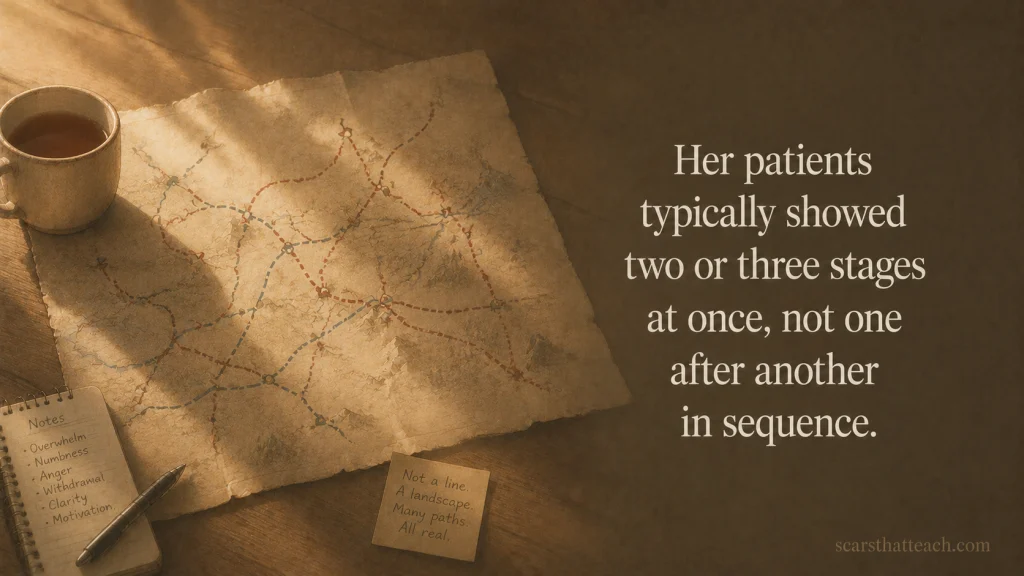
Kübler-Ross herself pushed back, repeatedly, against how the model came to be used. She wrote that her patients typically showed two or three stages at once, not one after another in sequence, and she spent years trying to correct the impression that grief moves through a fixed, orderly progression. That correction never fully caught on. The five stages became, in the public imagination, something closer to a checklist, and a great deal of grief content still presents them that way, as a roadmap a person can use to measure how far along they are.
What the Research Actually Supports
A systematic review of how the stages model is presented online found that it remains widely treated as a credible, sequential framework, even though it is, in the language researchers use, empirically unsupported as a universal model of how people grieve. That does not mean the five emotions Kübler-Ross named are not real. Denial, anger, bargaining, depression, and acceptance are all things people genuinely experience during loss. What is not supported is the idea that grief reliably moves through them in that order, that everyone experiences all five, or that arriving at acceptance marks some final, completed stage a person should be working toward on a schedule.
I want to say this plainly, because I watched it cause real harm: there is no correct order for grief, and there is no timeline you are supposed to be following. A person who feels something like acceptance in week two and something like anger in month eight has not done it wrong. Grief is not linear in the way a staircase is linear. It is closer to weather, returning, shifting, sometimes calm and sometimes not, often without warning and rarely in the order anyone would choose.
Grief Is Not Only About Death
I sat with grief that had nothing to do with a death more times than I can count. The loss of a marriage. The loss of a version of yourself you do not recognize anymore after an illness or an injury. The loss of a future you had been quietly building toward for years that simply stopped being possible. These losses are often harder to name as grief, because there is no funeral, no shared ritual, no clear social permission to be as affected as the loss actually warrants. People around the grieving person sometimes do not understand why it has hit so hard, and the grieving person themselves often does not either.
This kind of loss deserves the same honesty as any other. The absence of a body does not make the grief smaller. It often makes it lonelier, because the people around you may not recognize what you are carrying as something that needs to be carried at all.
What I Watched Actually Help, and What Did Not
I am wary of offering a list of things that help with grief, because grief is too individual for a list to be honest. What I can offer instead is what I noticed, across two decades, separating the people who found some steadiness from the people who stayed stuck longer than the loss itself required.
- People who stopped measuring their grief against a model, any model, tended to be gentler with themselves than people still trying to figure out which stage they were supposed to be in.
- People who let their grief look different from one week to the next, without treating the difference as a setback, tended to move through it with less added suffering.
- People who had at least one person who could sit with their grief without trying to fix it, explain it, or rush it, tended to carry it with more company and less isolation.
- People who kept expecting closure, a single moment when the grief would resolve and end, often felt more disoriented when that moment never arrived in the way they had pictured it.
None of this is a formula. It is an honest accounting of patterns I watched, offered with the full knowledge that your grief will not match anyone else’s, including the people I just described.
When Grief Becomes Something Worth Talking to Someone About
I am not a therapist, and nothing here is meant to diagnose or treat what you are carrying. Grief, even at its heaviest, is not a disorder, and most of what people feel after a significant loss falls within a wide range of normal human response. That said, if grief is significantly interfering with your ability to function day to day for an extended period, if it has not eased at all in its intensity over a long stretch of time, or if it has brought you to thoughts of harming yourself, that is worth bringing to a professional who is trained to sit with it in ways I am not equipped to here. Reaching out for that kind of support is not a sign that your grief is abnormal. It is a sign that you deserve more support than a single piece of writing can offer.
Final Thoughts: Let Your Grief Be What It Actually Is
If there is one thing I would want you to take from this, it is permission to stop comparing your grief to a model that was never built for the specific loss you are carrying. Whatever shape it has taken in you, however out of order or unrecognizable it has felt, none of that means you are carrying it wrong. The people who eventually found some steadiness were rarely the ones who grieved correctly. They were the ones who stopped trying to.
If you are looking for honesty about how loss can sit alongside everything else life still asks of you, the reflections gathered in honest words about carrying loss and disappointment may offer something worth sitting with as well.
Find the Question That Matches Where You Are
Some of these speak directly to what grief is and where the stages model falls short. Others address the specific shape grief takes when it has no clear endpoint, or when the loss is not a death at all. Read the lead-in for each and choose whichever sits closest to what you are actually living through right now.
| Article | What It Covers |
|---|---|
| What Is Grief | A closer, honest look at what grief actually is beneath the familiar language used to describe it. |
| Why Grief Doesn’t Follow a Timeline | Why the expectation of a schedule for grief tends to cause more harm than the grief itself. |
| Why Grief Comes in Waves | What it means when grief resurfaces unexpectedly, long after it seemed to have settled. |
| How to Grieve Something That Isn’t Death | An honest look at non-death losses and why they deserve to be named as grief too. |
| How to Support Someone Who Is Grieving | What actually helps someone carrying loss, and what well-meaning support often gets wrong. |
| Why Grief Never Fully Ends | What it means to live alongside a loss permanently, rather than waiting to be finished grieving. |
FAQs
🕊️ What is grief, really?
Grief is the human response to significant loss, and it touches far more than sadness. It can include anger, relief, confusion, numbness, and physical exhaustion, often shifting between them without warning.
📋 Are the five stages of grief accurate?
They describe real emotions, but the idea that grief moves through them in order is not supported by research. Kübler-Ross herself said people often experience several stages at once, not one after another.
⏳ Is there a normal timeline for grief?
No. Grief does not follow a predictable schedule, and how long it takes to feel steadier again varies enormously from person to person and loss to loss.
💔 Can you grieve something other than a death?
Yes. Grief can follow any significant loss, including a divorce, an illness, an identity shift, or a future you expected that did not happen.
🤝 When should grief be brought to a professional?
If grief is significantly affecting your ability to function for an extended period, or has brought you to thoughts of harming yourself, it is worth speaking with a trained professional rather than carrying it alone.