Why grief doesn’t follow a timeline comes down to something simple that gets lost under decades of cultural expectation: grief was never built to move in a straight line, and the research on bereavement does not support the idea that it should. The most common question I was ever asked in twenty years of sitting with grieving people was not how to survive their loss. It was whether the way they were surviving it counted as normal. Almost no one I ever sat with was grieving wrong. This piece covers why grief resists a timeline, what research suggests actually happens instead, and why the timeline expectation causes more harm than most people realize.

Why Grief Doesn’t Follow a Timeline
A man once asked me, eight months after his wife’s death, whether it was a problem that he still cried in the car on his way to work. He had read somewhere that grief was supposed to lift significantly after the first six months, and he had quietly started keeping score against that number, certain he was failing some test no one had actually written. I told him what I had told dozens of people before him in some version or another: there was no test, and there had never been a passing score. His grief was not behind. It was simply his.
That question, am I doing this right, was the one I heard more than any other in this work, far more than how do I survive this. People could often survive the loss itself. What wore them down was the second burden stacked on top of it, the suspicion that their grief was somehow out of sequence.
Where the Timeline Expectation Actually Comes From
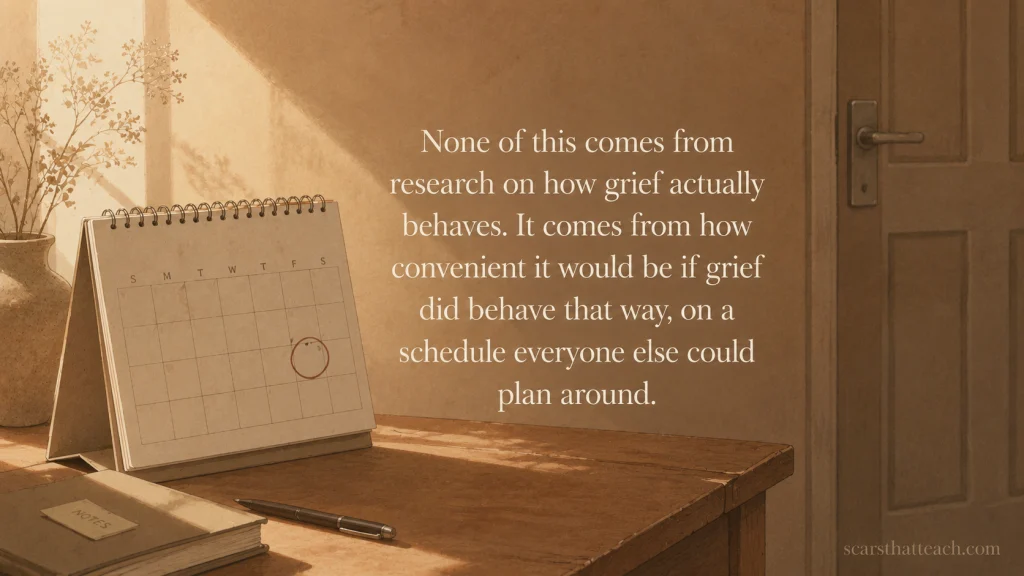
Much of the cultural expectation around grief duration comes from a vague but persistent sense that grief should diminish steadily over time and largely resolve within a year or two. Where exactly that expectation came from is harder to pin down than the five-stage model, but it shows up everywhere: in workplace bereavement leave policies that grant a handful of days, in the gentle but pointed comments from well-meaning friends a year out, in the quiet pressure to seem more like yourself by some socially acceptable point. None of this comes from research on how grief actually behaves. It comes from how convenient it would be if grief did behave that way, on a schedule everyone else could plan around.
The research tells a different story, and it is worth knowing in detail, because the gap between the cultural expectation and the documented reality is exactly where so much unnecessary suffering gets added on top of loss that was already heavy enough. A broader look at grief and loss in its full complexity makes the same point from another angle: the experience is wider and less orderly than any single model can capture.
What Actually Happens Instead: Oscillation, Not a Line
Researchers Margaret Stroebe and Henk Schut proposed what they called the dual process model of grief in 1999, and it describes something far closer to what I actually watched in two decades of sitting with grieving people than any straight-line model ever did. According to this model, healthy grieving involves oscillating between two different orientations rather than progressing steadily through fixed stages. In loss-oriented moments, a person faces the pain of the loss directly, remembering, yearning, sitting with the weight of what is gone. In restoration-oriented moments, a person turns toward the practical work of rebuilding a life around the absence, learning to manage what the person who died used to handle, finding new routines, occasionally laughing at something without guilt attached to it.
Both orientations are necessary, and the movement between them is not a sign of instability. It is what the research considers a healthy pattern. A person who stays only in loss-orientation for too long tends to struggle more, and a person who stays only in restoration-orientation, avoiding the loss entirely, tends to struggle differently but just as much. The oscillation itself, back and forth, sometimes for years, is closer to what grief actually looks like than any tidy line moving from devastation to acceptance ever was. That is also why broader reflections on failure, loss, and what they can teach us need room for experiences that do not resolve neatly or on command.
Why an Inaccurate Timeline Causes Real Harm
I watched the timeline expectation do specific, identifiable damage. A woman two years into grieving her son told me she had stopped mentioning him in conversation because she could see people’s faces shift, a kind of polite confusion at grief that had not, by their internal calendar, expired on schedule. She had not stopped grieving. She had simply learned to hide it, because the people around her had absorbed the same timeline myth she was fighting against in herself, and neither of them had the language to name what was actually happening.
This is the real cost of the expectation: it does not just pressure the grieving person to perform recovery ahead of when it has arrived. It teaches the people around them to expect that performance too, which means the grieving person often loses their support exactly when an anniversary, a holiday, or some unexpected trigger brings the loss-oriented wave back, sometimes with an intensity that surprises even them.
There Is No Correct Pace
I want to be honest about the range I actually witnessed, because honesty here matters more than tidiness. Some people I sat with felt something close to steadiness within months. Others carried an active, sharp grief for years, occasionally still do, decades after the loss. Both patterns were real. Neither one was wrong. The loss itself, the relationship to the person, the circumstances of the death, and the support available afterward all shape the pace in ways no single rule could ever predict.
- Grief that intensifies sharply around an anniversary, after years of relative steadiness, is a documented and common pattern, not a sign of relapse.
- Grief that resolves more quickly than someone expected does not mean the relationship or the loss mattered less.
- Grief that continues, in waves, for years past what anyone around you expected, is not automatically a sign that something has gone wrong.
What separates a difficult but ordinary grief from something that needs more support is rarely the calendar. It is whether the grief, at a given point, has made it consistently difficult to function in daily life over an extended stretch of time. That is worth discussing honestly with a professional equipped to help in ways a piece of writing cannot. Wanting that support is not a sign your grief was abnormal. It is a sign you deserve more than a timeline was ever going to give you.
Final Thoughts: You Were Never Behind
If you have been quietly measuring your grief against a calendar, wondering whether you should be further along by now, I want to say plainly what I told the man crying in his car on the way to work: there was never a test, and there was never a passing score. Grief moves the way it moves, and the back-and-forth you may be feeling, some days steadier, some days pulled under without warning, is not evidence that you are doing this wrong. It is closer to what grief has always actually looked like.
Understanding grief beneath the models most people have been handed leads back to the same conclusion: the calendar was never the measure. What matters is not whether grief has followed an expected sequence, but whether the person carrying it has room to move between loss and life without treating either movement as evidence of failure.
FAQs
⏳ How long does grief actually last?
There is no universal timeline. Duration varies enormously based on the loss, the relationship, and the person, and research does not support a fixed window for grief to resolve.
🔄 Why does my grief come and go instead of steadily fading?
This oscillation, between facing the loss directly and focusing on rebuilding daily life, is described by the dual process model as a normal, healthy pattern rather than a setback.
📅 Is it normal for grief to intensify around an anniversary?
Yes. Anniversaries, holidays, and unexpected triggers commonly bring grief back with surprising intensity, even after long periods of relative steadiness. This is a documented pattern.
😔 Is it bad if my grief feels worse two years later?
No. Grief is not linear, and continuing or resurfacing grief years after a loss does not mean something has gone wrong with how you are grieving.
🤝 When is grief worth bringing to a professional?
If grief is consistently making it difficult to function in daily life over an extended period, it is worth discussing with a professional, regardless of how much time has passed since the loss.