Does thinking about death make you live better? The honest answer is: sometimes, and not automatically. Research on mortality awareness has documented two very different reactions to confronting the fact of death, a defensive one that narrows a person, and a more constructive one that seems to open them up. This piece looks at what actually separates those two outcomes, drawing on both the research and twenty years of watching it play out in person. It is not a promise that thinking about death will change your life. It is a look at the conditions under which it sometimes does.
Does Thinking About Death Make You Live Better? What I Actually Noticed
The most consistent thing I noticed over twenty years of sitting with people who had thought hard and directly about their own death was not sadness. I expected sadness, and I saw plenty of it. But the people who had genuinely sat with the fact of their own mortality, rather than glancing at it and looking away, carried something else alongside the grief. I never fully found the right word for it. The closest I have come is that they seemed more awake to whatever was actually in the room with them.
That observation lines up with something researchers who study mortality awareness and how it shapes meaning have found, though it took them a more careful path to get there than a single chaplain’s impression ever could. Confronting death does not produce one universal response. It produces at least two very different responses, and which one shows up seems to depend on more than just how much someone has thought about dying.
The Two Directions Mortality Awareness Can Take
Terror management theory, a body of research built around exactly this question, has documented a defensive reaction that tends to show up when mortality becomes suddenly present in someone’s mind. People cling harder to their existing worldview, become less tolerant of people who see things differently, and in some documented cases show an increase in prejudice against outsiders to their own group. None of that looks like a person living better. It looks like a person bracing.
What the same research also documents, and what rarely makes it into popular writing on the subject, is a second, more constructive trajectory. A widely cited 2012 review of this research named it directly: mortality awareness can motivate people to improve their physical health habits, prioritize goals oriented toward genuine growth rather than status, invest more deliberately in relationships that matter to them, and act with more generosity toward their wider community. Those benefits are real and have been documented. They are just not the only thing mortality awareness produces, and they do not show up automatically.
What Actually Separates the Two Outcomes
Most popular writing on whether confronting death improves life skips straight past this part and treats mortality awareness as a switch: think about death, live better. The research is more specific than that, and more useful for it. The constructive trajectory tends to show up when mortality awareness is held inside some framework of meaning, something ordinary enough that most people already have a version of it without naming it that way. A responsibility toward a child. A faith practiced quietly for years. A craft or a piece of work someone has committed to. The daily, unglamorous work of caring for an aging parent. Any of these can give death somewhere to land instead of nowhere to go. Without something like that in place, the same confrontation with mortality is more likely to trigger the defensive reaction instead.
- Whether the person has some existing sense of what their life is for, even a loose one, versus facing mortality with no framework at all.
- Whether the confrontation with death arrives gradually, giving room to process it, versus suddenly and without warning.
- Whether the person has support around them while they sit with it, versus facing it in isolation.
- Whether the reaction moves toward relationships and growth, versus toward defending existing beliefs and judging others more harshly.
None of this means a person can guarantee the constructive outcome by following a checklist. It means the outcome depends on conditions, and the condition that matters most is whether death is being processed inside some frame of meaning or simply being reacted to.
What I Watched This Look Like, Both Ways
I saw both trajectories often enough to trust that the research was describing something real, not an abstraction. One pattern I watched more than once: a person receives a serious diagnosis, and in the weeks that follow becomes noticeably harder, more suspicious of the people trying to help them, more rigid about beliefs they had never previously needed to defend so forcefully. The fear had nowhere to go, so it hardened into something closer to a wall.
I also watched the other version happen, more than once, in people who had some existing sense of what mattered to them before the diagnosis ever arrived. A man who had spent years feeling mildly dissatisfied with a job that paid well but meant little to him left it within a year of a health scare that turned out, in the end, not to be fatal. He did not describe the decision as brave or dramatic. He described it as obvious once he actually let himself think about dying instead of flinching away from the thought every time it surfaced. The diagnosis did not change anything about the job. It changed how honestly he was willing to look at his own life while there was still time to do something about it.
What people commonly get wrong here is assuming the thinking itself is the active ingredient. It is not, on its own. Two people can think about death with roughly equal intensity and come out in opposite directions, one more generous and clear about what matters, one more defensive and closed off. The difference is not how much they thought about dying. It is what they had, or found, to hold that thought inside of.
Final Thoughts: A Conditional Answer, Not a Promise
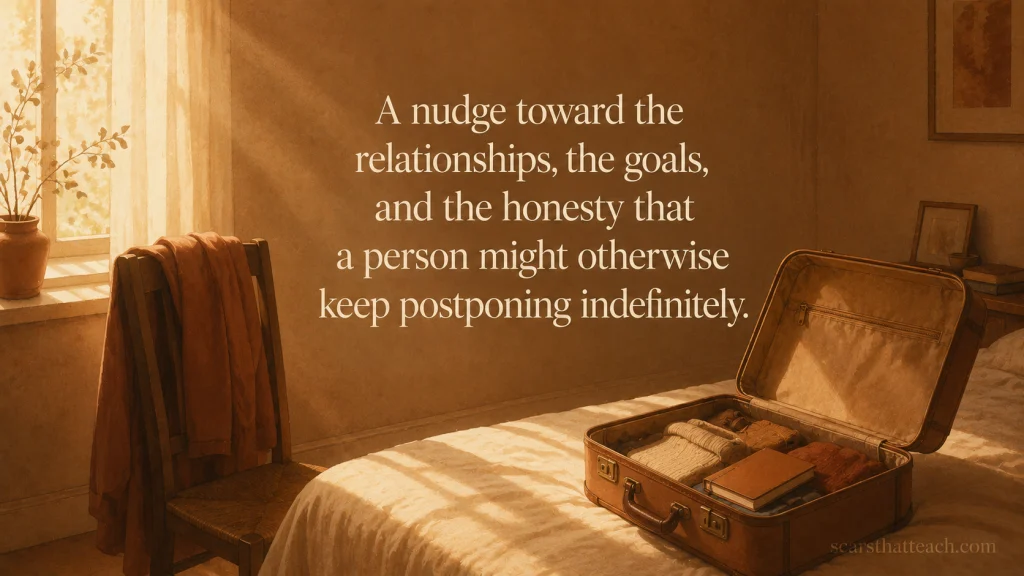
Does thinking about death make you live better? Sometimes, under conditions that matter more than the thinking itself. The research gives real reason to take mortality awareness seriously as something more than morbid preoccupation, but it does not license anyone to promise that facing death will automatically produce a better life. What it can offer, when the conditions are there, is a nudge toward the relationships, the goals, and the honesty that a person might otherwise keep postponing indefinitely.
If you want the wider picture of how confronting your own mortality tends to work, that gets covered more broadly in how thinking about your own mortality actually works. There is also a more direct look at what thinking about death actually does to how you live day to day, and a related piece on what people actually think about at the end of life, drawn from documented hospice experience. For verified reflections on what a life adds up to, there is also a collection of verified quotes on life lessons and mortality worth spending time with.
FAQs
💀 Does thinking about death make you live better?
Sometimes, but not automatically. Research documents both a defensive reaction and a more constructive one, and which shows up depends heavily on the conditions surrounding the thought, not just how much someone thinks about it.
🛡️ What is the defensive reaction to thinking about death?
People tend to cling more tightly to their existing worldview and become less tolerant of people who see things differently. It looks like bracing rather than growing.
🌱 What are the documented mortality awareness benefits?
Research has linked mortality awareness to improved health behavior, more growth-oriented goals, deeper investment in relationships, and more generous community-oriented behavior, under the right conditions.
🧭 Why does confronting death help some people and not others?
The difference usually is not how intensely someone thinks about dying. It is whether they have some framework of meaning to hold that thought inside of, rather than facing it as a raw, isolated threat.
⏳ Can I make myself have the constructive reaction on purpose?
Not with certainty, but building some existing sense of what your life is for, and facing mortality gradually with support rather than alone, tends to make the constructive response more likely.