
Why it is so hard to be consistent rarely comes down to the moment someone decides to change. It comes down to the stretch in the middle, after the decision stops feeling new and before the results have arrived to justify it. Most advice treats that stretch as a willpower problem, something more determination would fix. The research on habit formation points somewhere else entirely: the gap is a timing problem, the lag between when motivation predictably drops and when automaticity has not yet had time to take over. This piece covers what actually happens during that gap, and what helps a person get through it without needing more willpower than they already have.

Why Is It So Hard to Be Consistent?
The hardest moment I ever watched someone face was not the moment they decided to change something. Deciding has its own kind of energy behind it, and most people can find that energy when they need to. The hardest moment came later, somewhere in the middle stretch, when the decision no longer felt new and the result had not yet shown up to prove it had been worth making. I watched a man who had committed to rebuilding his health after a frightening diagnosis hit that exact stretch around the sixth week. The fear that had pushed him to start had faded. The body he was hoping to have had not yet arrived. He told me, almost embarrassed, that he could not explain why something that had felt so urgent in week one suddenly felt so easy to skip in week six.
I did not have anything clever to tell him in the moment, but I have thought about that conversation many times since, and the research on habit formation eventually gave me language for what he had actually run into. It was not a failure of character. It was a predictable gap, one almost everyone hits, between the energy that gets a person started and the structure that eventually keeps them going without needing that energy at all.
The Gap Between Motivation and Automaticity
Motivation is highest at the very beginning of almost anything, when the idea is new and the imagined version of the outcome still feels close. That initial burst is real, and it is also reliably short-lived, because it depends on novelty, and novelty wears off the moment a behavior becomes familiar rather than exciting. What is supposed to carry a person through after the novelty fades is automaticity, the point where the behavior no longer requires a fresh decision each time because it has become close to reflexive. The difficult stretch in the middle is simply the lag between those two things: motivation has already declined, and automaticity has not yet had enough repetition behind it to take over the job motivation used to do.
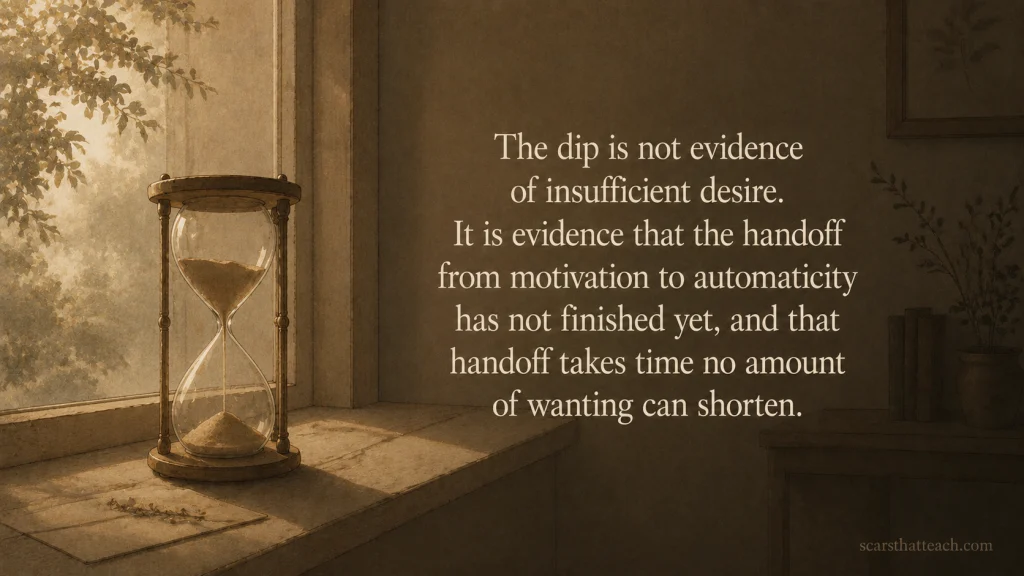
Most people never hear this explained to them this way. They are told instead that the dip in the middle is a sign they did not want it badly enough, or that more discipline is the answer. That framing gets the mechanism backward. The dip is not evidence of insufficient desire. It is evidence that the handoff from motivation to automaticity has not finished yet, and that handoff takes time no amount of wanting can shorten.
Why More Willpower Is the Wrong Fix
I watched a great many people respond to the dip by trying to push harder, treating the slipping consistency as proof they needed to want it more or grip it tighter. That approach tends to make things worse, not better, because it adds a layer of self-criticism on top of a gap that was never really about effort in the first place. Researchers studying the automaticity curve describe something closer to a diminishing-returns shape: early repetitions produce large jumps in automaticity, and each repetition after that produces a smaller jump, which means the middle stretch genuinely does feel harder relative to the visible progress it produces, even when real progress is still happening underneath the surface.
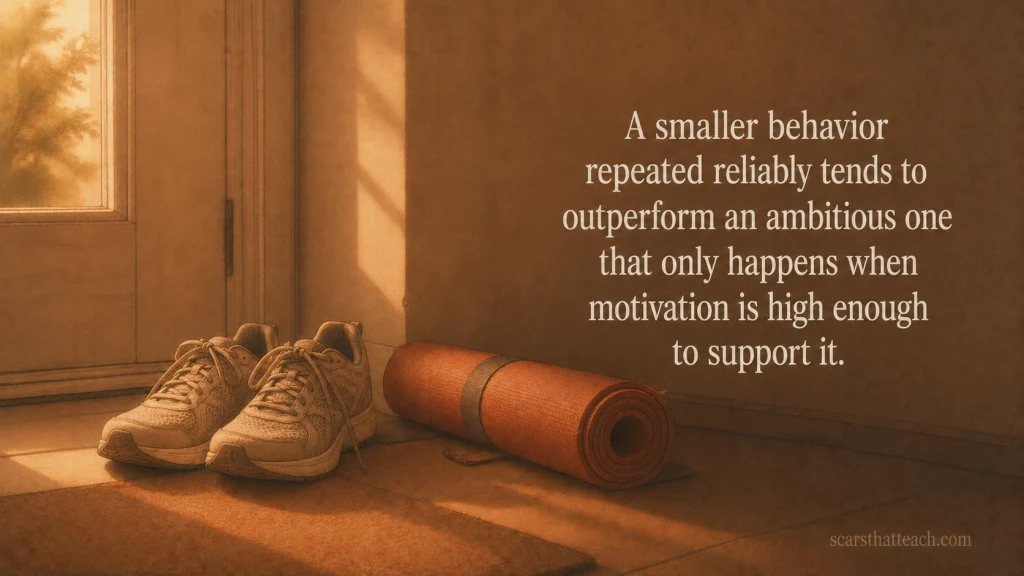
The more accurate fix is not more willpower. It is a smaller target, one consistent enough to survive a low-motivation day without requiring the same intensity the person brought to day one. Consistency, not intensity, is what the early phase of habit formation actually depends on, and a smaller behavior repeated reliably tends to outperform an ambitious one that only happens when motivation is high enough to support it.
What Actually Helps During the Gap
The man with the health diagnosis eventually got through his sixth week, not because his motivation came roaring back, but because he shrank the target until it no longer needed motivation to happen. He stopped trying to do a full workout on the days he did not feel like it and started doing ten minutes instead, sometimes less. The ten minutes did not feel impressive. It also did not require the same burst of resolve a full session did, which meant it kept happening on the days a full session would not have.
What made the shrunken version work was not the size alone. It was that the size matched what was actually sustainable on a bad day, rather than what felt appropriately ambitious on a good one. A few things tend to separate a target that survives the gap from one that does not:
- It can be done in under five minutes, so there is no plausible excuse left for skipping it entirely.
- It does not depend on a particular mood, location, or piece of equipment being available.
- It still counts, fully, even when a more ambitious version of the same day was clearly possible.
None of this is glamorous advice, and it does not promise the gap will feel good while you are in it. What it offers instead is a way through the gap that does not depend on a feeling that was never going to last as long as the gap itself.

Final Thoughts: The Gap Is Not Proof You Are Failing
If you are in the stretch right now where the decision has stopped feeling new and the result has not yet arrived, I want to tell you plainly that what you are feeling does not mean you wanted this less than you thought. Almost everyone who has ever sustained a real change has walked through this exact stretch, usually without anyone telling them what it actually was while they were in it. What got the man with the diagnosis through it was not finally finding more resolve. It was simply outlasting the stretch long enough for the part of his brain that runs on habit, rather than willpower, to start carrying some of the weight.
For a broader look at how habits form and what conditions make them stick, my piece on the mechanics behind lasting habits goes deeper into the structure underneath all of this. And for a wider view on what discipline actually requires over time, the collection on discipline and what it takes to keep going covers ground this piece only touches on.
FAQs
🔄 Why is it so hard to stay consistent with a new habit?
Motivation drops predictably once novelty wears off, but automaticity has not yet had enough repetition to take over. The hard stretch in the middle is that timing gap, not a lack of willpower.
😩 Why do I always lose motivation after a few weeks?
Initial motivation is tied to novelty, and novelty fades as the behavior becomes familiar. That drop is normal and expected, not a sign that you did not want the change enough.
💡 What actually helps you push through the consistency dip?
Shrinking the target so it can survive a low-motivation day, attaching it to a reliable cue, and accepting a smaller version of the behavior rather than treating anything less as failure.
🚫 Is struggling with consistency a sign of weak willpower?
No. It is more accurately a timing issue between when motivation declines and when automaticity develops, and that gap is something almost everyone experiences.
📉 Should I try harder when consistency starts slipping?
Pushing harder often backfires. A smaller, more sustainable target tends to work better than relying on a fresh burst of willpower to push through.