
How long does it actually take to form a habit? Not twenty-one days. That number has been repeated so often it sounds like settled science, but it traces back to a plastic surgeon’s observation about something else entirely, not to any research on habit formation at all. The only rigorous study of how long habits actually take found something longer, more variable, and more forgiving than the popular version. This piece covers where the 21-day figure came from, what the real research found instead, and why knowing the actual timeline changes how a person should think about a stretch of effort that has not yet paid off.

How Long Does It Take to Form a Habit?
Most people I knew who gave up on a change they genuinely cared about did it somewhere between day twenty-two and day thirty. Not because the change had stopped mattering to them, but because they had been told, somewhere along the way, that twenty-one days was the threshold. If the habit had not locked in by then, the thinking went, it never would. So they quietly stopped, convinced they had already proven something about themselves, when what they had actually proven was that a number they had been handed was wrong.
I want to walk through where that number actually came from, because once you see it, the twenty-one-day rule stops sounding like science and starts sounding like exactly what it is: a good story that got repeated until it hardened into fact.

Where the 21-Day Rule Actually Came From
The twenty-one-day figure traces back to a plastic surgeon named Maxwell Maltz, who wrote about it in the preface to his 1960 book Psycho-Cybernetics. Maltz had noticed that his patients took roughly twenty-one days to psychologically adjust to a change in their appearance after surgery, to stop flinching at a new face in the mirror, to stop feeling the phantom presence of an amputated limb. He even noted that people moving into a new home took about three weeks before it started to feel like home. Maltz used careful, qualified language. He said it took “a minimum of about 21 days” for an old mental image to dissolve and a new one to take hold. Minimum. About. Both words quietly disappeared as the observation got passed from person to person, until it became a flat, unqualified rule with no connection left to what Maltz had actually studied.
Maltz was not researching habit formation. He was researching how long it took people to adjust, psychologically, to a change someone else had made to their body. Somewhere along the way, self-help writers borrowed the number, dropped the qualifiers, and applied it to an entirely different question that Maltz never claimed to have answered.
What the Actual Research Found Instead
The only rigorous study built specifically to answer how long habit formation takes was conducted by Phillippa Lally and colleagues at University College London, published in 2010. Lally’s team tracked 96 participants for 84 days as they each tried to build one new daily behavior, measuring how automatic the behavior felt to them at regular intervals along the way. The average time it took a behavior to become automatic was 66 days, more than three times the popular number. The range was wider still, from 18 days for the simplest behaviors to 254 days for more demanding ones, depending heavily on both the person and what they were trying to build.
A 2024 systematic review and meta-analysis examining health behaviors specifically corroborated this finding, putting the realistic window at roughly two to five months for most habits to become automatic, not three weeks. There was one more detail in Lally’s research that mattered as much as the timeline itself: missing a single day of the behavior did not meaningfully disrupt the formation process. The habit was not as fragile as people assumed, and the timeline was not nearly as short.
Why the Wrong Number Does Real Damage
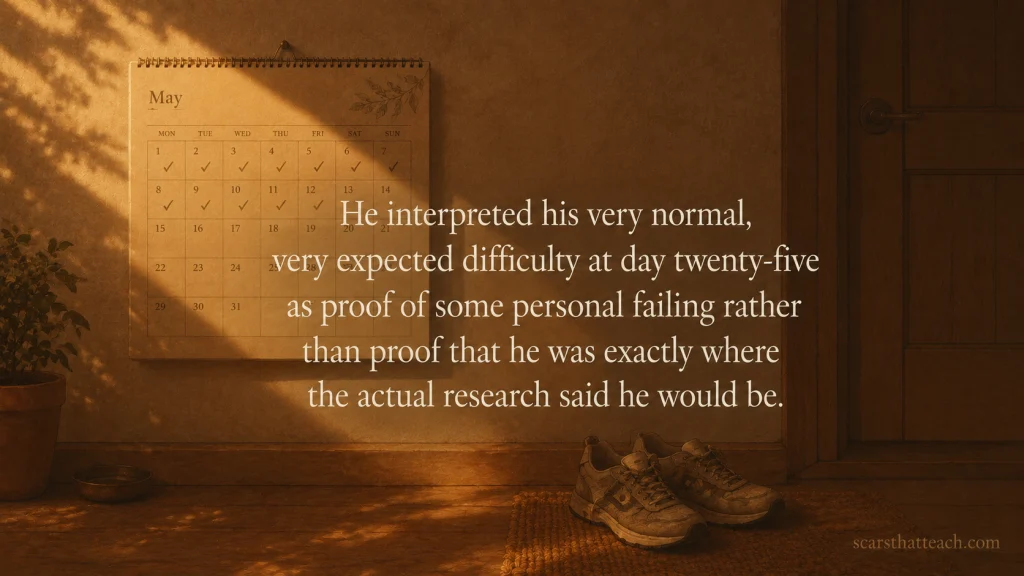
I watched the twenty-one-day myth cause more quiet damage than almost any other piece of advice I encountered in this work, precisely because it sounded so harmless. A man trying to rebuild a daily walking habit after a health scare gave up right around day twenty-five, telling me, almost apologetically, that he guessed it just was not going to take for him. Nothing about his effort had failed. He had simply been told the wrong number, and he interpreted his very normal, very expected difficulty at day twenty-five as proof of some personal failing rather than proof that he was exactly where the actual research said he would be.
This is the real cost of a myth like this one. It is not that the number is slightly off. It is that the number arrives with implied judgment attached, the suggestion that if the habit has not taken hold by then, the fault lies with the person rather than with an unrealistic expectation they were handed before they ever started.
What to Actually Expect
If you are building something right now and trying to set a realistic expectation, the honest version looks closer to this: a simple, low-effort behavior, drinking water at a certain time, might start to feel automatic within a few weeks. A more demanding behavior, a structured exercise routine, a significant change in diet, a new way of communicating with someone, may take two months, three months, sometimes longer, and that is not a sign anything has gone wrong.
A few concrete examples make the range easier to picture than a generic short-versus-long distinction:
- Drinking a glass of water after breakfast, something already attached to an existing routine, tends to land closer to three or four weeks.
- A structured exercise routine that requires planning, gear, and a specific time slot tends to land closer to two or three months, sometimes longer.
- A habit involving another person, like a new way of communicating with a partner or child, often takes the longest of all, since it depends on two people adjusting rather than one.
None of this guarantees a habit will stick. It does mean the difficulty most people feel between week three and week eight is not a verdict on their willpower. It is simply where the real timeline puts them.
Final Thoughts: You Were Never Behind Schedule
If you have ever quietly given up on something around the three-week mark, convinced it should have felt automatic by then, I want you to know the number you were measuring yourself against was never built for that purpose in the first place. The real research gives you a longer, more forgiving runway than the popular version ever did, and a single missed day along the way is not the disqualifying event it has been made out to be.
For a closer look at why the stretch in the middle of building a habit feels so difficult even when nothing has gone wrong, my piece on why consistency is so much harder than it looks goes further into that gap. And for a wider view on what discipline actually requires over time, the collection on discipline and what it takes to keep going covers ground this piece only touches on.
FAQs
📅 How long does it really take to form a habit?
Research found an average of 66 days, with a realistic range of 18 to 254 days depending on the behavior and the person. Three weeks is not an accurate benchmark.
🔍 Where did the 21-day habit myth come from?
It traces back to plastic surgeon Maxwell Maltz, who observed in 1960 that patients took about 21 days to psychologically adjust to a change in appearance, not to form a new behavioral habit.
⏱️ Why does the 21-day rule feel so widely accepted?
It has been repeated for decades by self-help writers who dropped Maltz’s original qualifiers, “minimum” and “about,” turning a loose observation into a hard, unfounded rule.
🚫 Will missing a day ruin my progress on a new habit?
No. Research on habit formation found that missing a single day does not meaningfully disrupt the process of a behavior becoming automatic.
🎯 Does every habit take the same amount of time to form?
No. Simple behaviors tend to become automatic faster, while more complex or demanding behaviors can take significantly longer, sometimes several months.