The internet has no shortage of advice for surviving holidays with toxic family. Most of it is tactical: gray rock your way through dinner, have an exit plan ready, keep your responses short and neutral. This piece covers that advice briefly, then asks the question none of those sources get around to asking: why is attendance still treated as a given in the first place? That question turns out to matter more than any of the tactics, and it is the one most people only think to ask much later.
What I Heard in Hospital Rooms About the Holidays
Most of the meaningful conversations I had about surviving holidays with toxic family did not happen in December. They happened months or years later, in a hospital room or a hospice setting, when someone was looking back at a long history of getting through it and trying to make sense of what that had actually cost them. Almost no one was at the bedside during the holidays. But the people who came up in those conversations, the ones described in the advice content as manageable for a single day, were described very differently in the quiet of those rooms.
Not with rage, usually. With something more complicated. A kind of fatigue at how many times they had packed a bag, driven to a house, gotten through it, and driven home. A question about what they had been protecting by going, and whether that thing had been real. Not bitterness, exactly. More like the specific exhaustion of someone who has been carrying something for a long time and is only now putting it down long enough to look at what it is.
That is where I want to start, because the tactical advice does not start there. It starts with the assumption that you are going and works backward from that. The question of whether you should be going, and why attendance keeps feeling like the only option, tends not to come up at all.
What the Standard Advice Covers
The standard advice for navigating a holiday gathering with toxic family members is consistent across sources. Have an exit plan: a predetermined time you leave, a reason ready that does not require defending. Practice gray rocking: become as uninteresting as possible, give short answers, avoid engaging with bait. Set expectations low in advance so that the day cannot disappoint you. Stay out of old arguments. Have a script ready for the moments you know are coming. Identify one or two people at the gathering who are safe, and stay near them when things get difficult.
This is not useless advice. Some of it is genuinely practical, particularly for people navigating gatherings where disengagement is actually possible. The gray rock method, in situations where someone is looking for a reaction, does reduce the reward they get from the interaction. Exit plans that are made in advance, rather than improvised in a moment of high emotion, do tend to be easier to execute. Knowing what you are walking into, and having thought through it beforehand rather than arriving and hoping for the best, does reduce a certain kind of reactivity.
The problem is not that the advice is wrong. The problem is what the advice never addresses, which turns out to be the more important part of the situation for most people who are genuinely struggling with it.
Why the Tips Often Fall Short
Every source covering this topic frames the day as a battle to get through. The frame is understandable. If someone is dreading a gathering and looking for help, telling them how to survive the next several hours is a reasonable response. But the battle frame carries some assumptions that are worth naming, because they shape what the advice leaves out.
The first assumption is that the difficulty is primarily situational, meaning that the problem is what happens in the room during the gathering. That is true up to a point. But for many people, the harder part is not the dinner itself. It is the weeks of dread leading up to it, the emotional crash that follows, and the recurring question of why this keeps happening every year. The tactics address the dinner. They do not address the loop.
The second assumption is that the measure of success is getting through the day without a major incident. That is a reasonable short-term goal. But it has a side effect: it makes attendance itself look like a neutral given, something that has already been decided, something the advice does not need to examine. The question of why you are going does not fit inside a list of tips for surviving the day. So it gets left out. And every year the tips get a little more refined, and the underlying question stays exactly where it was.
The longer patterns in difficult family dynamics, the ones that tend to make a single gathering feel so loaded, are a separate subject from what this piece is covering. What is worth pausing on here is the specific mechanics of why the day feels impossible even when the tactics are in place.
Gray rocking requires sustained effort across hours. It is not a passive state. It asks you to monitor your responses, suppress your natural reactions, and maintain a version of yourself that is deliberately blander than you are, in an environment that may be actively hostile to you. That is exhausting in a way that a single day’s effort does not fully account for. People come home from gatherings where the tactics worked and feel hollowed out anyway, because the tactics ask for a kind of emotional labor that does not show up in the instructions.
The Question That Tends Not to Come Up
The question is simple, and almost no one in this space asks it directly: why does going still feel mandatory?
That is not a challenge. It is a genuine question, and the answer is different for different people. Some people go because there are other people at the gathering they love and want to see, people who are not the source of the difficulty but who would be lost in the collateral of not showing up. That is a legitimate reason, and it deserves to be named clearly, because it is different from the other reasons.
Some people go because not going would cost more than going: estrangement from a parent, a consequence they are not ready to accept, a conflict they do not have the capacity to manage right now. That is also a legitimate reason. The cost-benefit analysis of attendance is genuinely complicated in some families, and the advice that treats not going as the obvious solution to a toxic gathering has often not thought very hard about those costs.
Some people go because they are not sure they have permission not to. The obligation feels external, something the family structure demands, something that would make them the problem if they declined. That is a different reason from the first two. It is not really a choice that has been made. It is a default that has never been examined.
And some people go because they are still hoping, year after year, that this time will be different. That some version of the family they needed is still available if they just keep showing up. That hope is the most exhausting reason of all, and it tends to be the hardest one to name out loud, because naming it requires admitting that the hope may not be warranted.
What I noticed in those later conversations, in the hospital rooms and the hospice settings, is that the people who had the most complicated feelings about decades of holiday gatherings were rarely the ones who had stopped going. They were the ones who had kept going without ever answering that question for themselves. Not because going was wrong. But because they had never actually chosen it. They had just not chosen otherwise.
What It Might Be Worth Asking Before the Next One
This is not an argument for skipping the gathering. Whether to go is a decision that belongs to the person making it, and the considerations are real and varied and not reducible to a formula. What it is an argument for is knowing, as clearly as you can, which reason is actually driving the decision before you arrive.
If you are going because there are people there you love, that is worth holding onto. It changes what the day is, and it gives the effort a different quality than simply enduring something.
If you are going because the cost of not going is genuinely too high right now, that is also worth being clear about. It makes the day feel less like a failure of your boundaries and more like a decision you made with the information you had.
If you are going because you have never quite gotten around to asking whether you have to, that is worth sitting with. Not necessarily as a reason to stop going. But as something that deserves a real answer, given how much it tends to cost over the years.
The tactical advice will still be there regardless. Gray rock still works when you need it. Exit plans still help. But the people I heard the fewest regrets from, in those later conversations, were not the ones who had the best tactics. They were the ones who had, at some point, decided what the gathering actually meant to them and showed up, or did not, on those terms.
There is something worth reading in what others have recognized about what it means to keep accepting mistreatment in the name of keeping the peace, collected in the toxic people quotes section, if that question is one you are sitting with.
Final Thoughts: Getting Through It Is Not the Same as Being Okay With It
There is a version of success that looks like getting through the holiday without a scene. The tactics work, the day ends, you drive home. By the measure of most advice on this topic, that is what you were trying to do, and you did it.
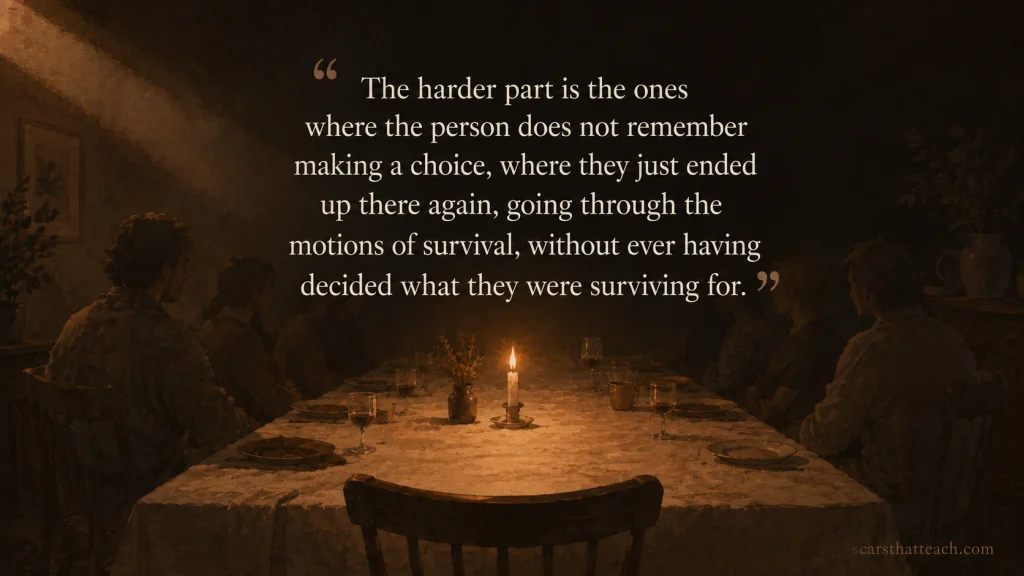
But getting through the day and being okay with the situation are different things. The tactics handle the first one. The second one requires a different kind of attention, and it tends to accumulate over years rather than resolving in a single afternoon. What I noticed, across many conversations about many years of holidays, is that the gathering itself is rarely the hardest part to look back on. The harder part is the ones where the person does not remember making a choice, where they just ended up there again, going through the motions of survival, without ever having decided what they were surviving for.
That question does not have a single answer. But it is worth asking before the next one, which will arrive whether you are ready for it or not. If you want to understand what the broader pattern of toxic family members tends to look like over time, that is covered in more depth in the next piece.
FAQs
😰 Is it okay to skip a holiday gathering with toxic family?
Yes, though the decision is rarely simple. The costs of not attending vary significantly depending on the family structure, the relationships involved, and what the consequences of absence would actually be. What matters more than the decision itself is whether it is a genuine choice, made with clear understanding of what is driving it, rather than a default that has never been examined.
🪨 What is the gray rock method and does it work?
The gray rock method involves making yourself as unreactive and uninteresting as possible, giving short neutral answers, and avoiding emotional engagement with provocative behavior. It can reduce the reward a difficult person gets from trying to draw a reaction. It works in some situations, particularly with people who are primarily looking for attention or conflict. Its limitation is that it requires sustained emotional labor over hours, which tends to be more draining than the instructions suggest.
🕐 How do I make an exit plan for a family holiday gathering?
Decide in advance what time you are leaving and, if needed, a reason that does not require defending or negotiating. Arriving separately from other family members so you control your own transportation helps. Having the plan settled before you arrive, rather than improvising it in a moment of high emotion, makes it significantly easier to follow through.
💬 What do I say when a toxic family member tries to start something?
Short, neutral responses that do not engage with the content of what is being said. “I hear you,” “I’ll think about that,” or simply changing the subject. The goal is to reduce the reward that comes from getting a reaction without creating a direct confrontation. Rehearsing a few of these in advance, for the specific situations you know are likely, tends to make them easier to use in the moment.
😔 Why do I feel terrible after the holiday even when nothing went badly wrong?
Getting through the day without an incident does not mean the day was not costly. Sustained emotional monitoring, suppressing natural reactions, and managing interactions with people who are genuinely difficult requires a kind of effort that does not dissipate just because the gathering ended. Many people also experience a low-grade grief after these events, particularly when they are still hoping for something from the family that the gathering made clear is not available.
🔁 Why do I keep going back every year even though I dread it?
Usually because the obligation feels external rather than chosen: something the family structure demands, something that would make the person the problem if they declined. Sometimes because there are other people at the gathering worth seeing. Sometimes because of a hope, rarely fully articulated, that this time might be different. Knowing which of these is actually driving the decision tends to change how the gathering feels, regardless of what you decide to do about it.