
Guilt and shame get used as the same word by most people, and that is a mistake with real consequences. Guilt says you did something wrong. Shame says you are something wrong, and that small shift changes almost everything about whether a person can actually move forward. I have watched the distinction decide, more than once, whether someone could eventually live with what they had done or stayed stuck in it for decades. This is the difference and why it matters more than most people realize.

What Actually Separates Guilt vs Shame
The difference that matters with guilt vs shame is rarely how serious the thing was. I sat with people who had done relatively small things and never recovered, and I sat with people who had done genuinely terrible things and found a way to live with themselves. What separated the two groups, almost every time, was not the act itself. It was whether they had decided the act proved something about what they had done, or something about what they were. One of those conclusions leaves a door open. The other one does not.
I think about a woman who spent three decades unable to forgive herself for a single sentence she said to her mother the week before her mother died. The sentence was unkind, said in exhaustion, the kind of thing most families say to each other under enough strain. What kept her stuck was not the sentence itself. It was the conclusion she had drawn from it, that saying something cruel to a dying woman proved she was a cruel person at her core. That conclusion is shame, and shame does not leave room for the kind of repair that guilt does, the same kind of repair that runs through most of the honest reflections on failure.
Guilt and Shame Meaning, in Plain Terms
Guilt is the feeling of having done something wrong. It is specific, tied to an action, and it points outward at the thing itself, the words said, the choice made, the harm caused. Research on guilt and shame meaning describes guilt as a functional moral emotion. It exists to do a job, and the job is to motivate acknowledgment, amends, and change. A person who feels guilty tends to ask what they can do about it. That question alone keeps a path open.
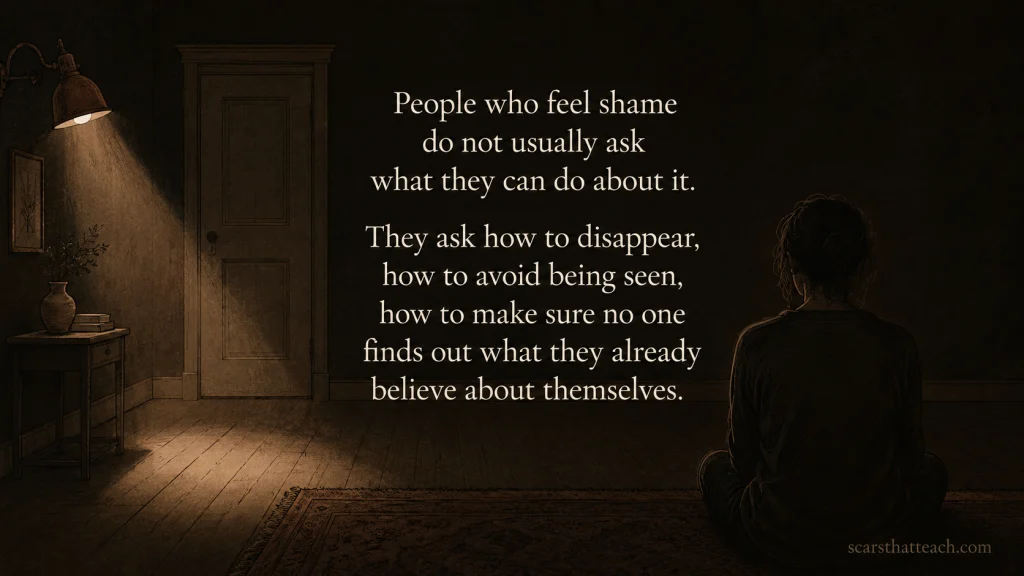
Shame works differently. Shame is the feeling of being fundamentally wrong as a person, not the feeling that you did something wrong but the feeling that the thing you did revealed who you actually are underneath. Brené Brown’s research on this distinction, along with work documented through sources like psychologytoday.com, has found that shame tends to produce hiding, disconnection, and self-destructive behavior rather than repair. People who feel shame do not usually ask what they can do about it. They ask how to disappear, how to avoid being seen, how to make sure no one finds out what they already believe about themselves. That is a very different question, and it rarely leads anywhere useful.

Why the Guilt vs Shame Psychology Distinction Changes What Comes Next
Most of what gets written about guilt and shame treats them as two points on the same spectrum, as though shame is just guilt that has gotten worse over time. That framing misses the part that actually matters for someone trying to live with their own past. Guilt points toward what was done, which means it is actionable. There is a specific thing to apologize for, repair, or change, and once that thing is addressed, guilt has somewhere to go. Shame points toward the self, and the self is not a specific thing you can apologize to or fix in an afternoon. That is why shame tends to produce paralysis instead of repair. There is nothing to do about being fundamentally wrong, only things to hide.
I sat with a man who had been unfaithful to his wife early in their marriage, decades before I met him. He had told her, she had stayed, and by every measure they had built a long, decent life together afterward. What he could not get past was not the affair. It was the story he had built around it, that he was the kind of man who could not be trusted, full stop, and that every good year since had been some kind of accident he did not deserve credit for. He had taken a guilty act and turned it into a permanent identity, and the identity was what kept him from ever fully letting it go. The common mistake here, and I watched it happen often, is assuming that feeling worse about something for longer is the same as taking it seriously. It is not. Shame can feel like seriousness from the inside, and it is part of why so many people quietly wonder why forgiving themselves feels so much harder than forgiving anyone else. It usually is not repair. It is often just a more permanent way of staying stuck.
A few patterns tend to show up reliably once you know to look for them:
- Guilt sounds like “I should not have done that.” Shame sounds like “Of course I did that, that is who I am.”
- Guilt motivates an apology or a change in behavior. Shame motivates avoidance, secrecy, or the kind of ongoing self-punishment that has nothing to do with repair.
- Guilt usually fades once amends are made, even imperfect ones. Shame tends to outlast the original event by years or decades, attaching itself to anything that resembles it.
- Guilt eventually answers to a specific action and runs out of things to say about it. Shame keeps finding new evidence for the same old verdict, no matter how much time has passed.
Self-forgiveness, when it happens at all, is almost always a process of moving something from the second category back into the first. Not pretending the act did not matter, but separating the act from a verdict on the whole person.

Final Thoughts: The Verdict You Did Not Have to Reach
If you have spent years carrying something, it is worth asking honestly which one you are actually carrying. Not whether what you did was serious, because serious things deserve to be taken seriously. The question is whether you decided, somewhere along the way, that the thing you did was a verdict on who you are, rather than a single choice you made and could still account for. That decision was yours, and the good news, if there is any, is that it can be reconsidered. Some of this depends on details only you know, the history, the relationship, what was actually said and done, so I will not tell you which one applies to your situation. What I can tell you is that the distinction is real, and it is worth more honesty than most people give it. If you are working through what comes after that honesty, I have written more about what it actually takes to forgive yourself, including the parts that have nothing to do with deserving it, and more specifically about how to forgive yourself for a specific past mistake.
FAQs
🔍 What is the simplest way to tell guilt and shame apart?
Guilt focuses on the act: “I did something wrong.” Shame focuses on the self: “I am something wrong.” If the feeling is about an action, it is guilt. If it has quietly become about your worth as a person, it is shame.
🧩 Why does it matter which one I am feeling?
Guilt tends to motivate repair, because there is a specific thing to address. Shame tends to motivate hiding and self-punishment, because there is nothing specific to fix about being a person. Knowing which one you are dealing with changes what actually helps.
🌀 Can shame turn into guilt, or guilt into shame?
Yes, and it happens often. A person can start with ordinary guilt over something they did and gradually build it into a permanent story about who they are. The reverse is also possible, separating the act from the identity, which is usually where self-forgiveness starts.
🛑 Is shame ever useful?
Research generally finds shame less useful than guilt, since it tends to produce avoidance rather than change. A brief moment of shame that pushes someone to reflect is different from shame that becomes a long-term identity, and it is the second kind that tends to cause the most damage.
🕯️ How do I know if I am stuck in shame instead of guilt?
If years have passed and you still cannot name a specific thing left to do about it, only a general sense of being unworthy, that is usually shame rather than guilt. Guilt tends to have an endpoint. Shame often does not, unless the story underneath it gets examined.