
Conflicts with a mother-in-law carry a particular weight that conflicts with blood family do not. You did not grow up inside her rules. You married someone who did. What makes this relationship difficult to navigate is not only the behavior itself but where she sits in the architecture of your marriage: between you and the person you chose, in a role you had no say in, with a history in your spouse’s life that predates you by decades. This is about what that dynamic actually looks like, why it is as hard as it is, and what tends to matter when people try to navigate it with some degree of clarity.

The One Family Member You Chose to Marry Into
There is a particular bitterness that can develop between people who came into each other’s families by choice rather than by birth. With blood family, the difficulty is at least contained inside a shared history. You grew up together. The dynamics were shaped over time, often so gradually that you absorbed them before you were old enough to question them. There is a kind of unwilling intimacy in that, even when the relationship is painful.
With a mother-in-law, none of that applies. You arrived as an adult, with your own formed sense of who you are and how things should work, into a family system that had already been running for decades without you. You did not grow up inside her assumptions. You did not earn her trust over years. You walked in, loving someone she had been the primary person for, and the adjustment that was required of both of you was significant whether it looked like it or not.
When that adjustment goes badly, what results is one of the more corrosive ongoing tensions a marriage can contain. Not because the mother-in-law is necessarily a villain, though some behavior does cross clear lines. But because of where she sits between you and your spouse, the conflict becomes hard to name clearly, hard to address without implicating the person you married, and hard to resolve without someone being asked to give something up.
What Toxic In-Law Behavior Actually Looks Like
The word toxic gets applied loosely enough that it has lost some of its usefulness. In the context of a mother-in-law relationship, the patterns that tend to do the most damage are not always the most dramatic ones. They are often the quieter, more persistent ones that are easy to second-guess and difficult to name without sounding petty.
Boundary-crossing is the most common pattern and also the most varied. It can look like showing up without calling, offering opinions on parenting or finances or housekeeping that were not invited, making decisions about family events without including the daughter-in-law, or treating the married couple’s home as an extension of her own. The individual instances often seem small. The cumulative effect is a steady message that her authority extends into spaces where it no longer belongs.
Triangulation through the spouse is the pattern that tends to cause the most direct damage to the marriage. This is when the mother-in-law routes her communication, her complaints, and her requests through her child rather than addressing the daughter-in-law directly. The effect is that the spouse is placed in the middle on a recurring basis, asked to carry messages, mediate disputes, or choose sides in situations where choosing sides is the last thing a marriage needs. The spouse ends up managing two relationships simultaneously, and neither relationship gets what it needs.
When Your Version of Events Is Not Believed
One of the more quietly damaging patterns is the minimizing of the daughter-in-law’s account of what happened. This does not always come from the mother-in-law directly. It can come from the spouse, or from the wider family, and often it is not intentional. It is just that her version of a conflict, or her account of something that was said, gets filtered through people who have a much longer and more established relationship with her than with the person she married.
The result is that the daughter-in-law finds herself in the position of having to justify her own perception of her own experience. She says something hurt her and is told she is being too sensitive. She describes a pattern and is told it was a one-time thing, or that the mother-in-law did not mean it that way, or that she has always been like that and means well. This is not the same as the mother-in-law being openly hostile. It is more insidious than that, because it operates through the people closest to her and leaves her feeling both injured and unreasonable for feeling injured.
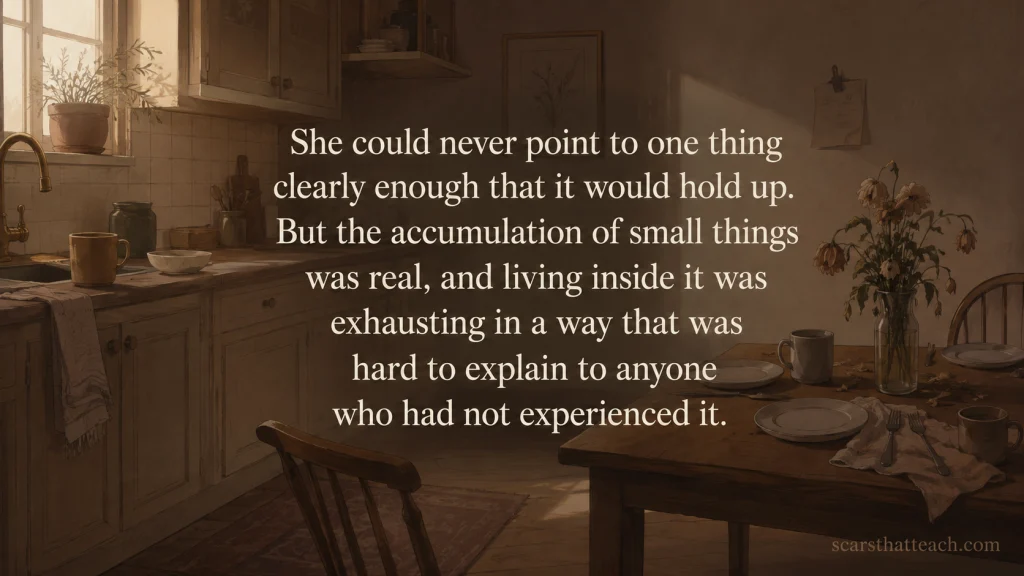
A woman I spoke with once described it as arguing with a fog. She could never point to one thing clearly enough that it would hold up. But the accumulation of small things was real, and living inside it was exhausting in a way that was hard to explain to anyone who had not experienced it. Part of what made it so exhausting was not the patterns themselves but the particular constraints of the relationship they were happening inside.

Why This Particular Relationship Is So Hard to Navigate
Most difficult relationships can be managed, at some level, through distance or reduced contact. You can step back from a difficult coworker, limit time with a difficult friend, or even restructure a relationship with a difficult blood relative in ways that reduce the damage. With a mother-in-law, the options are more constrained. She is connected to your spouse in a way that cannot be separated from your marriage. Reducing contact with her is not a private decision. It is a decision with consequences for someone else, and that someone else is the person you live with and have built a life with.
This is what makes the in-law relationship structurally different from most other difficult relationships. The damage she does does not stay contained to the relationship between her and the daughter-in-law. It spreads into the marriage, because the marriage is the connective tissue between them. Every conflict with her becomes, at some level, a question of how the spouse will respond. And how the spouse responds carries weight that is entirely separate from the behavior that prompted the conflict in the first place.
“The most exhausting part was not her. It was having to decide, every single time, whether this was worth bringing to my husband or whether I should just absorb it and move on.”
The spouse caught in the middle faces something genuinely difficult. Loyalty to a parent is not something that disappears when someone marries. A mother-in-law who raised her child through hard years, who was present through difficulty, who has a lifetime of shared history, carries real weight in her child’s life. Being asked to set limits on that relationship, or to consistently prioritize a spouse’s account of a conflict over a parent’s, is not a simple thing. The people who navigate this most successfully tend to be the ones who found a way to do it without requiring the spouse to permanently choose. But getting there usually takes clarity about what the actual problem is, and that clarity is often the hardest thing to establish.
What Tends to Matter When People Try to Address It
The SERP on this topic is split between two things that are both, in their own way, unsatisfying. One is the listicle format, which offers twenty signs that your mother-in-law is toxic followed by a set of tips for managing her. The other is the drama-aggregation format, which collects Reddit stories and AITA threads for the entertainment value of the conflict. Neither of these is useless, but neither one addresses what most people actually need when they are in the middle of this, which is some way to think clearly about a situation that is not clear.
What tends to matter, from everything I observed and from what the people navigating this described, comes down to a small number of things that are harder to do than they sound.
Getting the spouse aligned is the foundation. Not aligned against the mother-in-law, which tends to produce defensiveness and triangulation in the opposite direction. Aligned around the marriage itself. That means the spouse understanding, without being asked to take a side in any individual conflict, that the health of the marriage is the priority, and that anything that consistently undermines that health needs to be addressed rather than absorbed. This conversation is often the one that does not happen, because it requires the spouse to hold two things at once: love for a parent and clear limits on what that parent’s behavior is allowed to do to the marriage.
Naming patterns rather than incidents is what tends to make those conversations productive. One incident can always be explained. A pattern is harder to dismiss. This means resisting the urge to lead with the most recent thing that happened, because the most recent thing is almost always the easiest to minimize, and instead describing the shape of what recurs. Not “she did this last Sunday” but “this is the third time in six months that something like this has happened, and this is what the common thread looks like.”
Accepting the limits of what can be changed. A mother-in-law who has been operating this way for decades is unlikely to fundamentally change because someone asked her to. What can change is how the marriage responds to her behavior, what is allowed in versus what is held at the boundary, and what the couple does together when something crosses the line. The change that is possible is mostly internal to the marriage. That is a narrower thing than most people hope for, but it is also more durable than hoping she will eventually come around.
The patterns in a difficult in-law relationship rarely exist in isolation. They are usually connected to the broader dynamics of the family system the spouse came from, and understanding that context is often more useful than focusing on any one incident. For a wider frame on how toxic family dynamics tend to work and what they cost, the material on toxic family members covers the underlying structure that most of these situations sit inside.
Final Thoughts: What You Can and Cannot Change
The conflict with a toxic mother-in-law is rarely about her alone. It is about the role she holds in your spouse’s history, the way that history pulls in one direction while your marriage pulls in another, and the difficulty of establishing clarity inside a situation where the lines keep moving.
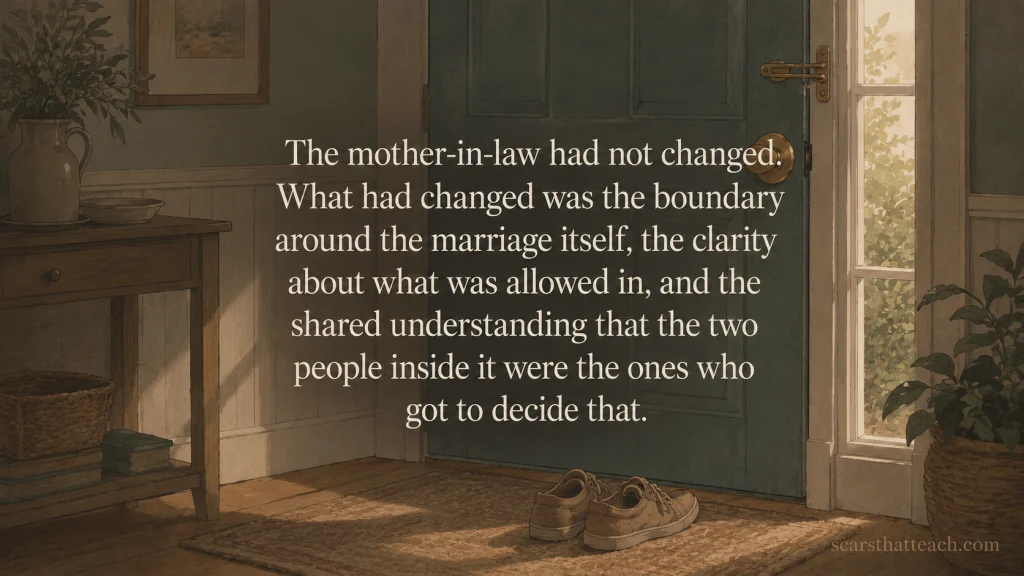
Most of the people I spoke with who had come out the other side of this with their marriages intact said the same thing in different words: the thing that had mattered most was not what they had done about her. It was what they and their spouse had figured out together about what the marriage needed, and then held to that even when it was uncomfortable. The mother-in-law had not changed. In most cases she had not significantly softened. What had changed was the boundary around the marriage itself, the clarity about what was allowed in, and the shared understanding that the two people inside it were the ones who got to decide that.
That is a quieter resolution than most people hope for when they are in the middle of the conflict. But the people who described it to me did not sound disappointed by it. They sounded, mostly, relieved. Not that she had changed, but that they had stopped waiting for her to. For more on the dynamics of people who use relationships to control or diminish others, the broader reflection on what toxic people tend to teach about the nature of that kind of damage is worth spending time with.
FAQs
🚩 What are the signs of a toxic mother-in-law?
The signs that tend to do the most damage are not always the most dramatic. Boundary-crossing that is persistent but individually deniable, triangulation through the spouse, and the minimizing of the daughter-in-law’s account of her own experience are the three patterns that come up most consistently. The cumulative weight of quiet patterns is usually what makes this relationship corrosive rather than any single incident.
💬 How do you deal with a controlling mother-in-law?
The most important variable is not the mother-in-law herself but whether your spouse understands what the behavior is costing the marriage and is willing to be aligned around the marriage’s needs. That conversation, and holding to what comes out of it, tends to matter more than any direct approach to the mother-in-law herself.
😤 Why does my mother-in-law treat me like an outsider?
Because in some structural sense, you were. You arrived into a family system that had been running without you for decades. That is not a justification for poor treatment, but it does explain something about the underlying dynamic. You represent a shift in her child’s primary loyalty, and not every parent navigates that shift with much grace.
🤝 How do you set boundaries with a toxic mother-in-law?
Boundaries in this relationship work best when they are established inside the marriage first, then held jointly rather than unilaterally. A limit that comes from both spouses is harder to dismiss or route around than one that comes only from the daughter-in-law. Naming patterns rather than individual incidents, and keeping the conversation focused on what the marriage needs rather than what the mother-in-law did, tends to make those conversations more productive.
💔 Can a toxic mother-in-law destroy a marriage?
Not on her own. What tends to destroy the marriage is unresolved triangulation, the spouse who is consistently unable or unwilling to hold a clear position, and the accumulated resentment of a daughter-in-law who has absorbed too much for too long without the conflict being addressed. The mother-in-law is the source of the pressure. How the marriage responds to that pressure is what determines the outcome.