
Self-doubt that sticks around for years is not a character flaw. It is a loop, and the loop runs on a specific mechanism: doubt leads to hesitation, hesitation prevents the accumulation of real experience, and the absence of that experience keeps the doubt exactly where it was. Most advice aimed at helping you stop doubting yourself targets the thinking, not the mechanism. That is why it tends to help briefly and then lose ground. What actually breaks the cycle is not confidence, which arrives after the fact anyway. It is action taken before the doubt resolves, concrete enough to produce evidence the loop cannot use.

When You Stop Trusting Your Own Read
In my years as a hospice chaplain, the people who described a life of second-guessing themselves were almost never people who doubted everything. They had a specific problem. They could not trust their own read on a situation. Should I take this job? Is this person safe to rely on? Am I making the right call here? The doubt was concentrated in one particular place, and that place was their own judgment. Not their skills, not their intelligence. Their judgment specifically.
What I noticed across those two decades, sitting with enough of those conversations, is that this kind of doubt almost always had a starting point. It usually traced back to a period in someone’s life where their own assessment of things had been consistently overridden. A parent who questioned every decision. A partner who reframed their instincts as evidence of immaturity. A workplace where trusting their own read had gotten them burned badly enough that they stopped doing it. After enough of that, the internal voice does not go quiet because it has been proven wrong. It goes quiet because it has learned not to compete.
By the time most people are asking how to stop doubting themselves, the habit is old. Knowing it has a history does not fix it. But it changes the frame. The problem is not that something is broken in you. The problem is that a specific pattern has been running for a long time, and it does not stop on its own just because you have noticed it.
The Mechanism Behind the Self-Doubt Cycle
Some degree of self-doubt in genuinely unfamiliar or high-stakes situations is not a problem. It is a reasonable signal that you are paying attention. The kind worth examining is the kind that shows up in situations that are not especially unfamiliar, where the stakes are ordinary, where someone who knows you well would find your hesitation surprising. That version follows a pattern. Once you see it, you cannot unsee it.
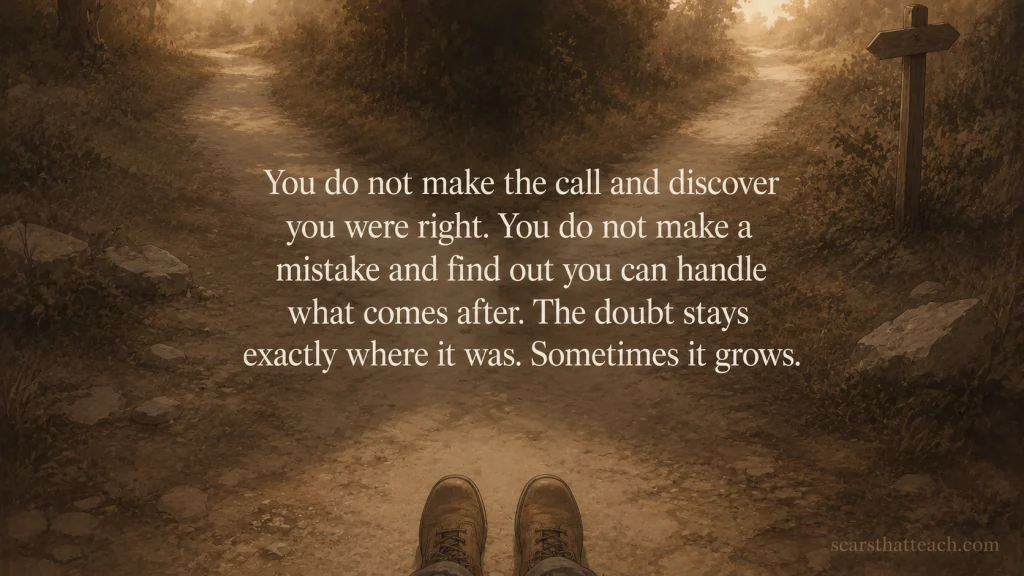
The self-doubt cycle works like this. You face a decision that calls for some reliance on your own judgment. The doubt arrives before you have done anything. You respond to it by hesitating, delaying, seeking reassurance from someone else, or finding a reason to step back from the situation. That hesitation feels protective. But hesitation also means you never accumulate the kind of experience that could actually challenge the doubt. You do not make the call and discover you were right. You do not make a mistake and find out you can handle what comes after. You do not get the concrete, self-referential evidence that would show your judgment is workable. The doubt stays exactly where it was. Sometimes it grows.
This is why the loop is so persistent. It is not irrational from the inside. Avoidance does prevent the specific thing you are afraid of, at least in the short term. The cost is that it also prevents anything from changing.
There is a pattern I watched enough times to stop treating it as coincidence. The people most locked inside this cycle were rarely people who had never made a good call. They had, many times. But they had spent enough years in situations where someone else’s certainty drowned out their own that they had stopped registering their own track record. Someone else had always been credited with the judgment, even when the instinct was theirs.
The following are signs that the self-doubt cycle is the issue, rather than ordinary, situational caution:
- You seek reassurance and feel better briefly, then the doubt returns without any new information having arrived. The reassurance did not produce evidence. It just quieted the loop temporarily.
- You delay a decision long enough that someone else makes it, then spend time wondering whether you should have said something sooner.
- You explain your reasoning at length, not because the other person needs to understand it, but because you need them to confirm it before you will act on it.
- Your confidence in a decision drops the moment someone else expresses doubt, even someone who knows less about the situation than you do.
- You avoid situations where you might be judged on your judgment above all else, not because you fear the consequences of failure but because you fear being seen as someone who made a bad call.
None of these are character failings. They are behavioral patterns that developed in a context and have outlasted it. Understanding that does not make them easier to stop, but it does point toward what actually needs to change.

Why Reframing Does Not Touch the Loop
The most widely offered advice for self-doubt is cognitive: notice the negative thought, challenge it, replace it with something more accurate. That approach has real value in some contexts. The problem is that it treats the doubt as though the doubt is what is driving the pattern. It is not. The inaction is driving the pattern. The doubt feeds on the absence of experience, and changing a thought does not produce experience.
I have watched people do the work of shifting their internal narrative, sometimes very carefully and with real sincerity, while leaving the behavioral pattern completely intact. They told themselves more accurate things and still did not make the call. Still held back in the meeting. Still let the other person set the terms. The thought became kinder. The loop kept running. This is not a reason to abandon that kind of work. It is a reason to understand what it can and cannot reach.
The same gap shows up in advice that focuses on body language, visualization, and affirmation. These are not useless. But they are aimed at how you feel going in, not at what the loop is actually running on. Confidence built on performance is thinner than confidence built on the concrete evidence of having acted, even imperfectly, and gotten something real from it.
Consider someone who spends months working on their sense of worthiness in relationships and genuinely shifts how they think about themselves, then freezes when an actual opportunity arrives, because the internal work prepared them to feel better but not to act differently. The thought changed. The behavioral pattern, the hesitation, the waiting for someone else to initiate, the second-guessing, was still right where it was. That is the gap most approaches to self-doubt do not close.
It is also worth noting that this kind of pervasive judgment-level self-doubt is distinct from patterns like feeling like a fraud in professional settings, which runs on a different mechanism and tends to show up differently. The commonality is avoidance. The specifics matter when you are trying to figure out what to actually do about it.

What Actually Interrupts the Cycle
The mechanism that breaks the self-doubt cycle is not confidence. Waiting for confidence before acting is the loop. What interrupts the loop is action taken in the presence of doubt, action small and deliberate enough to produce something the doubt cannot erase: a real outcome you can actually point to, one that happened because you decided something. This is not a particularly encouraging thing to hear, because it means the work happens in the discomfort rather than before it. But that is what the research on behavioral interruption of negative self-perception patterns consistently reflects: you do not change the belief by arguing with it. You change it by producing results that are inconsistent with it, and you produce those results by acting.
“Waiting for the doubt to resolve before you act is not caution. It is the doubt’s way of keeping you in place.”
The action does not need to be large. In fact, starting with high-stakes decisions is the wrong place. The goal is not to prove yourself in a consequential moment before you have built any track record of trusting yourself. The goal is to accumulate small, legible data points that your own memory can hold. Someone who begins making lower-stakes calls at work and then takes a moment afterward to register what happened, not to celebrate but just to note it, is doing something more useful than someone who is working on thinking better about themselves in the abstract. The noting matters. It builds the record that the doubt has been operating without.
A decision that does not go the way you hoped still breaks the loop if you stay with it. You made a call. It did not land the way you wanted. You found out what actually happened. You adjusted. That sequence, all four parts of it, is the opposite of avoidance. It produces something the loop has no answer for. The loop depends on the absence of any real record. A mistake you stayed present for is part of that record.
The hardest version of this is acting without getting someone else’s confirmation first. Because the loop tends to use external reassurance as a substitute for firsthand experience, and it is very good at that substitution. Stopping it means tolerating the discomfort of not knowing whether you are right before you act. That discomfort is uncomfortable precisely because it is the thing the loop has been protecting you from. Getting through it, even once, in a situation that does not matter very much, changes what you know about your own capacity to carry uncertainty. That is the mechanism. Not confidence. Tolerance for uncertainty built gradually through acting in its presence.
If you are looking at the broader set of questions around how you see yourself and what shapes that, the territory of self-confidence covers a range of related patterns worth working through alongside this one. And if the more practical question is how to build that confidence in a deliberate, step-by-step way, the work on building self-confidence from the ground up goes into that directly. The self-doubt cycle is one piece of a larger picture, and rarely the only piece.
Final Thoughts: You Are Not Waiting for Certainty
What most people are actually waiting for, when they describe waiting to feel more confident before they act, is for the doubt to stop. They want to get to a place where the question of whether their judgment is trustworthy no longer feels like a question. That is an understandable thing to want. It is also, in most cases, not how it works. The doubt does not stop first. The record accumulates until the doubt has less to work with. And the record only accumulates through action.
That is not a demand. Nobody has to take a particular step at a particular time or at all. But if you have been carrying this a long time and waiting for something internal to shift before you move, it is worth knowing that the shift tends to follow the movement, not precede it. Two decades of watching people reckon with what they wished they had trusted in themselves taught me that. The ones who found their way back to their own judgment almost never did it by thinking differently first. They did it by acting on something small, staying with what happened, and then doing it again.
If any of what is here points toward something you have been carrying for a long time, there is more to sit with. The patterns around self-worth and how we talk to ourselves in the hard moments are part of the same territory. Not because a quote fixes anything, but because language sometimes gives us a frame for something we have been carrying without one.
FAQs
💬 Why do I always doubt myself?
Persistent self-doubt, especially around your own judgment, usually has a history. It tends to develop in periods where someone else’s certainty consistently overrode your own, long enough that your internal voice learned to defer. It is not a fixed trait. It is a pattern that developed in a context and has outlasted it.
🔄 What is the self-doubt cycle and why does it keep going?
The self-doubt cycle runs on inaction. Doubt leads to hesitation, hesitation prevents the accumulation of real experience, and the absence of experience keeps the doubt in place. It is self-sustaining because avoidance feels protective in the short term, even as it prevents anything from changing.
🤔 How do I stop second-guessing every decision I make?
The most useful thing is not to stop the second-guessing by thinking differently, but to act before the second-guessing resolves, on something small enough that the stakes allow it. Then stay with what happened. The evidence you build by doing that is what the doubt has been running in the absence of. It does not happen quickly, but it is the actual mechanism.
🧠 What is the difference between self-doubt and imposter syndrome?
They overlap but are distinct. Imposter syndrome tends to show up in professional or achievement contexts, where someone cannot internalize their own success and fears being exposed as less capable than others believe. Pervasive self-doubt, as covered here, is about trust in your own judgment more broadly, not just in professional settings. The avoidance patterns are similar. The triggers and history tend to be different.
⏳ Does self-doubt ever go away completely?
For most people, some version of it does not disappear entirely. What changes is its hold. When you have built enough self-referential evidence through acting on your own judgment, the doubt has less to work with and carries less weight. It is still there sometimes. It just does not run the show the way it used to.
🪞 Is it possible to rebuild trust in your own judgment after a long time away from it?
Yes. And it almost always happens the same way: incrementally, through low-stakes action, with attention paid to what actually happened. Not sweeping gestures or major decisions. Small calls made without waiting for someone else’s sign-off, and the patient accumulation of what you learn from them.