A scarcity mindset around money is the persistent feeling that there is never enough, no matter what the actual number says. I watched this pattern hold steady across very different bank balances, which taught me that the feeling and the figure are not as connected as most people assume. This piece looks at why a scarcity mindset and money problems are not always the same thing, what keeps the feeling of never enough in place even after circumstances improve, and why that distinction matters for anyone trying to make peace with what they have.

The Feeling Rarely Changed When the Amount Did
One of the more reliable patterns I watched over two decades was this: the feeling of not having enough money did not move much when the amount of money did. I sat with people who had very little and were at peace with it, and I sat with people who had more than they would ever need and still described their finances with a kind of low-grade dread that never let up. If money scarcity thinking were simply a math problem, more money would have fixed it every time. It rarely did.
The people who eventually found some real peace around money almost always found it somewhere other than the bank balance. That is not a comfortable thing to hear if you are currently waiting for a number to arrive that will finally make you feel safe. But it points to something worth understanding clearly: scarcity mindset and money are related, but they are not the same thing, and confusing the two keeps people chasing a fix that was never going to land where they expected.
What a Scarcity Mindset Actually Is, and What It Is Not
A scarcity mindset around money is characterized by the persistent belief that there is never enough, regardless of the actual amount sitting in an account. This is distinct from genuine financial hardship, where someone does not have enough money to cover real needs. Both produce stress, and both deserve to be taken seriously, but they are not the same problem and they do not respond to the same solutions. Genuine scarcity is resolved, at least in part, by more money. A scarcity mindset is not, because the feeling was never purely a response to the number in the first place.
Financial therapists who study this pattern have found that it does not necessarily track with the actual reality of someone’s financial situation. Dr. Megan McCoy, a financial therapist whose work on this subject has been cited in coverage of the topic, has pointed out that this kind of thinking can show up just as easily at a comfortable income level as it can at a difficult one. That detail matters, because it tells you the feeling is not simply a report on your bank balance. It is something else, operating on its own logic, and that logic deserves to be looked at directly instead of assumed away.
Why the Feeling Does Not Resolve When the Number Improves
Most of what gets written about scarcity mindset treats it as the simple opposite of an abundance mindset, and frames the solution as a shift from one to the other, as though the feeling were a setting you could flip. What that framing leaves out is the more important question: what keeps a scarcity mindset in place even after circumstances genuinely improve. I think this is the piece that actually explains why so many people earn more over the years and feel no safer than they did before.
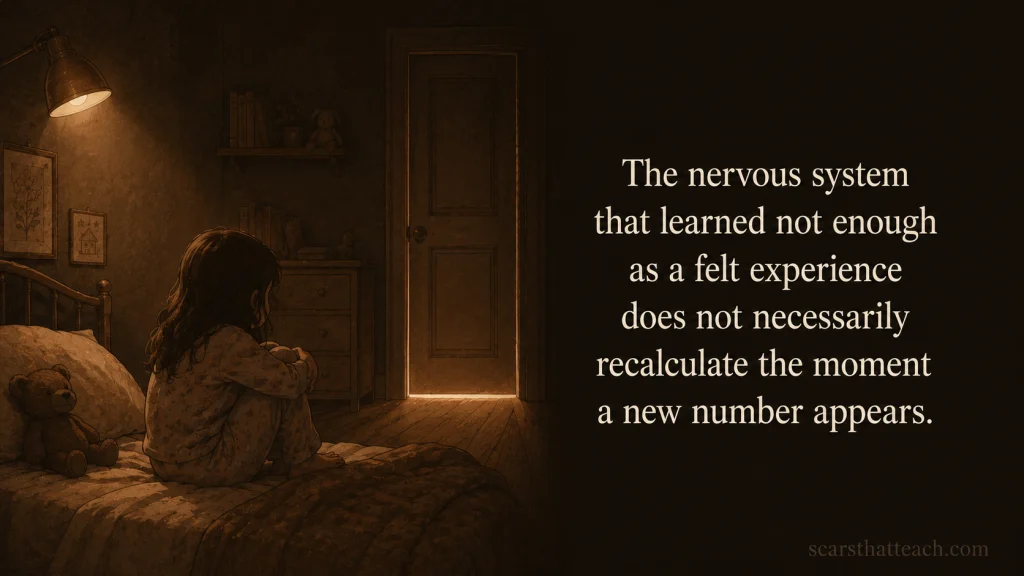
The feeling of never enough is typically learned early, as a response to an emotional experience rather than to a specific number. Someone who grew up watching a parent panic over an unpaid bill, or who lived through a period where money disappearing meant something frightening was about to happen, learns that money and danger are connected at a level deeper than arithmetic. That association does not update automatically just because the income changes years later. The nervous system that learned not enough as a felt experience does not necessarily recalculate the moment a new number appears. It keeps running the old pattern, because the pattern was never really about the number to begin with.
This is why someone can describe, with total sincerity, feeling financially unsafe at an income level that would have sounded unimaginable to an earlier version of themselves. It is not denial and it is not ingratitude. It is the same emotional alarm still firing on the same old trigger, even though the actual danger it was responding to is long gone.
When the Stress Is Not Coming From a Mindset at All
It would be dishonest to suggest that a scarcity mindset explains every case of financial stress, and I want to be direct about that. Some people feel financially stressed because they genuinely do not have enough money to cover what they need, and no amount of reframing changes that math. If your financial stress is rooted in real, current shortfall, the answer is not to examine your relationship with money in the abstract. It is to address the actual gap, through whatever practical means apply to your specific situation, including professional financial guidance suited to your circumstances.
The distinction worth holding onto is this: genuine scarcity is about the number. A scarcity mindset is about a feeling that persists independently of the number. Most people experience some mix of both at different points in their lives, and untangling which one is driving the stress in front of you right now is worth doing honestly, rather than assuming it must be one or the other.
Final Thoughts: The Number Was Never Going to Be the Whole Answer
If a scarcity mindset has been running quietly underneath your relationship with money, no amount you eventually reach was ever going to be the number that finally satisfies it, because it was never built to respond to numbers in the first place. That is not a hopeless thing to realize. It simply means the work is happening somewhere other than the bank balance, in the same place the feeling was learned to begin with.
If you want to understand more about how this kind of thinking takes shape, what is a money mindset covers the broader pattern, and how childhood shapes your relationship with money looks closer at where these associations are usually first learned. For what it actually looks like to start shifting this pattern, how to change your relationship with money picks up where this leaves off. The wider collection of questions on this subject lives at money mindset, and for words that speak to staying grounded through the work of changing a long held pattern, there is more in motivational quotes.
FAQs
💭 What is a scarcity mindset around money?
It is the persistent feeling that there is never enough money, regardless of the actual amount available. It can show up at low incomes and high incomes alike, because it is a learned emotional pattern rather than a direct reflection of someone’s finances.
📈 Why do I still feel like I never have enough money even though I earn more now?
The feeling of never enough is usually learned early as a response to emotional experience, not to a specific number. Income can change without that learned response automatically updating with it.
🔍 How do I know if I have a scarcity mindset or a real financial problem?
Genuine scarcity tracks with the actual numbers: there is not enough to cover real needs. A scarcity mindset persists even when the numbers improve. Many people experience some mix of both, so it is worth looking honestly at which one is driving the stress you feel right now.
🌱 Can a scarcity mindset around money actually change?
It can shift, but usually not through the arrival of a bigger number. Since the pattern was learned through experience, change tends to happen through addressing that experience directly rather than waiting for a different bank balance.
⚠️ Is feeling financially stressed always a scarcity mindset?
No. Real financial hardship is a genuine and separate problem, and it deserves practical attention on its own terms, not a reframe. A scarcity mindset specifically describes the feeling of never enough that persists independent of the actual numbers.