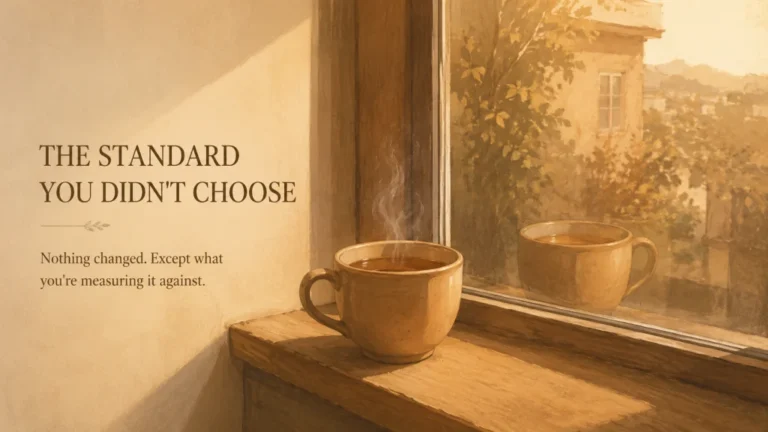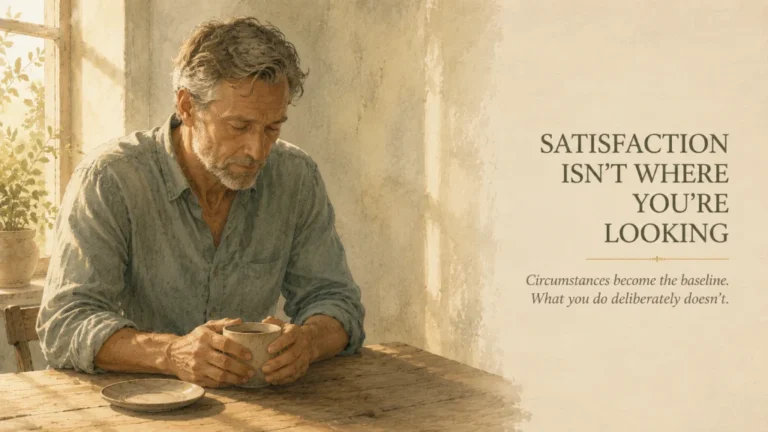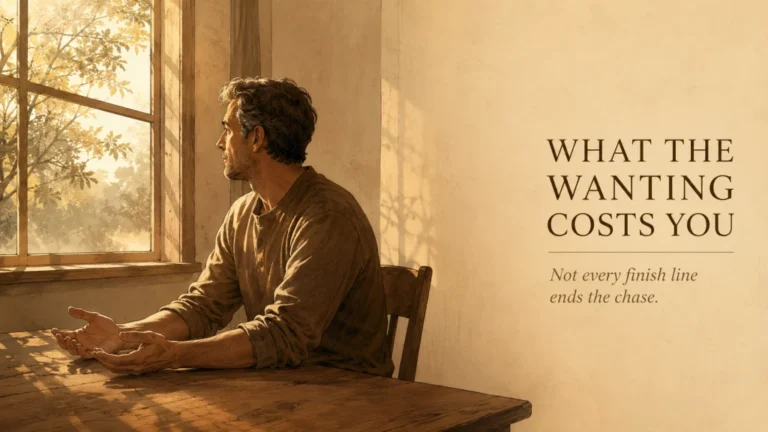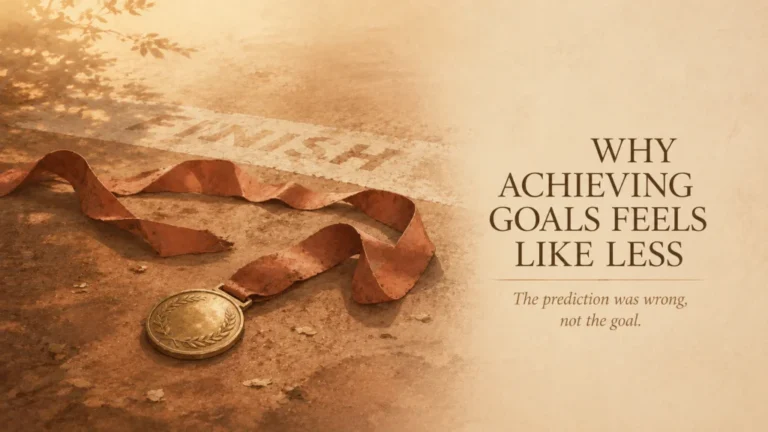
Why we stop noticing the good things has a real mechanism behind it, not just a vague sense of taking life for granted. The brain is wired to pay closer attention to novelty and threat than to anything calm or familiar, which means good things tend to fade from notice faster than bad ones stick around. That fading, called hedonic adaptation, is not permanent or automatic in one direction, and it responds to a particular kind of attention rather than to more of whatever already stopped registering. What follows covers the two mechanisms behind the fading and the particular shift in attention that actually slows it down.
What People Mean When They Say It Stopped Feeling Good
You know the moment: something that used to feel remarkable just doesn’t anymore, and you can’t quite say when it stopped. That shift is what people are pointing at when they ask why we stop noticing the good things, and the explanation has nothing to do with how grateful you are. I spent over twenty years sitting with people looking back over an entire life, and one report came up more consistently than almost any other. It was rarely about what had gone wrong. It was about what had been there all along, something steady and good that they had simply stopped seeing somewhere along the way, and the quiet surprise in realizing it had been there the whole time.
What is actually happening has a name, even if nobody uses it in conversation. The brain adapts to whatever stays the same, good or bad, and good things tend to fade from notice faster than bad ones do. A new home feels remarkable for a few months and then becomes simply the place where you live. A relationship that once felt like the center of the day becomes the backdrop to it. None of that means the good thing stopped being good. It means attention moved on to whatever was new or uncertain instead, because that is what the brain is actually built to track. For a broader look at what happiness actually tends to be built from, what happiness is actually made of is worth sitting with separately.
Why the Brain Stops Registering What Used to Feel Good
There are two mechanisms doing most of the work here, and both served a real purpose at some point. The first is negativity bias, a built-in tendency to pay closer attention to threat and novelty than to anything calm, safe, or familiar. A rustle in the grass mattered more to survival than a sunset that looked the same as yesterday’s, so the brain learned to spend its attention accordingly. The second is hedonic adaptation, the process by which a person settles into a new baseline after almost any positive change, until that change simply becomes the new normal instead of something worth registering.
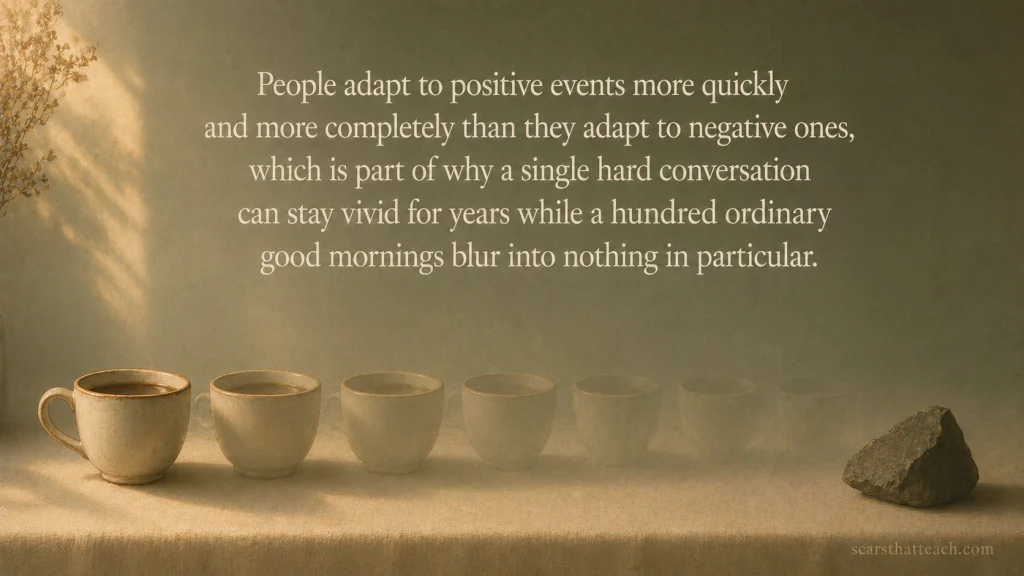
What research on this consistently finds is that the two do not adapt at the same speed. People adapt to positive events more quickly and more completely than they adapt to negative ones, which is part of why a single hard conversation can stay vivid for years while a hundred ordinary good mornings blur into nothing in particular. That asymmetry was not a design flaw. It pointed attention toward whatever still needed solving and let go of whatever was already settled, which kept people alive in circumstances far less safe than most of daily life now. It was just never built with any concern for why an anniversary dinner that once felt extraordinary can start to feel like any other Tuesday.
What Actually Disrupts the Pattern
Most explanations stop at naming the phenomenon, which leaves a person knowing why something faded without knowing whether anything can be done about it. Something can. The research on hedonic adaptation prevention points to two distinct disruptors, and neither one involves manufacturing a new positive event to chase the feeling of the last one. The first is variety. The second, and the more reliable of the two, is deliberate attention.
Attention works because habituation is really habituation to a pattern, not to the thing itself. The brain stops registering a familiar positive experience as the familiar version of it repeats, but it tends to wake back up the moment something asks it to notice a particular quality of that experience rather than the general shape of it:
- Naming one small detail about a familiar moment instead of registering it as a whole.
- Noticing what would be missing if the good thing were suddenly gone, rather than only noticing it while it is present.
- Changing the order, timing, or setting of something familiar instead of repeating it identically.
- Describing the experience to someone else in concrete terms, instead of summarizing it in one word.
What people tend to get wrong is assuming the fix is simply more of the same thing: a nicer dinner, a longer trip, a more impressive milestone. That approach treats the fading as a size problem, when it is actually an attention problem, and scaling an experience up tends to adapt on roughly the same timeline as the smaller version did. I sat with people who had reached genuinely remarkable milestones, the kind most people spend a lifetime working toward, and watched the shine wear off in a matter of months, the same way it had worn off everything before it. The thing that slowed it down, on the rare occasions anything did, was never doing more. It was paying closer attention to less.
Why Noticing It Happening Is Most of the Work
None of this means the good thing was never really good, or that something is wrong with you for no longer feeling the original spark every single time. The mechanism is built into how attention works, not a personal failure of gratitude or appreciation. What it does mean is that the fading is not permanent or automatic in one direction. It can be interrupted, in small, ordinary ways, more easily than most people expect.
If you want to go further into where this fits among the other ways small things carry lasting weight, the closer look at finding real joy in small, ordinary things covers the rest of what is worth knowing. And if the practical side of slowing this down is what you are after, how to actually savor an ordinary moment goes further into the specific practice of it.
FAQs
🤔 Why do we stop noticing the good things in our life?
Because the brain is wired to pay closer attention to what is new or uncertain than to what is calm and familiar. Good things tend to settle into the background once they stop changing, which is a known pattern called hedonic adaptation, not a sign of ingratitude.
🏡 Why does a new home or relationship stop feeling exciting after a while?
The mind adapts to whatever becomes consistent, treating it as the new baseline instead of something worth actively registering. The thing did not get worse. Attention simply moved on to whatever felt unresolved or new instead.
⚠️ Is hedonic adaptation the same thing as taking things for granted?
They describe a similar experience, but hedonic adaptation is the underlying mechanism, while taking something for granted is the everyday phrase people use to describe how that mechanism feels from the inside.
🔁 Can you actually reverse hedonic adaptation?
Not permanently, since some degree of adaptation is normal and even useful. What you can do is slow it down, mainly through deliberate attention to particular details rather than chasing more of the same experience.
🎯 Does doing something bigger help you appreciate it more?
Usually not for long. Scaling something up tends to adapt on roughly the same timeline as a smaller version of it, since the fading is about attention, not about scale.
👀 What is the simplest way to start noticing good things again?
Pick one familiar good thing and name a single exact detail about it instead of registering it as a whole. That small shift in attention is usually enough to make it feel noticed again, at least for a while.