The grief that comes with being estranged from an adult child is one of the loneliest kinds of loss I encountered across two decades of hospice work. It does not have a name in the way that bereavement does. There is no card for it, no ritual, no established language for what a parent carries when their child is alive and will not be in contact with them. What follows is not a roadmap to reconciliation and not an assessment of who was right. It is an honest account of what this kind of loss looks like, why it is so hard to hold, and what I can and cannot say about living with it.
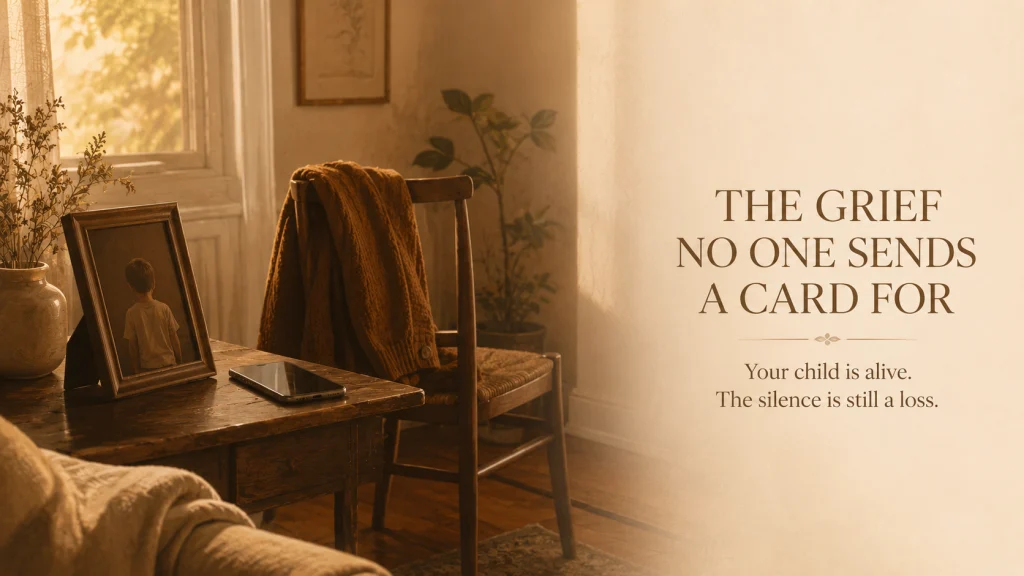
The Grief That Has No Card
Parents of estranged adult children carry something that the people around them often cannot locate on any familiar map of loss. I sat with many of them over the years, not always in the context of their own dying, but sometimes in the context of a spouse’s, where an adult child’s absence from the room became one of the central facts of the deathbed. The phone that sat on the nightstand and did not ring. The seat that had been prepared and remained empty. The question, offered quietly at some point in the vigil, of whether to try again. The hope that had not fully gone out even after months or years of silence.
This is not a marginal experience. According to research from the Cornell Family Estrangement and Reconciliation Project, led by sociologist Karl Pillemer, roughly 27 percent of Americans report being estranged from at least one family member, which translates to approximately 67 million people. Of those, around 10 percent reported estrangement specifically from a parent or child at the time of the survey. That is an estimated 25 million people holding some version of this loss at any given moment, most of them without a recognized framework for it and without much social support.
The numbers do not capture what the loss feels like from inside it. They do not capture the specific texture of this kind of grief: that the person is alive, that contact is theoretically possible, that the silence is not permanent in the way death is permanent, and that this ambiguity, rather than making the loss easier, often makes it harder.
Why This Loss Is So Difficult to Name
When someone dies, the world around them adjusts in ways that are imperfect but at least present. There are rituals. There is language. People bring food, send cards, acknowledge the loss in ways that signal to the grieving person that what they are feeling has a shape that others can recognize. The structures are inadequate in all the ways grief always exceeds structure, but they exist. They provide at least some acknowledgment that something real has ended.
Estrangement has none of that. Grief researcher Kenneth Doka identified a category he called disenfranchised grief: loss that society does not officially recognize, leaving the grieving person without ritual, condolence, or social permission to mourn. Family estrangement falls squarely into this category. There is no bereavement leave for a living child who does not call. There is no casserole dropped off for the parent who has not spoken to their son or daughter in three years. The loss exists, it is real, and it is largely invisible to the social structures that exist to help people grieve.
Psychologist Pauline Boss gave this a second name: ambiguous loss. The term refers to grief that occurs without closure or finality, where the person who is gone is not definitively gone. A child who is estranged is alive. They are somewhere. Contact, in theory, remains possible. The loss does not have an endpoint. This ambiguity does not soften the grief. In many cases, it intensifies it, because the question of whether it could change never fully resolves, and the cycle of hope and disappointment can extend for years or decades.
What I watched happen in the rooms I sat in is that people who tried to share this grief were often met with a specific kind of response that made things worse without intending to. The responses fell into recognizable patterns.
- “But what did you do?” The assumption, made instantly and often without malice, that estrangement must be explained by something the parent did wrong. Sometimes that is true. Often the reality is more layered than any single explanation can hold. But the question, whatever its intent, lands as an accusation at the moment a person is already in pain.
- “Have you tried reaching out?” As though the parent had not tried. As though the silence were a communication problem rather than a deliberate boundary being maintained.
- “I’m sure they’ll come around.” Said to comfort. Received as a dismissal of the possibility that this might not be temporary, and of the grief that belongs to that possibility.
- “Family is everything. They’ll realize that eventually.” This one is particularly hard, because it carries inside it the implication that the parent’s child has gotten something wrong, and that the parent’s job is to wait for the child to figure it out. It reassures without acknowledging, and it leaves the parent nowhere to put the grief that exists right now, in the waiting.
None of these responses come from cruelty. They come from a cultural discomfort with a loss that does not fit any of the available categories. The people around a grieving parent often do not know what to say, and so they say the thing that sounds most like comfort, which turns out to be a shape that does not fit.
What Carrying This Grief Actually Looks Like
I am not in a position to know what happened between any parent and the adult child who has chosen distance. The reasons for estrangement vary enormously, and they are not mine to evaluate. What I can describe is the pattern of what I observed across many different families, in different stages of the grief, stripped of the specific names and circumstances that do not belong to me to share.
One thing I saw consistently was the rehearsal. Parents who had not spoken to their children in months or years would describe, sometimes unprompted, the conversations they had been preparing in their heads. What they would say if the phone rang. How they would not push. How they would keep it short so as not to make things worse. How they had gone over it enough times that the words felt worn smooth from handling. The conversation had not happened. The rehearsal of it had become a kind of private ritual to fill the space where contact would have been.
Another thing I saw was the social editing. Parents who had learned to give the shorter version of the story in social settings: their child was busy, or they had grown apart, or it was complicated. The full version was not something most settings could hold, and most parents had learned that quickly. The abbreviated version protected them from the responses that hurt, but it also meant carrying the real weight of it in private, without the relief that comes from being witnessed. That isolation compounded the grief in its own quiet way.
Holidays surfaced it in particular. Not because the parent had necessarily expected the day to go differently, but because the day had a shape that made the absence more visible. A family gathering that had once included a child and now did not. A phone that other people were calling and that did not include this particular number. The comparison between how the day looked to other people and what was actually being held in the room.
What I want to be careful about here is this: I am not describing these patterns to assign them a cause, or to suggest that the adult child was wrong to create the distance. Both things can be true at once. A parent can be in genuine grief over a loss they experience as devastating, and an adult child can have had legitimate reasons for establishing the boundary that created it. The grief I am describing belongs to the parent. What belongs to the adult child is not mine to speak to here, and I will not try.
What I Cannot Promise, and What Might Still Help
Most of what exists for parents in this situation is split between two categories. The first is clinical research summaries: prevalence data, risk factors, typologies of estrangement. Useful for understanding the landscape, not much help for getting through a Tuesday in the third year of silence. The second category is community and program funnels, peer support groups and online memberships organized around shared experience. These can provide genuine value, particularly the relief of being with other people who do not need the loss explained. But they are not the same as sitting with the grief in a way that does not immediately organize it into a program or a pathway.
What I cannot promise is reconciliation. I cannot tell a parent that if they do the right things, the estrangement will end. I do not know that. The research on reconciliation is careful not to offer guarantees, and two decades of sitting with families at the end of life taught me that some rifts do not close, even when everyone involved would have wanted them to. A parent who holds out for reconciliation as the only acceptable outcome can spend years in a kind of suspended state, unable to grieve fully because they are still waiting, and unable to stop waiting because the loss is not final.
What I observed was that the parents who found a way to hold the grief with a little more room around it were not necessarily the ones who reconciled or who let go of hope. They were the ones who had found some way to acknowledge the loss as a loss, to grieve it as the real thing it was, rather than framing it entirely as a problem to be solved. That is not the same as giving up. It is the difference between being inside the grief and being consumed by it.
For parents whose grief has become severe, or where the loss is layered with other difficulties, professional support is the right resource. A therapist who works specifically with estrangement and ambiguous loss can offer something that no article can: sustained, individual attention to a situation that deserves it. The question of reconciling with a dying parent from the adult child’s side is addressed in a separate place on this site, for those who may be navigating both sides of this grief.

Final Thoughts: What Sitting With This Actually Requires
The grief that parents of estranged adult children carry is real. It does not need a cause assigned to it to be real. It does not need to be resolved to be acknowledged. And it does not need to be hidden because the social world around it does not quite have a place for it yet.
I have sat with parents who never received the call they were waiting for. I have also sat with parents who did, sometimes late, sometimes in circumstances no one would have chosen. Neither outcome erased the years of grief that came before it. What the grief needed in both cases was not a resolution. It needed to be treated as the serious loss it actually was, by the person carrying it if no one else.
That is the only thing I know how to offer with any confidence: that the loss is real, the grief belongs to you, and what you do with it does not have to be organized around the hope of an ending. You can carry it and still live inside the years that are passing. That is not a small thing. It is, in fact, the thing.
The broader dynamics of difficult family relationships, including the patterns that can lead to estrangement, are explored in the section on toxic family members. Pillemer’s research identified money and inheritance as among the most common fault lines in families; for those carrying that particular strain alongside everything else, there is a separate piece on a family member who keeps asking for money. And for the kind of hard-won perspective that tends to survive long years inside complicated families, there is more in the collection of wisdom on toxic relationships.
FAQs
💔 How do you grieve an estranged adult child who is still alive?
The same way you grieve any loss that has no clear endpoint. You name it as a loss, even when the social world around you does not have a ceremony for it. You allow yourself the grief without requiring it to resolve first. And you try not to hold the whole weight of it alone, whether that means a trusted person in your life, a therapist familiar with ambiguous loss, or others who carry something similar.
🔇 What is it called when your adult child cuts off contact?
Researchers call it family estrangement. The grief that follows is often described as disenfranchised grief, loss that society does not formally recognize, and as ambiguous loss, grief without closure or finality. The child is alive. Contact is theoretically possible. That ambiguity, rather than making the loss easier, often makes it harder to process.
❓ How common is estrangement between parents and adult children?
More common than most people realize before they experience it. Research from the Cornell Family Estrangement and Reconciliation Project found that about 10 percent of Americans reported being estranged from a parent or child at the time they were surveyed. That is roughly 25 million people. Most of them are not talking about it openly.
🔄 Will my estranged adult child ever come back?
I cannot tell you that. Some do. Some do not. Some contact is re-established and does not hold. The research on reconciliation is honest about the uncertainty. What I can say is that organizing your life entirely around that answer, while understandable, tends to keep the grief from ever being processed as the real loss it is in the meantime.
🧠 Should I see a therapist for estrangement grief?
If the grief is severe, persistent, or affecting your daily functioning, yes. A therapist who works specifically with ambiguous loss or family estrangement can offer sustained, individual attention that no article or peer community can fully replace. This is one of those situations where professional support is genuinely the right resource, not a last resort.