Most people who want to know how to build a gratitude practice that lasts assume the problem is consistency, so they buy a nicer notebook and try harder. The real reason these practices fade has less to do with willpower and more to do with what they ask you to write. I have watched the difference between a practice that survives a hard season and one that quietly disappears after three weeks, and it almost always comes down to two things: specificity, and whether the practice leaves room for what is actually difficult. This piece walks through what the research on gratitude journaling actually supports, where the standard advice falls short, and what a version of this looks like that can hold up under real pressure.

Why a Notebook Was Never What Made It Last
If you have wondered how to build a gratitude practice that lasts longer than a few enthusiastic weeks, the answer rarely lives in the notebook itself. In twenty years of sitting with people near the end of their lives, I watched dozens of them talk about what they were grateful for, and almost none of them credited a journal for teaching them that. What stayed with people was not the page. It was the habit of noticing one specific thing they had stopped seeing, until noticing it became as automatic as checking the weather.
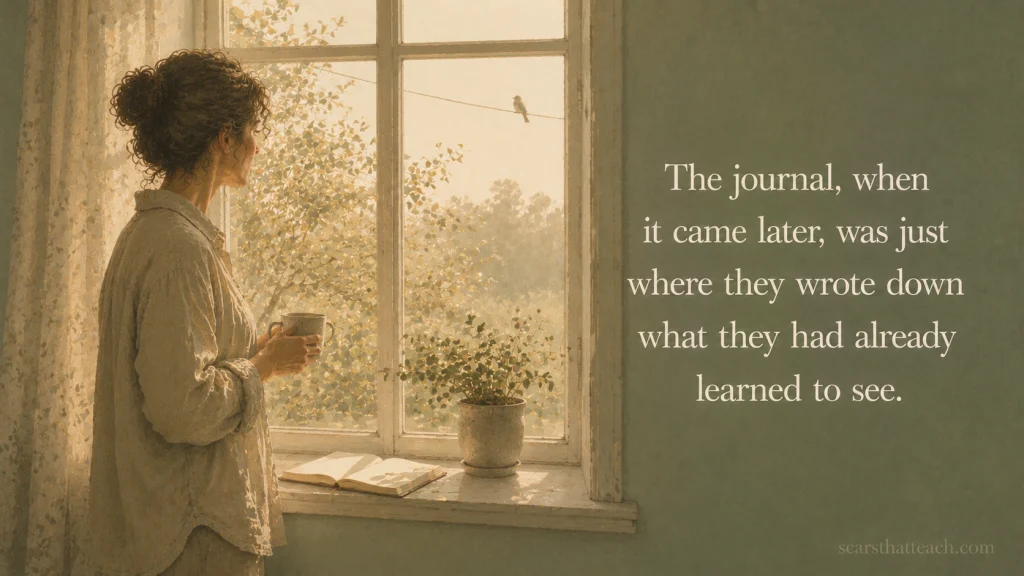
The pattern showed up often enough that I stopped thinking of it as a coincidence. The people whose gratitude held up under real pressure, illness, grief, the slow erosion of getting older, were almost never the ones who started by listing five things every night. They were the ones who started by paying close attention to one ordinary thing they had stopped noticing: a particular sound their house made in the early morning, the specific way someone they loved laughed at something that was not even funny. Once that single thing became visible to them again, it tended to multiply on its own. The journal, when it came later, was just where they wrote down what they had already learned to see.
What the Research on Gratitude Journaling Actually Shows
Robert Emmons, the psychologist who has spent the most time studying this directly, found something similar when he and his colleague Michael McCullough tracked adults who kept weekly gratitude journals against a group who tracked daily hassles instead. The gratitude group exercised more, reported fewer physical complaints, and felt more optimistic about the week ahead than the comparison group did. A separate three-week trial with adults managing a chronic illness found a close version of that same pattern: more energy, a stronger sense of connection to other people, and better sleep, compared with those who did not keep the practice. None of this required a perfect routine. It required a sustained one.
The Greater Good Science Center at U.C. Berkeley, where much of this research has been gathered and explained for a general audience, lists effects in that same range: grateful people sleeping more hours each night, falling asleep faster, and feeling more refreshed upon waking, alongside higher levels of positive emotion. None of these findings claim that gratitude erases hardship or repairs a relationship on its own. What they show, more modestly and more usefully, is that consistent attention to what is good changes something measurable in a fairly short amount of time. That is worth taking seriously without overselling it into something it was never meant to be.
The Difference Between Specific and Generic Gratitude
Almost every set of gratitude practice tips online says some version of the same thing: write down three things you are grateful for before bed. That advice is not wrong. It is just incomplete, and the incompleteness is exactly where most practices quietly die. Clinical writing on this subject draws a clear line between two kinds of gratitude: a broad, abstract kind, such as “my family” or “my health,” and a specific kind tied to one particular moment, person, or detail. The specific kind is what tends to survive past the first few weeks, because there is something the mind can actually picture.
A man I knew used to write “my grandchildren” in his notebook most nights, and after a few weeks the words had stopped meaning anything to him. They had become wallpaper. What changed things was not abandoning the practice. It was narrowing it: one Tuesday phone call with one grandchild, the specific joke they told, the exact tone of their laugh coming through the line. That version of gratitude was harder to write and far less likely to go stale, because it asked him to notice something true instead of recycling a category he had stopped feeling.
The Mistake That Quietly Turns Gratitude into Performance
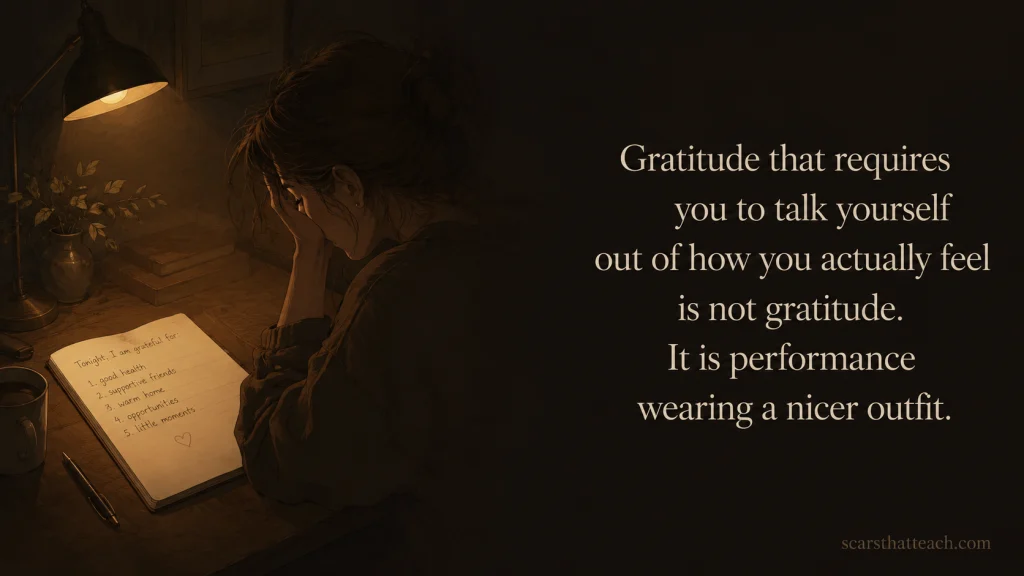
The second condition matters just as much and gets ignored more often: a gratitude practice that requires you to push past or talk yourself out of a difficult emotion before you are allowed to feel thankful is not actually gratitude. It is suppression wearing a nicer outfit. Clinicians who work with this directly describe a healthier version that holds both truths at once: notice what is hard first, without editing it down, and only then notice what you are grateful for alongside it, not instead of it.
The gratitude that survives is the kind that lets the hard thing speak first, then makes room for what is good anyway.
People get this backward for an understandable reason. Gratitude has been sold for years as a mood fix, something you reach for specifically to stop feeling bad, which sets up the exact failure it is supposed to prevent. A caregiver I sat with once kept a strict three-things-a-night practice through her husband’s decline, then stopped midway through because every entry felt like a small lie she was telling herself about how the day had actually gone. What worked better, when she returned to it months later, was naming the hard thing first, out loud or on paper, before reaching for what she was grateful for. The two did not cancel each other out. They sat in the same room without either one needing to win, because naming the hard part first took the pressure off needing the rest of the day to feel resolved, which left room for whatever good was sitting next to it anyway.
If you have already tried something like this and watched it fall apart anyway, you are not the exception. There are specific reasons a gratitude practice can stop working before it has a real chance to take hold, and most of them have nothing to do with how much willpower you started with.
Gratitude Practice Tips That Actually Hold Up
None of this means starting over from nothing. It means changing what you ask the practice to do. A sustainable gratitude practice is built around noticing, not performing, and that single shift changes what an entry actually looks like once you write it down. In practice, that shift tends to look smaller than expected:
- Not “my health,” but the specific morning your knee did not hurt enough to notice it
- Not “my partner,” but the exact thing they said that made you laugh on a hard day
- Not “today was good,” but the ten minutes that made the rest of the day worth getting through
- Not a forced positive spin on a bad day, but the hard part named honestly, followed by whatever sat next to it
None of these examples take more time than the generic version did. They simply ask for more attention to one true detail instead of a wider, vaguer net. That shift alone is usually what separates a practice that survives a difficult season from one that quietly stops getting opened. If you want the fuller breakdown of why a gratitude practice quietly stops working for so many people, that piece goes deeper into the patterns behind it.

Final Thoughts: What Lasts Is What You Actually Notice
I do not think a gratitude practice fixes grief, or a strained relationship, or the fear of running out of time. I sat with too many people for whom none of those things resolved cleanly to promise you otherwise. What it can do, when it survives past the first few weeks, is give you a frame for something you were already carrying without language for it. Some of the people I sat with kept a single line nearby for exactly that moment, the kind found in short lines about happiness people return to on hard days, taped inside a cabinet door or folded into a wallet. Not because it explained anything. Because it caught something they already half knew and needed reminding of.
If your own version of this falls apart in a week, that does not mean you are bad at gratitude. It usually means the practice was built for a generic list, not for the specific, sometimes uncomfortable shape of your actual life. Start smaller than feels productive. Notice one true thing instead of three vague ones. Let the hard parts sit in the room too. That is the entire difference between a practice that fades and one that lasts.
FAQs
🌱 How do I start a gratitude practice that actually sticks?
Start with one specific thing instead of a list of three or five. Notice that one thing for a week before adding anything else. Specificity, not structure, is usually what keeps a practice alive past the first few days.
📓 Why does my gratitude journal feel fake or forced?
That usually means the entries have drifted into broad categories like “my family” or “my health,” which stop feeling true after a while. Naming one exact moment instead of a category tends to fix this almost immediately.
⚖️ What is the difference between gratitude and toxic positivity?
Gratitude can sit alongside a hard feeling without erasing it. Toxic positivity asks you to replace the hard feeling with a positive one instead. If a practice requires you to talk yourself out of how you actually feel first, it has crossed that line.
⏳ How long does it take for a gratitude practice to make a difference?
Some of the research behind this points to noticeable changes within a few weeks of consistent practice, including better sleep and more positive mood. A few weeks of real attention tends to matter more than months of a half-hearted list.
✍️ What should I write besides the same three things every night?
Write the one detail from the day you would actually miss if it disappeared. That is almost always more specific than “my health” or “my job,” and it is much harder for a detail like that to start feeling hollow.
💭 Is it normal to feel grateful and sad at the same time?
Yes, and naming both honestly tends to make the gratitude feel more real, not less. Forcing yourself to feel only one of those things is usually where a practice quietly starts to break down.