When a parent who hurt you is dying, something happens to the decision you thought you had already made. The estrangement that felt settled last year suddenly feels like a question again. Not because anything has changed between you and them, but because the window for it to change is closing. This is one of the harder situations I watched people navigate, and it is harder in a specific way that most of the available advice does not capture: it pulls in two directions at once, and both of them are real.
What the Room Actually Looks Like
I have sat in rooms where adult children arrived at a dying parent’s bedside carrying hope I could almost see on them. Not hope that the parent would survive. Hope that something between them would finally shift. That the proximity to death would do what years of distance could not. That the parent would say the thing they had never said, and that it would matter in the way the child had always needed it to.
Some of those rooms went the way the child hoped. Not often, but it happened. A parent who had spent decades being withholding said something real in the last days, and the adult child left carrying something they had not arrived with.
More often, that is not what happened. The dynamics that had shaped the relationship for thirty or forty years did not lift because the parent was dying. They compressed. A parent who had always managed the family through guilt found ways to do it from a hospital bed. Siblings who had been set against each other for years did not suddenly find common ground at the bedside. The adult child who arrived hoping for acknowledgment left without it, and had to grieve not just the parent but the possibility they had let themselves believe in.
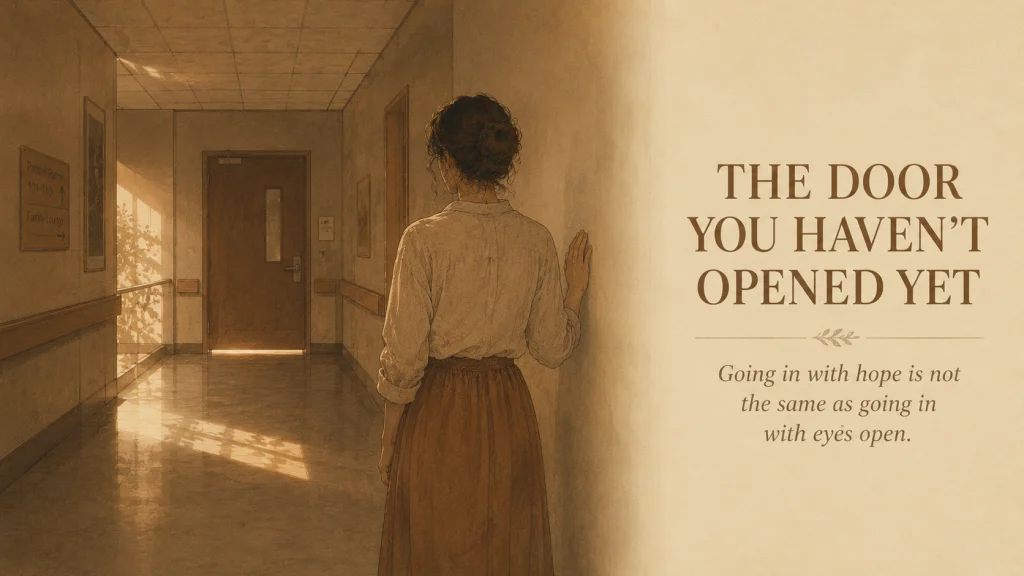
That is not a reason to stay away. It is a reason to go in with your eyes open, which is the only thing this can offer you.
Why Dying Pulls People Back
The pull toward reconciliation when a parent is terminally ill is not irrational. It makes human sense. Death is finite, and most people know on some level that unresolved things do not resolve themselves after someone is gone. The opportunity closes. Whatever was unsaid stays unsaid permanently, and that permanence carries a different weight than distance does.
There is also something about mortality that genuinely does change people, sometimes. A person who spent their life performing strength will occasionally let it go near the end. Someone who never apologized finds the words when the armor gets too heavy to carry. These things happen. I watched them happen. The mistake is not in hoping for them. The mistake is in building the decision around the hope rather than around an honest read of the person you actually know.
The pattern that sends adult children back to estranged parents on deathbeds is not simply love, though love is usually part of it. It is also guilt, which is not the same thing. Guilt that says: I will regret this if I do not go. Guilt that says: whatever they did, they are still my parent, and there is something wrong with me if I cannot find it in me to show up. Guilt that says: what will other people think if I am not there.
These are real pressures. They deserve to be named honestly, because conflating them with genuine desire for reconciliation is exactly how people end up in rooms they were not ready for, hoping for things the situation could not deliver.
What Dying Does Not Do to a Difficult Person
There is a version of this that almost everyone who has not watched it up close tends to believe: that dying equalizes people. That facing the end softens what was hardened, repairs what was damaged, brings out the essential person underneath the behavior. That the difficult parent becomes, at the last, someone easier to be in a room with.
Sometimes this is true. I have watched it. What I have watched more often is that dying amplifies what was already there. A person who managed their family through control, who had always been the center of gravity in the room and resented anything that shifted that, tends to find ways to hold that position even from a hospital bed. A parent who made their children feel responsible for the parent’s emotional state does not typically stop doing that because their body is failing. The mechanism has been in place for decades. Mortality does not dismantle it.
What this means practically is that the adult child who walks into that room hoping the dying parent will finally see them clearly, finally offer what they withheld for decades, is walking into a situation where the odds are not in their favor. That does not mean it cannot happen. It means the decision about whether to go cannot rest on that hope.
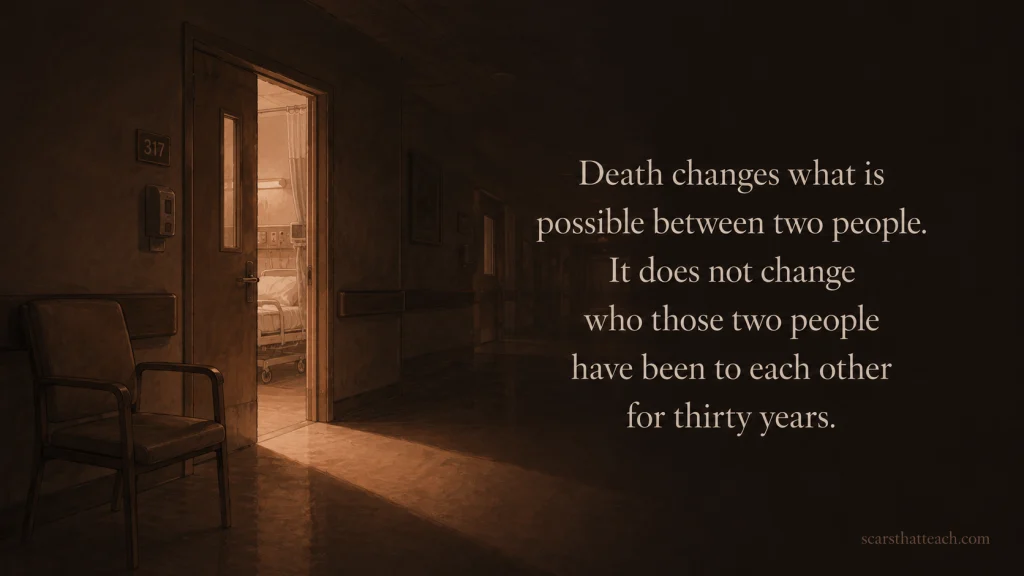
“Death changes what is possible between two people. It does not change who those two people have been to each other for thirty years.”
The question worth sitting with before you decide anything is not “what if they’ve changed?” It is “what do I need from this, and is it something this situation can actually give me?” Those are different questions, and the second one is harder to answer honestly.
Why the Existing Advice Does Not Help
The content that exists on this topic tends to split into two camps that do not talk to each other. One camp advocates for reconciliation, usually from a mediation or coaching perspective: life is short, you will regret it if you do not try, no relationship is beyond repair. The other camp validates estrangement, usually from a support perspective: you protected yourself for good reasons, your peace matters, you do not owe a difficult parent access to you just because they are dying.
Both of these positions contain real truths. Neither of them is much use to the adult child standing in the middle of it, because both of them are asking the wrong question. Reconciliation advocates ask: can you find it in you to go? Estrangement validators ask: do you owe them this? The question most people are actually asking is quieter and more specific: what is going to be true for me in a year, or in ten years, whichever version of this I choose?
That question does not have a universal answer. I have watched people go to a dying toxic parent’s bedside and come away with something worth having. I have watched people go and come away with new wounds and confirmed everything they had worked hard to accept. I have watched people stay away and find that decision easier to carry than they expected. I have watched people stay away and carry the weight of it for the rest of their lives. The decision is yours, and it depends on things only you know about the specific history between you and this specific parent. The patterns I can describe from two decades of watching these situations play out are not a formula. They are, at best, a clearer frame for the decision you already have to make.
For broader context on how these dynamics tend to take shape across a family, the patterns in what makes toxic family members so difficult to leave map directly onto what happens when one of them is dying.
What to Actually Ask Yourself Before You Decide
The generic version of this question is: will I regret it if I do not go? That is not a bad question, but it is not precise enough. Regret takes specific forms. The regret of having stayed away is different from the regret of having gone and found nothing there. Only you know which one you are more likely to carry, and that depends on knowing yourself honestly, not on what either camp tells you you should feel.
- What are you hoping this visit changes? If the answer is something the parent controls, specifically: whether they apologize, whether they acknowledge what happened, whether they finally treat you differently, then you are handing the outcome of this decision to someone whose behavior you have not been able to predict or influence for your entire life. That is a real thing to know before you walk in the door.
- What does going actually cost you? Not in a guilt-accounting sense. Practically: do you have children you would have to explain this to, a spouse who would need to navigate it with you, a recovery period that has real timeline consequences? The cost is not a reason to stay away, but it is a real part of the decision, and it deserves to be weighed honestly rather than dismissed as selfishness.
- Can you go without needing anything from them? There are people who genuinely can show up at a dying parent’s bedside to say goodbye without requiring the parent to give them anything in return. If you are one of those people, that is worth knowing. It means the visit can be on your terms rather than on the hope that their terms have finally changed. If you cannot do that honestly, that is also worth knowing.
- What does staying away actually protect? Not in theory. Specifically. The answer might be something real: your mental health during a period when you are already managing something fragile, a boundary you have held at significant cost, a decision you made carefully and not impulsively. Or the answer might be something less clear. Knowing which one it is helps.
- Is there a version of this that is not all or nothing? Going does not have to mean returning to a full relationship or pretending the estrangement did not happen. Staying away does not have to mean forever or indifference. Some people show up once, briefly, for reasons that belong to them and not to the parent. Some people write a letter that gets read at the bedside without their being there. These are real options, and the fact that the two-camp framing does not talk about them is one of its real limitations.
None of these questions answer the decision for you. That is on purpose. What they can do is help you separate the pressures that are coming from outside, from what other people expect or what you think you are supposed to feel, from the things that are actually yours.
What People Most Often Get Wrong
The most common mistake I watched people make in this situation was deciding to go on the basis of hope and deciding to stay away on the basis of protection, without being honest with themselves about which of those motivations was actually driving the decision. Neither of those is a moral failure. They are both extremely human. What follows is not a judgment on either choice. It is an observation about what tends to happen when the stated reason and the real one do not match.
A person who goes primarily because they are afraid of how they will look to other family members if they do not, and tells themselves it is because they want closure, is likely to come away from the visit confused about why it did not deliver what they hoped for. The confusion comes from the mismatch. They went looking for something from the parent when the actual driver was managing their own image in the family. Those are different situations requiring different things, and the visit cannot serve both at once.
Equally, a person who stays away primarily because going is uncomfortable and frightening, and frames that as a boundary set for their own protection, is likely to carry the decision differently than they expect. Discomfort and protection are not the same thing. Staying away because you genuinely cannot afford the impact of that environment on your current wellbeing is a real reason. Staying away because the room frightens you, and naming it as something else, tends to leave a residue that does not clear as cleanly. Not because the choice was wrong. Because the reasoning was not quite honest, and we tend to know the difference.
The problem is not making the “wrong” choice. The problem is being unclear about why you are making the choice you are making, because that clarity is exactly what allows you to carry whatever comes afterward.
What Comes After, Regardless of What You Decide
One thing I want to say plainly, because it tends not to appear in either camp’s version of this: the grief after a toxic parent dies is specific. It is not always less than the grief after an uncomplicated relationship ends. In some cases it is harder, because it carries both the loss of what existed and the loss of what never did and now cannot. If you reconciled and it went badly, you may be grieving both the parent and the hope you brought to the room with you. If you stayed away, you may be grieving a relationship that in reality ended years or decades ago but that you had not fully acknowledged as over until now.
That kind of grief does not follow the standard template, which is part of why people who carry it often feel like they are doing it wrong. They are not. They are grieving something genuinely complicated, and they need a frame for it that acknowledges the complication rather than smoothing it over into something tidier.
What I observed, across many of these situations over twenty years, is that the people who came through this most intact were not the ones who made the “right” decision about whether to go. They were the ones who were honest with themselves about why they made the decision they made, and who did not spend the years afterward trying to retroactively justify it. The decision about what to do before a toxic parent dies is one part of a longer reckoning. Whatever you decide, you will carry the rest of it. Being clear-eyed about what you are carrying, and why, is not a small thing.
If the weight of this specific situation is more than you can sort through on your own, working with a grief counselor or a family therapist who has experience with estrangement can help. Not because there is a professional answer to this question, but because the grief that follows this situation, in whichever direction you go, is real and often complicated enough that having a place to bring it matters. The dynamic this touches on, particularly if there are siblings navigating it alongside you, is one I have written about at more length in the context of what people say about toxic relationships when they have had enough distance to see them clearly.
What This Is and Is Not
This is not an argument for reconciliation, and it is not an argument against it. I am not the person who gets to decide what you owe a dying parent who hurt you. Nobody is, except you.
What I can tell you, having sat with hundreds of people as they worked through the aftermath of decisions like this one, is that the quality of the decision matters less than the honesty behind it. People who went and were clear about why they went tended to be able to hold the experience, whatever it contained. People who went looking for something specific from someone who had never given it to them, and came away without it, tended to carry that in a way that did not resolve easily. People who stayed away and knew exactly what they were protecting came away from that choice differently than people who stayed away and were never quite sure.
You know this parent. You know what you have needed from them that they have not given you. You know what it costs you to be in a room with them, and you know what it costs you to keep your distance. Whatever you decide, go in knowing why. That is the only part of this that I am confident about, having watched it from as many angles as I have.
If you are working through the broader question of what happens to estranged adult children when a parent is dying, the parent’s-side counterpart to this situation is one I have examined separately in what estranged parents carry, which holds a different set of observations from the same bedside.
FAQs
❓ Should you visit a toxic parent who is dying even if you are estranged?
There is no universal answer. The decision depends on your specific history with this parent, what you genuinely need from the visit, and whether you can go without handing the outcome to someone whose behavior has been unpredictable or harmful for decades. Going out of guilt tends to produce a different result than going with clarity about why you are going.
💭 Will I regret not visiting an estranged parent before they die?
Some people do. Some people find the decision easier to carry than they expected. What I have observed is that regret is more likely when the decision was made on unclear grounds: when someone stayed away primarily out of fear and framed it as protection, or went primarily out of social pressure and framed it as a choice. Clarity about your actual reasons tends to make the decision, in either direction, more bearable afterward.
😔 Do people change before they die, even if they were toxic?
Sometimes. I have watched it happen. More often, the patterns that defined someone for decades do not lift because their body is failing. A parent who managed their family through control or guilt tends to find ways to continue doing that from a hospital bed. Going in hoping for change is understandable. Building the decision around that hope, without an honest read of the person you actually know, tends to lead to harder rooms.
🧩 What if my siblings want me to reconcile with our dying parent and I do not want to?
Siblings pushing for reconciliation when a parent is dying is one of the most common pressures in this situation, and it is worth naming separately from your own feelings about the parent. Your siblings’ need for the family to appear unified at the end is real, but it is their need. It is not a reason to do something you are not ready for. Their distress about your choice is understandable. It is not the same as their being right.
🌀 How do you grieve a toxic parent who has died?
With the understanding that this grief is not simple, and that the fact that it is complicated does not mean you are doing it wrong. You may be grieving both the person who died and the relationship that never existed. Both of those are real losses. The grief after a difficult or estranged parent dies often does not follow the shape people expect, and it tends to go easier when you stop trying to make it fit a cleaner template than the relationship actually had.
🛡️ Is it okay to stay away from a dying parent who was abusive?
Yes. There is no obligation that overrides genuine harm. If going would put your mental health or your safety at risk, or if there is a history of abuse that has not been addressed, staying away is not a failure of character. If you are navigating a situation involving active danger, please reach out to a professional rather than working through it alone. This is a question about your wellbeing, not only about what you owe someone else.