
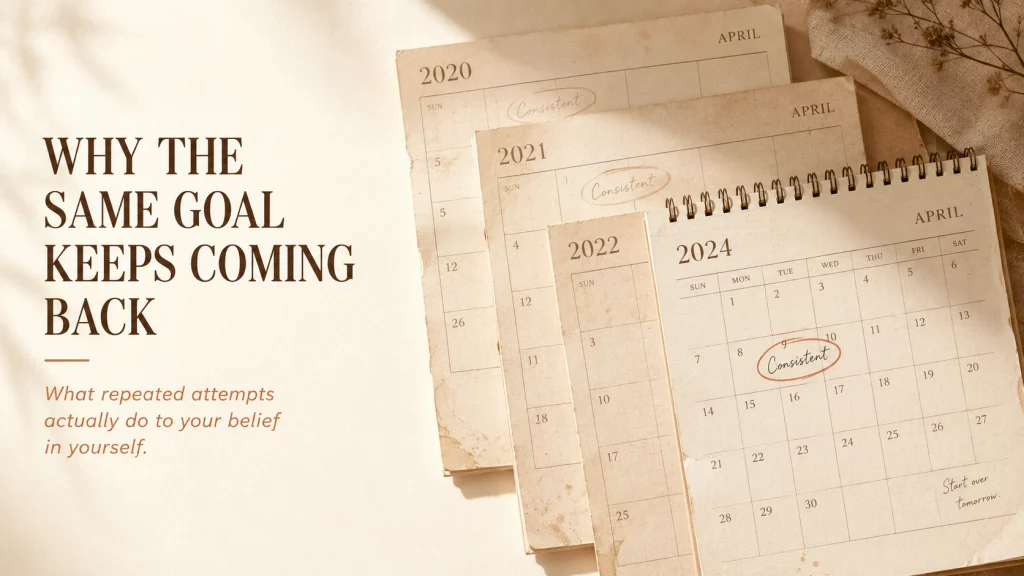
If you keep setting the same goal every year and never finishing it, the honest question is not why you lack discipline. It is why the fifth attempt at something keeps starting from the same place as the first. Each abandoned try leaves a mark on how much you believe you can actually pull it off, and that quiet erosion, not a fresh lack of motivation, is usually what is repeating. Understanding that shift changes what the next attempt needs to look like.
The Goals People Mentioned Most Were Rarely the Ones They Feared
One version of the same quiet question came up more than almost any other I heard: why do I keep setting the same goals every year and never actually finish them? The goals people mentioned most often, sitting with me near the end of things, were not the ones they had been most afraid to try. They were the ones they had been telling themselves they would get to for so long that saying it out loud again had become part of the shape of an ordinary year. Lose the weight. Finally write the book. Reconnect with the brother they stopped calling. Not one dramatic failure. A quiet, repeated setting-down of the same thing, year after year, until the goal itself started to feel less like a plan and more like a ritual that never required completion.
I remember one man telling me, almost as an aside, that he had put the same line on his list every January for over a decade, the same six words, and he said it the way you might mention an old habit you no longer questioned. If that pattern sounds familiar, you already know the mechanics of it better than any outside description could capture. What is harder to see from inside it is why nothing changes from one January to the next. The answer is rarely a character flaw. It has more to do with what repeated abandonment quietly does to how much you trust yourself to finish, a mechanism worth understanding before deciding what this next attempt needs to look like.
The Shape This Cycle Usually Takes
Goal researchers who study repeat abandonment describe a fairly predictable arc. It starts with real motivation, the kind that is not faked or performed, the kind that genuinely believes this time will be different. Progress follows, sometimes real and sometimes just the feeling of momentum. Then a setback arrives, often not a catastrophic one, just the ordinary kind: a missed week, a bad month, a conflict that eats the time the goal was supposed to occupy. What happens after that setback is where the cycle either breaks or repeats. Rather than adjusting the plan and continuing, the goal quietly gets shelved, and it resurfaces later, usually around a symbolically fresh starting point, resurfaces in almost the identical form it took the last time.
What tends to get missed is the piece in between the setback and the re-setting. The conditions that produced the setback the last time, the missing plan for what to do when motivation dipped, rarely get examined or changed. A goal that returns without that examination is not a fresh attempt. It is the previous one, wearing a new calendar year.

What Repetition Actually Does to You
Here is the part that most advice on this topic skips entirely. The fifth time you set a goal is not a psychologically neutral event just because it looks identical to the first time on paper. Psychologist Albert Bandura’s research on self-efficacy, the belief in your own capacity to carry out a specific course of action, found that this belief is built primarily through direct experience. Each time you succeed at something, the belief strengthens. Each time you abandon it partway through, the belief takes a hit, and that hit does not reset when the calendar does.
This is why a goal set for the fifth time is genuinely a different psychological event than the same goal set for the first time, even when the wording on paper is identical. The first attempt begins with whatever baseline confidence you brought to it. The fifth attempt begins carrying four prior data points. Some part of your mind reads those data points as evidence, quietly, that finishing is not something you do. That lowered expectation is not something you consciously decide to believe. It operates underneath the decision, shaping how much effort feels worth investing before the outcome has even been tested again.
- You approach the task with less energy than the content of the goal alone would predict, because part of your mind is already anticipating the familiar ending.
- Early friction gets interpreted as confirmation rather than as normal difficulty, since it matches what happened the last several times.
- The goal starts to feel like something you are supposed to want rather than something you are actively pursuing, because part of you has quietly stopped expecting to finish it.
- Giving up this time takes less internal resistance than it did the first time, because the pattern of stopping has its own kind of familiarity now.
None of this means the goal is unreachable or that something is permanently wrong with your resolve. It means the standard advice, just try harder this time, is aimed at the wrong problem. Some of what actually determines whether this attempt lands differently belongs to chasing a goal versus building the system underneath it, which addresses a related but separate reason identical efforts keep producing identical results.

What Actually Needs to Change on Attempt Number Five
If the goal keeps returning in a familiar shape, the honest move is to stop treating the re-set as a fresh start and start treating it as a continuation with new information available. That information includes exactly where the plan broke down last time, not in general terms but specifically. Was it a particular week of the month, a particular kind of stress, a particular person or obligation that reliably pulled focus away? Vague recollections like it just didn’t work out are not specific enough to change anything. The setback has a shape, and most people who cycle through this pattern have never actually examined it closely enough to name it.
The date the goal gets set matters less than most people treat it as mattering. A January 1st start carries emotional weight, a sense of a clean page, but a clean page is not the same thing as different conditions. If the recurring trigger, the missed workout, the skipped budget check, the phone call not returned, tends to show up around a specific week or a specific kind of week, starting again on a symbolically significant date does nothing to address it. What actually changes an outcome is starting on the day the recurring trigger is least likely to show up, or better, starting with a plan that already accounts for it, rather than starting on a date chosen for how it feels.
The plan itself is worth looking at honestly, too. Running an identical plan a fifth time and expecting a different result treats the plan as innocent, when the plan is very often part of what produced the setback in the first place. I sat with a woman once who had tried, for six years running, to reconcile with her sister using the same opening line, delivered the same way, at the identical kind of gathering where it had failed every year before. She was not lacking sincerity. She was reusing a method that had already told her, six times, that it did not work in that setting. A goal that has failed repeatedly deserves a genuinely different approach on the next attempt, not more determination applied to the same one.
Removing friction matters more than most people expect. If the goal requires a decision every single day, willingness to decide is exactly the resource that repeated failure has already worn down. A plan that requires fewer decisions, the gym bag packed the night before, the savings transfer set to automatic, the first sentence of the letter already written, asks less of a part of you that has good reason to be running low. This is not about motivation. It is about designing the fifth attempt so that less of it depends on a resource you already know is depleted.
There is one more shift worth naming, and it is the hardest one. Somewhere across five attempts, the goal can quietly become tangled up with who you believe you are, not just what you intend to do. Finishing it starts to feel like proof you are a certain kind of person, and failing it starts to feel like proof you are not. That tangle raises the emotional cost of every attempt and makes the goal harder to approach lightly enough to actually work on it. Separating the outcome from your sense of who you are, treating the goal as something you are doing rather than something that defines you, tends to lower that cost enough to make the next attempt possible at all.
Rebuilding self-efficacy after repeated abandonment tends to happen through small, completed successes rather than through renewed ambition aimed at the same large target. A goal that has failed four times at its full size is a poor candidate for a fifth attempt at that same size. A smaller version, finished cleanly, does more to restore the belief that finishing is possible than another attempt at the original scope, even if the smaller version feels almost embarrassingly modest by comparison.
This Pattern Does Not Mean Something Is Wrong With You
I want to be direct about something, because this particular pattern tends to carry a specific kind of shame that other kinds of failure do not. Setting an identical goal repeatedly and not finishing it can start to feel like proof of a character defect, evidence that you are simply not the kind of person who follows through. That conclusion is common and almost never accurate. The mechanism described here, motivation, setback, quiet shelving, re-setting without adjustment, is close to universal. It shows up in people who are disciplined in nearly every other part of their life and in people who are not, because it is a pattern in how belief responds to accumulated experience, not a verdict on someone’s underlying character. This distinction matters more than it might seem, and it sits alongside a broader picture of what separates people who follow through, which is rarely the simple presence or absence of willpower.
Naming the pattern honestly is not the same as excusing it or pretending it doesn’t matter. It is the difference between fighting this goal for the sixth time with the same tools that failed five times before, and finally understanding what those five attempts actually did to the ground you are standing on now.
Final Thoughts
People rarely arrive at the end of their life regretting the goals they never finished nearly as much as they regret never understanding why they kept circling it without ever naming what kept pulling it back down. I think of the man with the same six words on his list every January, saying it like an old habit rather than a hope, and what has stayed with me is not the goal itself but how gently he had made peace with never reaching it, as if the not-reaching had become the point. It does not have to be the point. For anyone ready to make attempt number five smaller, more specific, and built around the actual shape of their own history, the broader questions worth sitting with live at the fuller set of goal-setting questions this touches on.
FAQs
🔁 Why do I keep setting the same goals every year and never finishing them?
Each abandoned attempt lowers your belief in your own ability to finish that specific goal, so the next attempt often starts with less confidence than the last, not less desire.
💭 Does repeatedly failing at a goal mean I lack willpower?
Not usually. The pattern is closer to accumulated self-efficacy loss than a character flaw, and it shows up in highly disciplined people just as often as anyone else.
📉 Why does the same goal feel harder each time I set it?
Because each prior abandonment becomes part of the evidence your mind uses to predict this attempt’s outcome, which quietly reduces the energy you bring to it before you have even started.
📏 Should I make the goal smaller if I keep failing at it?
Often, yes. A smaller version finished cleanly does more to rebuild confidence than another attempt at the original scope, even though it can feel like settling for less.
🗓️ Why does New Year’s seem to trigger this cycle so often?
A symbolic fresh start makes it easy to re-set the goal without examining what actually caused the last attempt to stall, which lets the pattern repeat unaddressed.