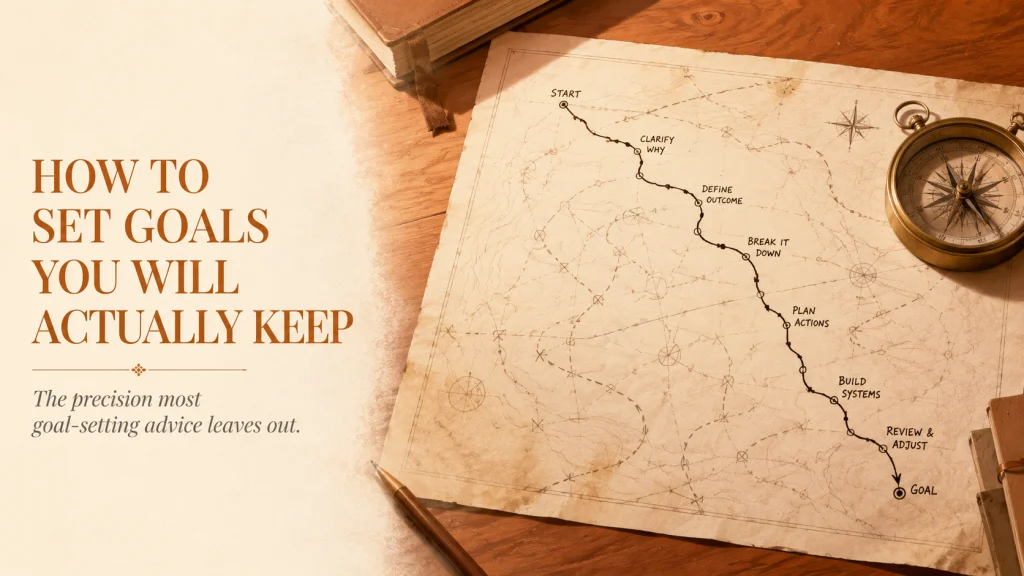
The goals I heard described with the most feeling, in twenty years of listening to people talk about their lives, were almost always the vaguest ones, and they were almost always still unfinished. Learning how to set goals you will actually keep starts with a specific, research-supported shift: trading a general wish for a precise target, then adding two things most people skip entirely. The first is deciding exactly when, where, and how you will act, in an if-then format that removes the need to decide in the moment. The second is naming the obstacle that will likely get in your way before it shows up, instead of only picturing the finish line. None of this is complicated. Most people have simply never been shown all three pieces together.
The Goals People Said With the Most Feeling Were Usually the Vaguest
I noticed a pattern over the years that surprised me the first dozen times, and then stopped surprising me at all. When someone talked about a goal with real emotion in their voice, a catch in it, the goal itself was almost always stated in the most general terms. Be a better father. Get healthy. Stop wasting time. Reconnect with my sister. These were not small wishes. They mattered enormously to the people saying them. And they were, more often than not, the exact same goals those people had been carrying, unfinished, for years, sometimes decades. The specificity was missing, and without it, the feeling had nowhere to land.
That is the part almost nobody tells you when they hand you advice about goal setting. It is not that vague goals are unimportant or insincere. It is that a vague goal gives your mind an easy way to feel like it is making progress without actually requiring anything measurable of you. Get healthy has no finish line, so almost anything can pass for a step toward it, and almost nothing ever quite counts as arriving. That gap between the feeling and the follow-through is exactly where a specific goal starts to do work that a general one never can. If you want to know how to set goals you will actually keep, that gap, and what closes it, is the whole subject worth sitting with.

Why a Specific Goal Outperforms a Well-Meant One
This is not just a hunch I formed from watching people. Researchers Edwin Locke and Gary Latham spent decades studying exactly this question, and their finding held up consistently: specific, challenging goals produce meaningfully better performance than vague, do-your-best goals. That result surprises people the first time they hear it, because do-your-best sounds generous and specific sounds rigid. But the generosity is the problem. A goal like do your best leaves the mind free to decide, privately and without much scrutiny, what counts as enough. A specific goal removes that room to negotiate. It does not ask you to try. It tells you exactly what trying looks like, and exactly how you will know if you got there.
I think about a man I sat with whose stated goal, for as long as his family could remember, was to be more present. Nobody could argue with it. Nobody could measure it either, including him. It could mean putting down a phone once, or it could mean nothing changed at all, and there was no way for him to fail at it in a way he would notice, which also meant there was no way for him to succeed at it in a way that stuck. A specific version of that same wish, something closer to having dinner at the table without the television on four nights a week, would have given him something to measure himself against. Vagueness felt kinder in the moment. It was not kinder. It was just quieter about how little it required.
The Layer That Even a Specific Goal Leaves Out
Here is where most goal-setting advice stops, and where it starts to fall short. Specificity in the outcome is necessary, but it is not sufficient on its own, and I have watched plenty of people with a perfectly specific goal still fail to move on it for months. Psychologist Peter Gollwitzer’s research on what he called implementation intentions found a second layer that matters just as much as the goal itself: deciding, in advance, exactly when, where, and how the action will happen. Not I will exercise more, and not even I will exercise four times a week, but something closer to if it is Monday, Wednesday, or Friday at six in the morning, then I will put on my shoes and walk for twenty minutes before I check my phone. The if-then structure is what does that work.
What I find most useful about this research, from where I sit, is what it explains about willpower that most people get backward. People tend to believe that failing to follow through means they lacked discipline in the moment it counted. Often what actually happened is that the moment arrived and there was a decision still waiting to be made, and decision-making under fatigue or resistance is exactly when people are worst at it. You are not relying on finding willpower at six in the morning. You already decided at a calmer hour what six in the morning would look like, and all that is left is to follow through on it.
- If I feel too tired after work to go to the gym, then I will do ten minutes at home instead of skipping the day entirely.
- If I sit down to write and do not know where to start, then I will reread yesterday’s last paragraph before doing anything else.
- If a family gathering brings up the old argument, then I will say I need a few minutes and step outside before responding.
Notice what those examples have in common. None of them assume perfect conditions. Each one already has a plan for the version of the day that does not go smoothly, because that is the version of the day that actually shows up most often.
Naming the Obstacle Before It Finds You First
There is a third piece, and it is the one people resist the most, because it feels like it is inviting failure into the room before you have even started. Psychologist Gabriele Oettingen’s research on what she called mental contrasting found that imagining the obstacle standing between you and the goal, deliberately and specifically, before you begin, produces better follow-through than picturing the finish line alone. Pure positive visualization, the kind most goal-setting content still recommends without qualification, can actually work against you. Oettingen’s research found that dwelling only on the desired outcome produces a kind of premature relief, as though the satisfaction of arriving has already been felt in advance, quietly spending the energy that was supposed to fuel the actual work.
A woman I spoke with had a goal to finally finish the degree she had left unfinished thirty years earlier. She could describe, in vivid detail, what the graduation would feel like. She had pictured it so many times that describing it barely raised her pulse anymore. What she had never once described to me was the actual obstacle: an evening class three nights a week, arriving home exhausted from a job that left nothing in reserve. Naming that specific obstacle out loud, for the first time in years, did more for her than another round of picturing the ceremony ever had. It gave her something to plan against instead of something to hope past.
Final Thoughts: Precision Is a Form of Respect for the Goal
None of these three pieces work especially well alone. A specific goal with no if-then plan still leaves the hardest moment undecided. An if-then plan built around a vague goal has nothing precise to aim itself at. And either one, built entirely on positive visualization with no obstacle named, tends to run out of energy exactly when it is needed most.
The order matters more than people expect, and this is usually where I see someone stall out even after they have heard all three pieces. The instinct is to jump straight to the if-then plan, because it feels the most actionable, the most like doing something. I will exercise after work sounds like an implementation intention. It is not one. The outcome underneath it is still vague, so the if-then plan has nothing solid to attach itself to, and it tends to dissolve within a week or two the same way the original vague goal did. The same thing happens when someone starts with naming an obstacle before the goal itself is specific. You cannot plan against a barrier to a destination you have not actually located yet. Specificity has to come first, not because it is the most important piece by itself, but because the other two pieces are only as sharp as the outcome they are built to serve.
Put together in that order, specificity, an if-then plan, and a named obstacle stop being three separate techniques and start functioning as one coherent way of taking a wish seriously enough to actually finish it. If you have wondered whether the deeper issue is not the goal itself but whether goals or the daily systems behind them matter more, I have written about that question in why systems matter as much as the goal itself, and if the more honest question is why the goal never got off the ground in the first place, that is covered in why most goals fail before they start.
Both live inside the wider collection I keep on questions about setting and following through on goals, alongside the deeper look I have written on why positive thinking about a goal can backfire, and the broader discipline questions that sit underneath all of it in what steady follow-through actually requires.
FAQs
🎯 How specific does a goal need to be to actually work?
Specific enough that you and someone else could agree, without debate, whether you did it or not. If there is room to negotiate what counts as progress, the goal is still too vague to change your behavior.
🧩 What is an implementation intention in plain terms?
It is a decision you make ahead of time about exactly when, where, and how you will act, usually written as an if-then statement. It removes the need to decide anything in the moment you are least likely to decide well.
🪨 Why would imagining obstacles help instead of hurt my motivation?
Because picturing only the positive outcome can create a false sense of already having arrived, which drains the energy you needed for the actual work. Naming the obstacle gives you something concrete to plan against instead.
📅 Do I need all three steps, or is a specific goal enough on its own?
A specific goal is the necessary starting point, but on its own it still leaves the hardest moments undecided. Adding an if-then plan and naming the obstacle is what carries a specific goal through to the follow-through stage.
🔄 What should I do if I keep breaking my own if-then plan?
Look closely at whether the obstacle you planned for is the real one. Most broken if-then plans were built around the obstacle someone assumed would show up, not the one that actually did.