
The hardest conversations I had in twenty years of hospice work were rarely about someone giving up on a goal that was clearly failing. They were about someone holding on to a goal that was still entirely possible, but had quietly become too heavy to carry in the way they had originally planned to carry it. Learning how to stay motivated when a goal takes longer than expected starts with understanding why long timelines drain motivation even when nothing about the goal itself has changed: the mind runs on visible progress, and a distant goal gives it almost none. The fix is not more inspiration. It is changing what you measure, from the outcome you are still waiting for to the actions you are already taking, so your motivation has something recent to respond to.

The Goals People Struggled With Were Rarely the Ones Going Badly
I expected, early in my work, that the hardest goals to talk about would be the ones that were clearly not going to happen. They were not. Those conversations, painful as they were, had a kind of clarity to them. What was much harder to sit with was someone whose goal was still completely reachable, who had made real progress, and who had simply run out of the particular kind of energy that had carried them through the first year, or the first three. Nothing was wrong with the plan itself. It had just taken longer than they had planned for, and nobody had told them what that specific kind of tired would feel like, or that it was a different problem than giving up.
That distinction matters more than it sounds like it should. Giving up on a goal and losing steam on one that is still worth having are not the same experience, and they do not call for the same response. If you are in the second category, and I suspect you are if this is what brought you here, the goal itself is probably not the thing that needs examining. What needs examining is why a plan that once felt energizing now feels like something you are dragging behind you, and what would actually put some of that energy back.
Why Motivation Fades Even Though Nothing Has Gone Wrong
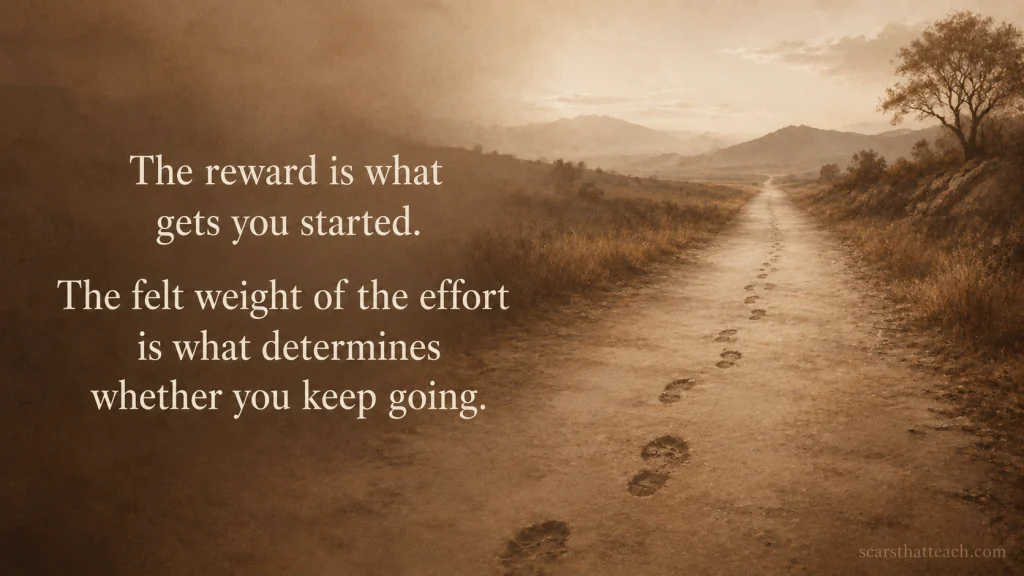
There is a reasonably well-established pattern behind why this happens, and it has less to do with willpower than most people assume. Motivation toward a goal depends heavily on visible progress. When a reward feels close and a person can see themselves getting nearer to it, effort tends to follow. But research on effort and reward has found something less intuitive: once someone actually begins working toward a goal, their ongoing behavior is driven far more by how much effort the work requires moment to moment than by the size of the reward waiting at the end. The reward is what gets you started. The felt weight of the effort is what determines whether you keep going, and that weight does not care how big the original prize was.
A goal with a long timeline puts this mechanism under a particular kind of strain. Early on, the milestones are close enough together that the mind gets regular proof it is moving. A year or two in, with the finish line still distant and the day-to-day work largely unchanged, those signals thin out. The cost of continuing stays exactly the same, sometimes even grows, while what used to make that cost feel worth it becomes rare. The system that was supposed to keep rewarding you for pursuing the goal has simply gone quiet, because it was never built to run on a reward that far away.
Where the Usual Advice to Push Through Misses the Point
Most of what gets written about staying motivated leans on mindset. Remember your why. Visualize the outcome. Read something inspiring before you start your day. I do not think any of that is dishonest, exactly, but I think it is aimed at the wrong part of the problem. It tries to manufacture more feeling about a reward that is still far away, when the actual gap is that your mind has stopped getting proof that anything is happening at all. You cannot think your way into a feedback signal that does not exist. You have to build one.
The more useful shift is measuring what researchers sometimes call the leading indicator instead of the lagging one: the actions you are actually taking, rather than the distant outcome you are still waiting on. James Clear’s writing on systems makes a related point that applies directly here, that a person who tracks their process closely gets far more usable feedback than one who is only checking in on the far-off result, because the process happens daily and the result does not. Locke and Latham’s research on goal pursuit found something similar: consistent feedback loops are one of the strongest predictors of sustained effort toward a goal, and a loop only works if it tells you something on a timescale short enough to matter to how you feel today.
In practice, this can be almost embarrassingly small, and that is by design rather than in spite of it. A signal only does its job if it arrives on a timescale the mind can actually register as recent, and a year-end outcome does not qualify no matter how meaningful it is. A week is short enough to still feel connected to what you did, which is why a weekly total lands as real progress in a way that a distant milestone, however large, simply cannot compete with. Not did I finish the book, but did I write for twenty minutes today. Not am I financially independent yet, but did I do the thing this week that moves the number, even slightly. A short list of what that can look like:
- A visible tally of the sessions completed, not the milestones reached, kept somewhere you actually see it.
- A weekly check for whether the core action happened at all, separate from whether it produced a result yet.
- A record of the small course corrections made along the way, since those are proof of engagement even when the outcome has not moved.
None of these change the timeline. What they change is what your mind has to work with day to day, and that turns out to matter more than most people expect.

What People Get Wrong When the Timeline Stretches
The mistake I saw most often was not laziness, and it was rarely a change of heart about the goal itself. It was mistaking fatigue with the process for doubt about the destination, and then trying to solve the wrong problem. A man I sat with had spent four years rebuilding a business after a fire had taken the original location, working out of a storage unit for the first year and a half before he could afford anything better. He was not behind because he lacked resolve. He was behind because four years of unglamorous, mostly invisible effort, invoices, cold calls, a slow rebuild of trust with suppliers who had watched him lose everything once already, had worn down the part of him that used to feel something when he made progress. He kept telling me he had lost his drive, as though the goal itself had gone stale. What had actually happened was that he had stopped noticing he was still moving, because none of it looked like the reopening he had pictured, and he had never been tracking anything smaller than that.
Once he started keeping a plain, weekly note of what he had actually done, not what he had produced but what he had shown up and done, something in him settled that four more motivational talks would not have touched. It did not make the remaining distance shorter. It gave him something closer than the finish line to measure himself against, which is often all a tired person actually needs in order to keep walking.

Final Thoughts: The Goal Did Not Get Heavier, the Feedback Got Thinner
If you have been carrying a goal for far longer than you expected to, I want to be plain about something: the fact that it is taking longer does not mean you misjudged it, and it does not mean you are less disciplined than the person who reaches a goal faster. It usually means you are in the part of a long timeline where the mind stops getting the proof it needs, and nobody warned you that this part would feel like losing interest when it is really just running low on feedback. Build a smaller, closer signal to measure yourself against, and let the distant one stay distant for now.
If the deeper question underneath this is whether you are chasing the goal in a way that was ever going to sustain itself, I have written more on that in why the daily system matters as much as the goal itself, and if you are not sure the goal was built to survive a long timeline in the first place, that is covered in how to set goals you will actually keep. If something further back is the real issue, the reasons a goal stalls before it even gets moving are covered in why most goals fail before they start.
All three sit inside the wider collection I keep on questions about setting and following through on goals, and the broader discipline underneath any of it is something I have written about more fully in what steady follow-through actually requires.
FAQs
⏳ Why does motivation fade on a goal that is still going well?
Because motivation depends on visible progress, and a long timeline stretches the gap between what you do and what you can actually see change. The goal has not failed. The feedback you were relying on has simply gone quiet.
📉 Is losing motivation on a long-term goal the same as giving up?
No, and the difference is worth checking honestly. Giving up usually comes with real doubt about whether the goal is still wanted. What you are describing sounds more like exhaustion with a process that has not changed, which calls for a different response than reconsidering the goal itself.
📊 What should I track if the outcome is still far away?
Track the actions you are actually taking rather than the distant result: sessions completed, whether the core action happened this week, small corrections made along the way. These give your mind proof of movement on a timescale it can actually use.
🔁 Will tracking my effort instead of the outcome make the goal happen faster?
Not directly. It does not shorten the timeline. What it does is give you something closer than the finish line to measure yourself against, which is usually enough to keep a tired but still-committed person moving.
🧭 How do I know if I should keep going or if the goal has actually changed?
If your hesitation is about the effort feeling heavy rather than the destination feeling wrong, that is fatigue, not a change of direction. If the goal itself no longer fits who you are or what you want, that is a different and more honest conversation to have with yourself.