When everything falls apart, the usual advice about starting over tends to arrive before you can use it. Start small. Reach out. Set a goal you can actually achieve. None of it is wrong, but most of it skips a step that has to come first: a tentative answer, however incomplete, to what still holds any weight for you now. This piece is about that step, and why it is the only place where beginning again actually begins.
The Place Everyone Skips When Life Falls Apart
Nobody who has figured out how to start over after life falls apart did it by first knowing where they were going to end up. That is not how I have ever watched it happen, and I have watched it happen more times than I can count. What I noticed, across two decades of chaplaincy work, is that the people who eventually found a way back did not begin with a plan. They began with one thing that still pulled at them, even when everything else was gone. A relationship they needed to repair. A kind of work they had put down and missed more than they expected. A person they wanted to be present for. The plan, if it came at all, came much later.
The reason this matters is not obvious until you have tried to start over without it. Someone loses their job of twenty years and their marriage in the same period. The people around them offer the same reasonable advice: update the resume, join a group, set small achievable goals. All of it sounds correct. None of it moves. Not because the person lacks resilience, but because the question that makes any action navigable has not been answered yet. What am I moving toward? When there is no answer to that, even the smallest step feels arbitrary. You are picking a direction in a landscape you do not recognize, toward a destination you cannot picture, for reasons you cannot yet name.
The one thing I watched people find their way back with was not a goal. It was something closer to a signal: one thing that still registered as real when everything else felt empty. Finding that, before anything else, is the only starting point I have ever seen hold.
Why Goals Come Second, Not First
The advice to set new goals after a major collapse is eventually necessary. But it tends to be offered too early, before the thing that makes goals navigable has been re-established. Goals require direction. Direction requires some sense of what you are pointing toward. That sense, what matters, what you want to protect, what you are not willing to lose even now, is often exactly what the collapse has disrupted. The job was tied to your identity. The relationship defined the shape of your days. The home was evidence of the version of yourself you had built. When those things fall away, the direction can fall with them.
What the more honest accounts of recovery tend to agree on is that the viable sequence runs through values before it reaches goals. Not values in the abstract, the kind you write on a card and put in a drawer. Something more immediate: what still matters to you right now, in the wreckage of what has fallen apart. The answer does not need to be complete. It does not need to be certain. It needs only to be real. One thing that still registers. One thing worth returning to or protecting. That is enough to orient the first step.
What people have said about failure and beginning again across very different lives tends to return to the same observation: the recovery rarely came from finding the right plan. It came from finding something worth recovering toward. The plan followed from that, not the other way around.
Why the Standard Advice Feels Hollow Right Now
Start small. Accept support from the people around you. Give yourself time. These are all accurate. They are also the advice that most people in the middle of a real collapse cannot act on yet, and the reason is almost never what people assume. The assumption, usually from the outside looking in, is that the person lacks willpower, or motivation, or resolve. The actual problem is usually that none of the actions have an anchor. They point somewhere, but not somewhere the person can name or feel.
Start small is good advice once you have some answer, even a tentative one, to what you are starting small toward. Without it, the immediate question is: small what? Small steps in which direction, for what reason, on behalf of what version of your life? The action is available. The meaning that would make it feel like movement rather than spinning is not. This is where most people get stuck, and where most advice fails them.
The common mistake is treating the practical tactics as the starting point when they are actually the second thing. The first thing, finding even one aspect of what still matters, is harder, less visible, and almost never named in the list of steps. It also has to happen before the steps can do anything useful.
There is also a separate dimension of this that belongs to why starting over feels so difficult to even approach: the particular weight of having to become a different version of yourself when the old one felt settled and earned. If that disorientation is part of what you are carrying, why starting over feels this hard covers that ground directly. What I am focused on here is the more practical question of where to place the first step once you are ready to take one.
What Finding the First Thing Actually Looks Like
Finding what still matters after a collapse is not usually a journaling exercise. It tends to arrive sideways, in moments that are easy to miss. Someone mentions a person they have not spoken to in years and something shifts. Someone asks about a kind of work they used to do, not as a career plan but simply because they miss it. Someone says, almost as an aside, that they want to be a certain kind of parent right now, even in this. Those are the signals. They do not arrive as goals or ambitions. They arrive as small, honest admissions of what still holds weight.
The question “what matters to me now” is often too large to approach directly after a major disruption. The smaller version tends to be more accessible: what is the one thing, if I could do it today, that would feel like it meant something? What is the one relationship I keep returning to in my thinking? What is the one kind of day I can still picture that I would want?
For some people, this question stays genuinely inaccessible for a while, not because of avoidance but because what fell apart was so entwined with their sense of self that the separation needs more time. If that is where you are, rebuilding a sense of who you are after loss may be the more pressing question first, before this one can be answered honestly.
Once something surfaces, even something partial and uncertain, the practical steps begin to make more sense than they did before. Not because the steps have changed, but because they now have somewhere to point.
- Start with the relationship or connection that keeps coming to mind, not as a project but as the one thing you actually want to do. Make the call. Send the message. That is a step with meaning behind it, not a productivity exercise, and that difference is felt in whether it moves you.
- Look for what went quiet during the period before things fell apart that you did not notice you valued. Sometimes what matters most is what stopped being available without ever being named.
- Let the first goal be small and tied to the thing you identified, not to a larger reconstruction plan. A step toward something you can name is more durable than a step toward a version of your life you cannot picture yet.
- Accept support not as a strategy for resilience but as a practical acknowledgment that isolation makes the first step harder, not easier. The people around you cannot tell you what matters to you. But they can make the environment in which you figure it out less difficult to inhabit.
If you are starting over in the second half of life, some of what I have described here carries a different texture. The options that feel genuinely open, and the ones that do not, are not the same at fifty-five as they are at thirty. Starting over at 40 or 50 has its own specific weight that this piece does not try to address directly. What holds across ages is the sequence itself: find the signal that something still matters, then let the steps organize themselves around it.
Final Thoughts: The Only Thing That Has to Happen First
There is a version of everything I have described here that sounds simpler than it is. Find what still matters. Place the first step toward it. Let the plan come later. It is manageable when the situation is still abstract. I have watched enough people hold this in their hands, in the middle of something genuinely collapsed, to know that it does not always feel manageable from inside it. That is not a reason to put it down. It is just an honest acknowledgment of where the work actually lives.
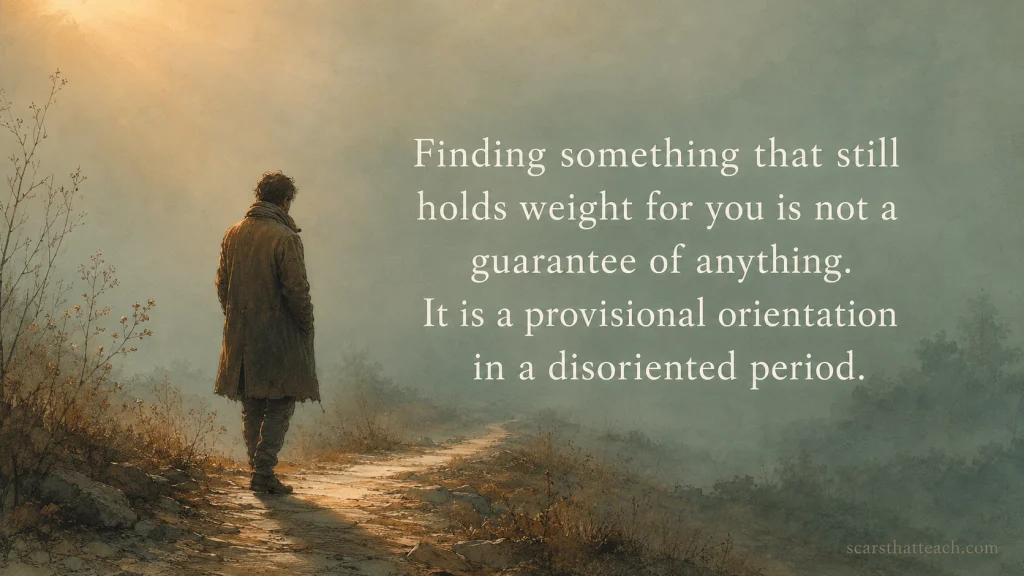
Finding something that still holds weight for you is not a guarantee of anything. It is a provisional orientation in a disoriented period. It gives the practical steps a direction they did not have before. It does not tell you where you will end up. It only tells you where to place the first step, which is the only thing that needs to happen right now.
Starting over after life falls apart is a larger territory than any one piece can cover. If what you are carrying includes questions this piece does not reach, what starting over actually involves is worth sitting with alongside what is here.
FAQs
💔 How do you start over when everything in your life falls apart at once?
Not by finding the right plan first. By finding one thing that still holds some weight for you, even now, and placing the first step toward it. The plan, if it comes, comes later. The signal that something still matters has to come before the steps can mean anything.
🧭 What is the first step when you need to rebuild your life after a major setback?
The first step that holds is a step toward something you can actually name as mattering to you. Before that, the practical advice, start small, set goals, accept support, tends to feel arbitrary. Not because the advice is wrong, but because it has nowhere to point yet.
😶 Why does starting over feel impossible even when I know what to do?
Usually because knowing what to do is not the same as having a reason to do it that feels real. When a major collapse disrupts your sense of what matters, even clear instructions can feel empty. The missing piece is almost never knowledge. It is direction.
🤝 Should I talk to a therapist when my life falls apart?
For some people, especially when what has collapsed is overwhelming or grief is acute, professional support makes the work more bearable and more effective. It is not a baseline requirement for starting over, but it is a genuinely useful resource when what you are carrying is too heavy to sort through alone.
⏳ How long does it take to start over after a major life collapse?
Long enough that the question itself can become a burden. There is no honest answer that serves most situations. What I can say is that the people I watched who moved through this most fully were not the ones who moved fastest. They were the ones who found something real to move toward, at whatever pace that required.