Most people who start over solve the practical part faster than they expect: a new job, a new routine, a new place to live. What takes longer is the part nobody warns them about, which is the absence of anything that feels like it matters. This piece walks through why purpose doesn’t return the way most advice promises it will, what the common framing gets wrong about discovering it, and what actually tends to bring it back. By the end, you will have a clearer sense of where to put your attention next, even if the timeline is not something I can promise you.
When the New Life Still Feels Mechanical
The new life can be running on schedule and still feel like it belongs to someone else. That is usually the moment people start asking how to find purpose when starting over, not because anything is broken, but because nothing yet feels like it is for something. You go to work, you pay the bills, you do the things a functioning life requires, and somewhere in the middle of doing all of it correctly, you notice that none of it feels like it is for anything. That gap is not a sign you are doing it wrong. It is a sign that the part of you that decides what matters has not caught up with the part of you that is managing the logistics.
I spent over two decades sitting with people who were near the end of their lives, and a pattern showed up across hundreds of conversations that I stopped attributing to coincidence. The people who eventually found their footing after a major change, a divorce, a death, a career that ended without warning, were almost never the ones who found new goals the fastest. They were the ones who, sooner or later, landed on one thing that still felt like it belonged to them. Not a five year plan. One thing. The goals came after that, not before it.
Why a Sense of Purpose Doesn’t Just Come Back
Purpose is not a single decision you make once and carry with you. It is built the slow way, through years of small activities, relationships, and contributions that quietly add up until they form the backdrop of a life that feels worth getting up for. You rarely notice it being built because none of the pieces look significant on their own. A standing dinner with a friend. A role at work that made you useful to people you respected. A daily habit that connected you to something outside your own head. None of that reads as purpose while you are living it. It only reads that way in hindsight, once it is gone.
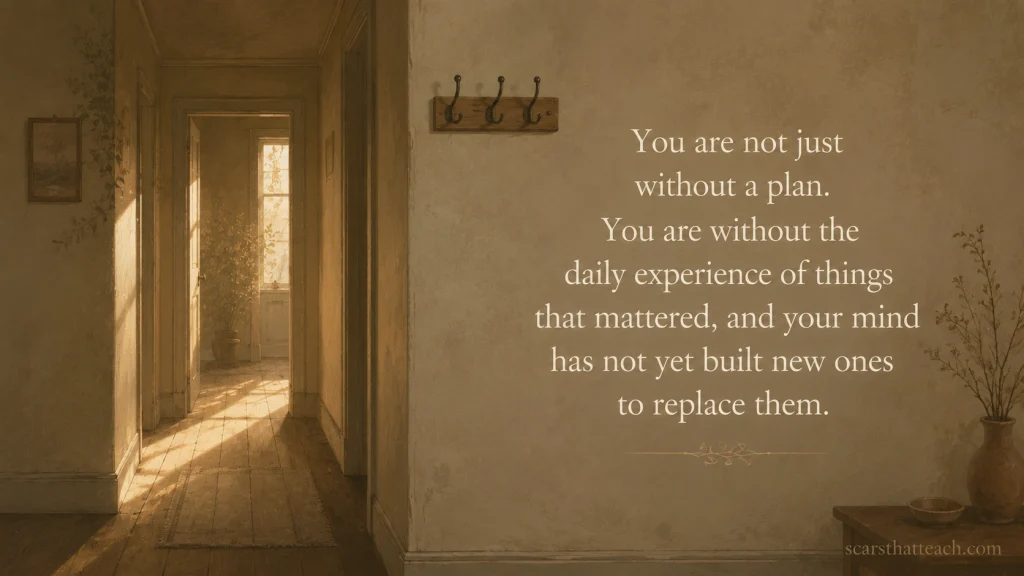
That is what makes starting over so disorienting. When the old structure ends, whether by choice or by circumstance, most of those small contributors end with it. You are not just without a plan. You are without the daily experience of things that mattered, and your mind has not yet built new ones to replace them. It is also where most of the confusion around meaning after starting over actually comes from: the absence gets read as a sign that something is broken, when it usually just means the accumulation has not happened yet in the new life, because accumulation takes time that cannot be rushed by wanting it to move faster.
Where Most Advice About Finding Purpose Goes Wrong
Most of what gets written about this treats purpose like a lost object: something you go looking for, something hiding under the surface of your life waiting to be uncovered if you ask yourself the right questions. I understand why that framing is appealing. It suggests the answer already exists somewhere and you just have to find it. But that is not how it tends to work in practice, and it is not what I watched happen in the rooms I sat in.
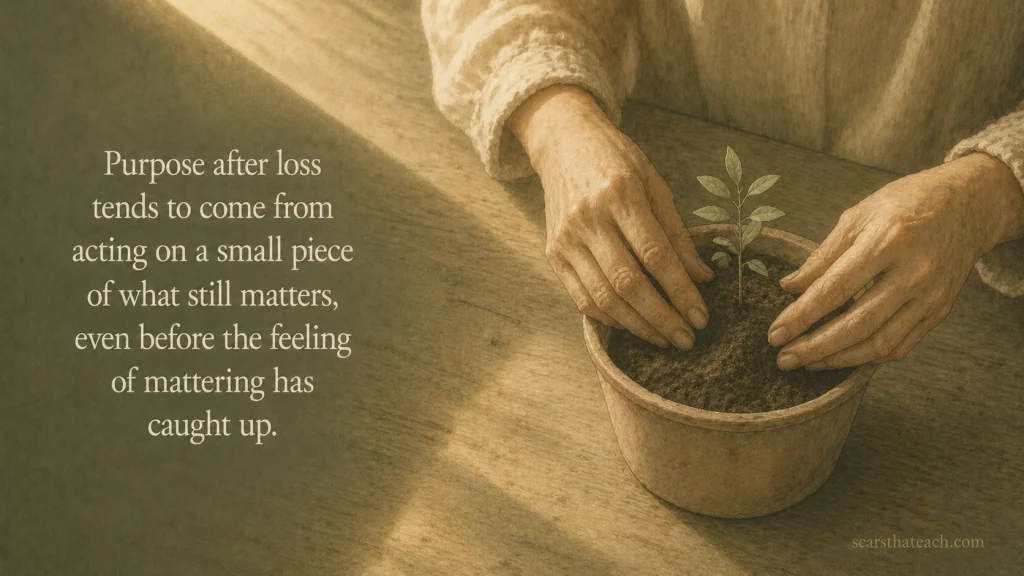
The more accurate picture is that purpose is reconstructed from what you already value, not retrieved from somewhere outside you. It does not begin with a grand new direction. It begins with small, specific actions that make a claim on what you actually care about, repeated long enough that they start to accumulate the way the old ones once did. A man I sat with, a composite of several conversations I’ve had over the years rather than any single person, once told me he had spent a full year after his retirement waiting to feel like himself again before he let himself start anything new. The waiting was the problem. In most of the purpose after loss situations I watched up close, the action came first and the feeling of mattering caught up afterward, not the other way around.
Here is what people commonly get wrong when they are trying to find purpose after a major life change: they look for one decision big enough to replace everything the old life provided. There is rarely a single decision that does that work. What tends to work instead is several small, repeated commitments that, individually, look too modest to matter.
Small Actions That Make a Claim on What You Care About
If purpose is built rather than found, the question becomes what to actually do while you wait for it to accumulate. The honest answer is smaller than most people want it to be, and that is exactly why it works. You are not trying to replace the old structure all at once. You are trying to plant a handful of things that, given enough repetition, will start to feel like they belong to you the same way the old ones once did.
A few patterns showed up often enough across the people I talked with that I think they are worth naming directly:
- Reaching back out to one relationship that mattered before the change, even briefly, rather than waiting for it to rebuild itself.
- Volunteering time toward something connected to an old value, not necessarily an old role, since the value can survive even when the job or the relationship did not.
- Taking on one small responsibility that someone else is counting on, since being needed tends to reconnect people to purpose faster than being free does.
- Returning to a skill or a craft that once gave you a sense of contribution, even at a smaller scale than before.
- Naming, out loud or in writing, the one thing from the old life you would not want to lose even if everything else changed.
None of these are dramatic, and that is the point. People starting over often wait for a feeling of certainty before they act, when in most of the situations I watched, the feeling arrived after the action, not before it. Your specific situation matters here more than any list can account for. What rebuilt a sense of purpose for one person depended heavily on what they actually valued underneath the role they lost, and that detail belongs to you, not to me.
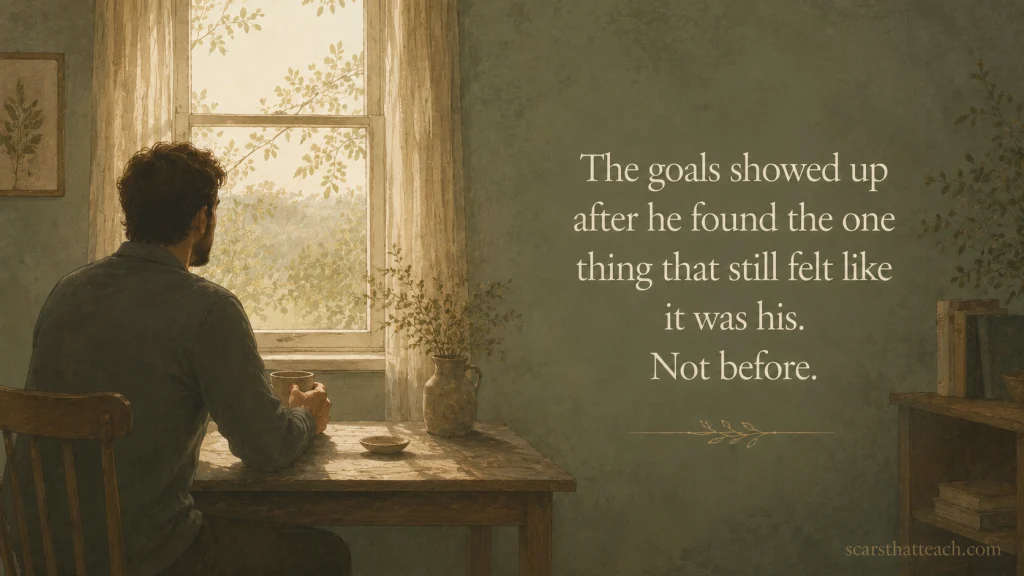
The goals showed up after he found the one thing that still felt like it was his. Not before.
Final Thoughts: What This Doesn’t Promise
I want to be direct about what this cannot do. Doing the small things I described will not guarantee that purpose returns on any particular timeline, and I am not going to pretend that consistency alone fixes everything that a major change took from you. What it can do is give you something to act on while the rest of it catches up, which is more than most people have when they are standing in the middle of starting over with nothing yet that feels like it matters.
If the difficulty of the restart itself is what you are still working through, it might help to look at why starting over feels so hard in the first place, or, if the life that ended did so all at once rather than gradually, at how people rebuild after a life that fell apart without warning. And if you are working through other questions tied to rebuilding a life from a harder starting point, you can find more of that thinking gathered under how people make sense of starting over. For a different angle on what people carry forward from things that did not go the way they planned, there is also what people actually learn from failure, which sits closer to where purpose and regret tend to overlap.
FAQs
🧭 How do you find purpose after starting over?
You generally do not find it in one decision. It tends to come back through small, repeated actions tied to what you already valued before the change, not through searching for something hidden. Start with one of those actions before you feel ready, and let the sense of purpose catch up to it.
🌱 Why don’t new goals feel meaningful right away?
Because meaning is usually built from accumulation, not assigned by the goal itself. A new goal can feel hollow at first simply because it has not yet accumulated the small contributions and relationships that made the old life feel worth it.
😞 Is it normal to feel lost even when life looks fine on paper?
Yes, and it is one of the most common things I heard from people who had handled the practical side of a major change well. Looking fine on paper has very little to do with whether the new life has started to feel like it matters yet.
⏳ How long does it take to feel a sense of purpose again?
I cannot give you a timeline, and I would be skeptical of anyone who does. It depends on what was lost, what you rebuild it with, and how consistently you act on the small things rather than waiting for motivation to arrive first.
🔍 What’s the difference between purpose and goals?
Goals are the structure. Purpose is the reason the structure feels worth maintaining. You can hit every goal on a list and still feel nothing if the goals are not connected to something you actually value, which is usually the piece people skip when they start over.