
Self-forgiveness is harder than forgiving someone else, and not for the reasons most people assume. The difficulty is not about the severity of what was done. It is structural: there is no external party to direct the release toward, the person who caused harm has access to every detail of it, and forgiving themselves can feel like a betrayal of the people they hurt. The most persistent obstacle, though, is one that is rarely named directly: the belief that continuing to suffer is itself a form of moral responsibility, and that stopping the suffering means the harm no longer matters.

The Direction the Mercy Has Nowhere to Go
Something I noticed, across many years of sitting with people near the ends of their lives, was that the ones who described the most unresolved difficulty with forgiveness were often not talking about someone who had wronged them. They were talking about themselves. And what struck me was that many of them had, at some earlier point, managed to forgive other people for things that seemed, from the outside at least, considerably more serious than what they were still holding against themselves. The difference was not in the severity of the wrong. It was in the direction of the forgiveness. When you forgive someone else, there is a recipient. There is a relationship, or at least a space, in which the release can occur. When you try to forgive yourself, that recipient is also you, and the mercy has nowhere specific to go.
That asymmetry is one I have seen cause genuine confusion in people who are trying hard to move past something and cannot understand why the trying is not working. They have done the things they were told to do. They have acknowledged the harm. They have apologized, in some cases many times. They have tried to make it right. And still, when they turn toward themselves with something like compassion, it collapses. The distance they can hold for someone else, the space in which forgiveness becomes possible, is not available in the same way when the person they are trying to forgive is inside them.

Why Self-Forgiveness Is Harder Than Forgiving Someone Else
There are several structural reasons self-forgiveness is more difficult, and they are worth naming because understanding them tends to reduce the amount of blame people place on themselves for struggling with it.
The first is the absence of an external recipient. When you forgive another person, you are releasing a claim you hold against someone outside yourself. There is a direction to the act, and a certain logic to the release. When you try to forgive yourself, the person releasing and the person being released are the same, and the act has a strange circularity that makes it difficult to know when, or whether, it has happened.
The second is access to detail. When someone wrongs you, you know what they did, but you do not know everything about why, or what it felt like from the inside, or how many times they almost didn’t. When you wrong someone else, you have all of that. You remember the moments you chose, the moments you could have stopped, the ways you understood perfectly well what you were doing. That full internal access makes the case for the prosecution much stronger than it ever could be against someone else.
The third is the feeling that forgiving yourself is a betrayal of the people you hurt. Forgiving yourself can feel like declaring the matter closed, and declaring the matter closed can feel like diminishing the harm. If the people you hurt have not forgiven you, forgiving yourself can feel like a presumption. If they have suffered consequences that you have not, forgiving yourself can feel like unfairness. The mercy you would extend to yourself seems, in this framing, to come at the expense of the people who deserved something from you that they may not have fully received.
The Standard You Hold Yourself To
There is also the problem of standards. Most people hold themselves to a version of their own behavior that is considerably more exacting than the standard they apply when judging others. Part of this is appropriate, because you are responsible for your own actions in a way you are not responsible for other people’s. But part of it is not appropriate, and it is the part that evaluates past behavior against a standard of who you should have been rather than who you actually were at the time, with the knowledge, maturity, and resources you actually had. That evaluation is unfair in a specific way, and it tends to generate the kind of self-judgment that is not proportionate to the actual wrong.
People who are very hard on themselves for past mistakes often have a version of this problem. They know what the right thing to do was, in retrospect, with full information and the emotional distance of time. They are judging their past self by their current understanding, and finding that past self inadequate by that measure. That finding is not wrong, exactly, but it is also not the same as what accountability requires.
The Most Persistent Obstacle: Suffering as Moral Accounting
The difficulty I have seen persist the longest, in people who have genuinely tried to move past something and cannot, is this: the belief that continued self-punishment is itself a form of moral responsibility. The reasoning, usually not fully articulated, is something like: what I did was serious, and the only appropriate response to serious harm is to carry it. To stop carrying it would be to say it no longer matters. To forgive myself would be to let myself off the hook for something I should not be let off the hook for.
This belief is understandable. It has an internal logic, and it comes from a genuinely moral place. The person who believes it is not indifferent to the harm they caused. In some ways they are more conscious of it than people who moved on quickly. But the research on this is fairly direct: self-punishment does not help the people who were harmed. It does not undo what happened. It does not reduce the suffering of anyone except, sometimes, the person doing the punishing, who gets to feel that they are at least paying something. What it actually does is keep the person who caused harm from being fully available to do better.
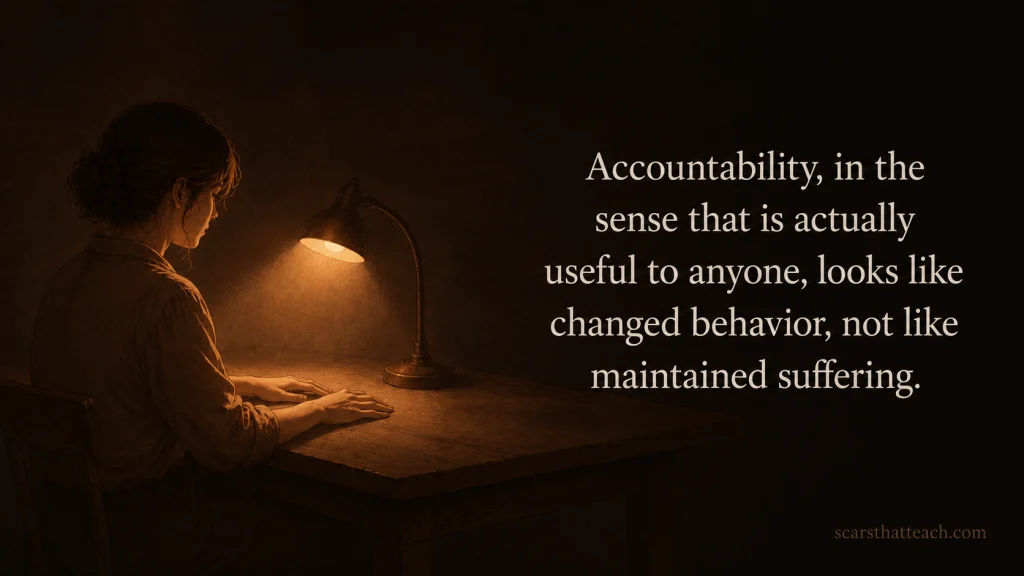
That is not a comfortable finding, because it means the suffering that felt like accountability is not functioning as accountability. It is functioning as something closer to a holding pattern: a way of not having to answer the harder question of what it would mean to actually move forward and do differently. Accountability, in the sense that is actually useful to anyone, looks like changed behavior, not like maintained suffering. The suffering can feel more morally serious than the change, but it does far less.
- Self-punishment feels like accountability because it costs the person something. But cost is not the same as repair, and what the people harmed usually need is not the punisher’s ongoing suffering. It is changed behavior.
- Continued self-punishment can be a way of avoiding the more uncomfortable work of genuine accountability, which involves change, not just pain.
- Forgiving yourself is not the same as saying the harm did not matter. It is the condition that makes it possible to do something useful with what happened, rather than remaining inside it.
- The distinction between self-forgiveness and letting yourself off the hook is one that matters and is worth examining directly. The two are not the same, even when they feel the same.
What Self-Forgiveness Is Not
The confusion between self-forgiveness and self-exculpation is one of the main reasons people get stuck. If forgiving yourself means deciding you did nothing wrong, or that what you did was acceptable, or that the harm it caused was not real, then of course it is not possible for someone who takes the harm seriously. That version of forgiveness requires a falsification of the record, and people with any integrity at all will not do it.
But that is not what self-forgiveness is. Self-forgiveness does not require revising the facts. It does not require deciding that what happened was fine. It requires something closer to: acknowledging what happened fully, taking responsibility for the part that was yours, and then releasing the ongoing punishment without releasing the accountability. Those are separable. The accountability lives in changed behavior, in how you carry what you learned, in what you do differently going forward. The suffering is not required for any of that. It is possible to hold full responsibility for something and to stop punishing yourself for it. Those are not in conflict. They feel in conflict, which is a different thing.
The specific question of where the line falls between self-forgiveness and genuinely letting yourself off the hook is worth spending time with, particularly if the distinction is not feeling clear. The cluster on forgiving yourself versus letting yourself off the hook goes into that directly. And if the self-punishment is the part that feels most immediate, how to stop punishing yourself addresses that specifically.

Final Thoughts: Hardness Is Not Evidence of Inadequacy
The difficulty of self-forgiveness is not a sign that you are doing it wrong, or that you are not trying hard enough, or that what you did was so serious that forgiveness is simply not available to you. It is a sign that you are working against several structural features that make this genuinely harder than forgiving someone else, and against a belief about suffering and accountability that feels moral but tends not to function that way.
What I can offer from my years of sitting with people who were working through this is that the ones who eventually found something like peace were not the ones who had minimized what they did. Most of them had sat with it longer and harder than almost anyone around them knew. What changed was not their assessment of what had happened. It was their relationship to the idea that continued suffering was the only appropriate response to it. When that belief loosened, even a little, something else became possible that had not been before.
The process of how self-forgiveness actually works, not as a concept but as something you move through over time, is what how to forgive yourself for past mistakes covers. The wider context of self-forgiveness questions, and how they tend to connect, is part of the larger conversation at forgiving yourself. For the questions about failure, what it means, and what people who have come through it tend to say about it, the quotes about failure and what they actually get right section is worth looking at.
FAQs
😔 Why is forgiving yourself so much harder than forgiving other people?
Several structural reasons: there is no external recipient for the release, you have full internal access to every detail of what you did, and forgiving yourself can feel like a betrayal of the people you hurt. The act also has a circular quality that forgiveness toward someone else does not have, which makes it hard to know when, or whether, it has occurred.
🤔 Is continuing to feel bad about something the same as being accountable for it?
No, though it feels that way. The research on this is fairly clear: self-punishment does not help the people who were harmed. What functions as real accountability is changed behavior, not sustained suffering. The suffering can feel more serious and morally weighty than change, but it does far less for anyone involved.
😤 Does forgiving myself mean saying what I did was okay?
No. Self-forgiveness does not require revising what happened or deciding the harm was acceptable. It requires acknowledging what happened fully, taking responsibility for your part in it, and releasing the ongoing self-punishment without releasing the accountability. Accountability lives in changed behavior. Suffering is not required for that, even though it tends to feel that way.
🔄 What if the people I hurt haven’t forgiven me yet?
Their forgiveness is theirs to give or not give, on their own timeline. Your self-forgiveness is a separate process. Waiting for their forgiveness before allowing your own is understandable, but it gives them a kind of authority over your internal process that the two things do not actually require. You can take full responsibility for what you did and work toward self-forgiveness without requiring their absolution first.
💭 Why do I keep replaying what I did even when I want to move on?
Repetitive rumination about past wrongs is often connected to the belief that continued attention to the harm is itself a form of moral responsibility. Stopping the replay can feel like abandoning accountability. It is also sometimes driven by the mind searching for a version of events where the outcome was different, which is not a search that resolves. What tends to interrupt it is not willpower but a shift in the underlying belief about what the replay is doing.
🧠 Is there a difference between self-forgiveness and letting yourself off the hook?
Yes, and the difference matters. Letting yourself off the hook involves minimizing or dismissing what happened. Self-forgiveness involves acknowledging it fully and releasing the self-punishment while keeping the accountability intact. The two feel similar from the inside, which is part of why people who take harm seriously resist the first and get stuck approaching the second. They are not the same act.
🌱 How do I actually begin to forgive myself?
That is a process question rather than a mechanism question, and it deserves more than a short answer. The starting point, for most people, is separating what accountability actually requires from what continued suffering is doing. If the suffering is genuinely serving accountability, it will look like changed behavior. If it is not producing change, it is worth asking what it is actually for. The process of moving through self-forgiveness over time is covered in detail at how to forgive yourself for past mistakes.