
Most people who cannot forgive themselves are not refusing because they believe they do not deserve it. They are refusing because forgiving themselves feels like the same thing as excusing what happened, and that feels like a betrayal of anyone who was harmed. This piece addresses that specific confusion directly. Self-forgiveness and excusing yourself are not the same thing, and understanding the difference is what makes self-forgiveness possible without requiring anyone to pretend that what happened was acceptable. You can hold full accountability and release self-punishment at the same time. Those are not competing positions.

The Fear Behind the Refusal
In over twenty years of hospice chaplaincy, I sat with people who were working through some of the worst things they had ever done. What I noticed, more times than I can count, is that the resistance to self-forgiveness was rarely what it looked like on the surface. The most common thing I heard was not “I don’t deserve to forgive myself.” It was closer to this: if I stop suffering for what I did, the people I hurt will somehow know, and they will feel it as abandonment.
That fear has a real moral weight to it. The suffering feels like it is doing something. Like it is keeping the person in relationship with those they harmed, honoring what happened, making clear that they understand the gravity of it. Letting go of the suffering feels like letting go of that thread. And if that thread is all that remains of the accountability, releasing it feels like a form of erasure.
What I observed, across many of those conversations, is that the suffering had long since passed the point of useful learning. It had become its own destination. The broader territory of self-forgiveness and what makes it so difficult covers more of the picture. This piece focuses on the specific confusion that tends to sit at the center of the resistance.

Why Self-Forgiveness Gets Mistaken for Excusing Yourself
The confusion is understandable, and it starts with how forgiveness works in everyday language. When we talk about forgiving another person, we usually mean releasing a grievance, moving past what happened, no longer holding it against them. When that frame gets applied inward, it produces a natural reading: forgiving yourself means not holding what you did against yourself anymore. Which means not caring about it anymore. Which means not caring about the people who were harmed.
By that definition, self-forgiveness is morally wrong. If forgiving yourself means declaring what happened acceptable, or releasing your responsibility for it, then refusing to forgive yourself is the more honorable position. It keeps the weight present. It does not allow the person to walk away clean from something that was not clean. The people I sat with who were most resistant to self-forgiveness were, in many cases, people with a very strong moral sense. The resistance itself was evidence of that.
That reading feels internally consistent. The problem is that it is built on the wrong definition of what self-forgiveness actually is. Researchers who have studied forgiveness directly, including Fred Luskin and others whose work appears through institutions like the Greater Good Science Center, distinguish explicitly between self-forgiveness and self-excusing. Self-excusing is minimizing what happened, disputing the harm, shifting the blame, releasing responsibility. Self-forgiveness is something different: the release of ongoing self-punishment, while maintaining full awareness of what happened and full accountability for it. The harm was real. The responsibility is real. The ongoing suffering does not have to be the price of acknowledging both.
Understanding why this confusion runs so deep is part of what makes self-forgiveness so hard for most people. The short version is that the two things, excusing and forgiving, feel identical from the inside when the guilt is active enough. They are not identical. What they require and what they leave intact are very different.
What Forgiving Yourself Actually Means
The distinction that tends to make the difference is this: forgiving yourself means releasing the self-punishment, not releasing the facts. What happened happened. The harm was real. Your responsibility for it does not dissolve. None of that changes. What changes is whether you continue to use suffering as a form of penance for it, indefinitely, past the point where the suffering is doing anything useful.
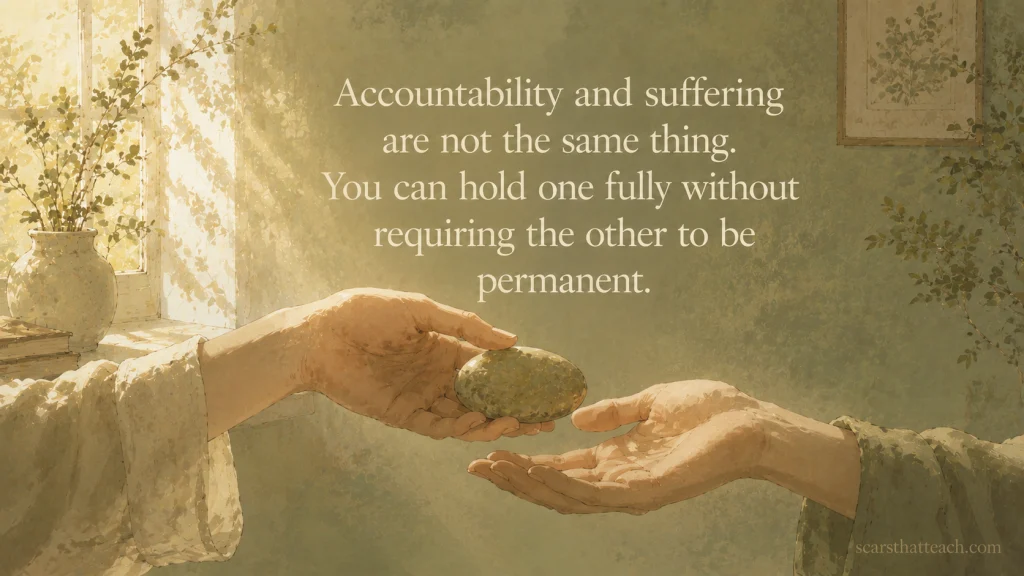
“Accountability and suffering are not the same thing. You can hold one fully without requiring the other to be permanent.”
The clearest way I have found to hold this distinction is to look at what self-forgiveness actually leaves intact and what it actually releases. Most of the fears people carry about it are fears about what they would have to give up. In practice, forgiving yourself requires giving up very little of what they are afraid of losing.
After forgiving yourself, the following remain fully intact:
- Your understanding of what you did and why it was wrong.
- Your recognition of the harm it caused to real people.
- Your responsibility for what happened and for whatever amends are still available.
- Your changed behavior, if any behavior has changed as a result.
- Your relationship to those you harmed, in whatever form that relationship still exists.
- Proportional guilt, the kind that functions as information rather than as ongoing punishment.
What self-forgiveness releases is the ongoing loop of self-punishment that does not serve any of those things. The rumination that circles back to the same material without generating anything new. The suffering held in place not because it is doing anything, but because releasing it feels wrong. That is the specific thing being released, and it is not the same as releasing accountability.
The procedural question of how to actually move toward self-forgiveness is a different one, and working through the practical steps of forgiving yourself for past mistakes covers that ground. This piece is about the conceptual confusion that stops most people before they ever get to the steps.

What Self-Punishment Does and Does Not Do
Sustained self-punishment has an internal logic that is worth naming directly because it feels morally coherent from inside it. If you keep suffering, it signals that you understand the weight of what you did. If you stop suffering, maybe you never really understood. The suffering becomes a kind of ongoing proof of accountability, a way of staying in right relationship to what happened by never letting yourself off the hook from it.
The problem with that logic is what the suffering actually produces. Not what it signals internally, but what it generates for anyone else. Self-punishment past the point of useful learning does not repair anything. It does not address any outstanding need of the people who were harmed. It does not change what happened, and it does not change the person’s capacity to act differently going forward. In many cases, it impairs that capacity, because a significant portion of the person’s attention and energy is directed inward at the suffering rather than outward at anything that could constitute an actual response to what happened.
There is also something uncomfortable in here that I observed often enough to name. Very prolonged self-punishment can quietly become a way of remaining focused on oneself rather than on those who were harmed. The attention stays on the guilt, on the suffering, on the internal experience, rather than on any available repair, any change in behavior, any genuine reckoning with what the other person needed. That is not a deliberate evasion. But it is worth noticing. Suffering is not the same as accountability. It can coexist with accountability, but it can also substitute for it in ways that are easy to miss from inside the pattern.
“There is a version of carrying guilt that honors what happened. And there is a version that simply keeps the person in a loop that no longer leads anywhere. The two can look identical from the outside, and sometimes from the inside as well.”
The distinction between productive self-reflection and rumination is one that writers on self-forgiveness return to consistently. Productive self-reflection moves: it generates new understanding, changed behavior, or some form of amends. Rumination loops. It returns to the same material without producing anything that was not already there. If what you are doing with the memory of what happened is looping rather than moving, the suffering is not doing what you believe it is doing.
Accountability Does Not Require Permanent Suffering
The thing that makes the distinction between self-forgiveness and excusing yourself difficult to hold in real time is that inside active guilt, the two can feel identical. The guilt insists that releasing the suffering is the same as releasing the accountability. It is not. Those are two separate things, and keeping them separate is what makes it possible to move forward without having to pretend that what happened did not matter.
What I observed across two decades, watching people sit with the worst things they had done, is that the ones who found a way to forgive themselves did not become more careless or less accountable. Many became more precise in their accountability, because they were no longer using suffering as a substitute for it. They stopped performing penance and started actually addressing what could still be addressed. Changed behavior where that was possible. Honest acknowledgment where amends were not. Presence for the people who remained in their lives, rather than the kind of withdrawn, self-directed suffering that made them less available to everyone.
That shift — from suffering as proof of accountability to action as its expression — is what most writing on failure and genuine reckoning points toward. The writing on failure and what it leaves behind tends to return to one consistent observation: the people who carry their mistakes most honestly are not the ones who suffer longest. They are the ones who stop using the suffering as a stand-in for the harder work of actually changing.
FAQs
🤔 Is forgiving yourself the same as letting yourself off the hook?
No. Letting yourself off the hook means minimizing what happened, disputing the harm, or releasing your responsibility for it. Self-forgiveness means releasing ongoing self-punishment while keeping all of that fully intact. What you did, the harm it caused, and your accountability for it remain unchanged. What changes is whether you continue to use suffering as permanent penance for it.
😔 Does forgiving myself mean I do not care about the people I hurt?
No. The fear that it does is one of the most common reasons people resist self-forgiveness, but the fear is based on a misreading. Self-forgiveness does not release your recognition of the harm, your responsibility for it, or your relationship to those who were affected. It releases the loop of self-punishment — one that was never serving anyone, including yourself.
💭 Can I forgive myself and still feel guilty?
Yes. Self-forgiveness is not about eliminating guilt. Proportional guilt, the kind that functions as information and points toward accountability or changed behavior, can coexist with self-forgiveness. What self-forgiveness releases is guilt that has become rumination, a loop that returns to the same material without generating anything new or useful.
❓ What is the difference between self-forgiveness and making excuses?
Making excuses involves minimizing what happened, shifting the blame, or denying the harm. Self-forgiveness involves fully acknowledging what happened and choosing not to continue punishing yourself indefinitely for it. Researchers who study forgiveness describe these as distinct: one releases accountability, the other releases suffering. Only one of them is self-forgiveness.
🧭 How do I know when self-punishment has gone past the point of being useful?
When it is no longer generating anything new. Useful self-reflection moves: it produces changed understanding, different behavior, or some form of amends. When the same material keeps returning without producing any of those things, the suffering has become a loop rather than a reckoning. That is the point where continuing it stops being accountability and starts being something else.