
Most people use self-confidence and self-esteem as though they mean the same thing. They do not. Self-confidence is situational, tied to specific abilities and contexts; a person can be highly confident in their professional skills while feeling deeply uncertain about everything else. Self-esteem is more foundational, a general underlying sense of worth that does not require any particular performance to exist. Building one does not automatically produce the other, and confusing them leads people to spend years working very hard on exactly the wrong thing.

Two Confessions, Two Decades
Of all the conversations about confidence and self-worth I could have written, I keep returning to the one I did not expect to be having in a hospice setting. Over more than twenty years as a chaplain, I heard two confessions often enough that I eventually stopped treating them as separate surprises. The first: I know I am good at what I do, and yet I feel like I am somehow not quite enough. The second, rarer but just as real: I am not sure I can do any of this, and yet I know I am someone worth doing it for.
Both pointed to the same structural possibility. The people who said the first were usually highly competent, often recognized for it, carrying the kind of external evidence that is supposed to settle the question of worth. And yet the question remained open. The people who said the second often had modest records by conventional measures and a bedrock sense of themselves that had survived things their confidence had not. Two different people, carrying opposite problems, both pointing to the same truth: that confidence and a sense of worth are not the same thing, and they can exist in very different proportions in the same person.
That is the distinction worth understanding. Not as a vocabulary exercise, but because which one you actually lack determines what is possible to do about it.

What Self-Confidence Is, and What It Is Not
Self-confidence is situational. It is belief in your ability to handle a specific context, perform a specific task, or navigate a particular kind of challenge. A person can have a great deal of it in one domain and very little in another, at the same time, without either state contradicting the other.
The surgeon who operates with calm certainty and becomes someone else entirely at a dinner party is not confused. The professional speaker who has stood in front of audiences for twenty years and still dreads a direct personal confrontation is not being inconsistent. These are not contradictions. They are what confidence looks like in practice: domain-specific, built through accumulated evidence of ability, and not automatically portable to other areas of life.
This is also what makes confidence buildable in a relatively direct way. Repeated exposure to a specific kind of challenge, gradual accumulation of evidence that you can handle it, practice in the domain where confidence is thin: these things work, within their limits. A person who is not confident in public speaking can become more confident in public speaking. What this process does not do, on its own, is produce a more general sense of being enough. Those are two different mechanisms, aimed at two different things.
What Self-Esteem Is, and Why It Is Harder to Name
Self-esteem is harder to point to, which is part of why it gets conflated with confidence. It is not tied to any specific ability or situation. It is a more general underlying sense of personal worth, the quiet answer to the question of whether you belong here, whether you are enough as a person, independent of what you produced today or whether anyone noticed.
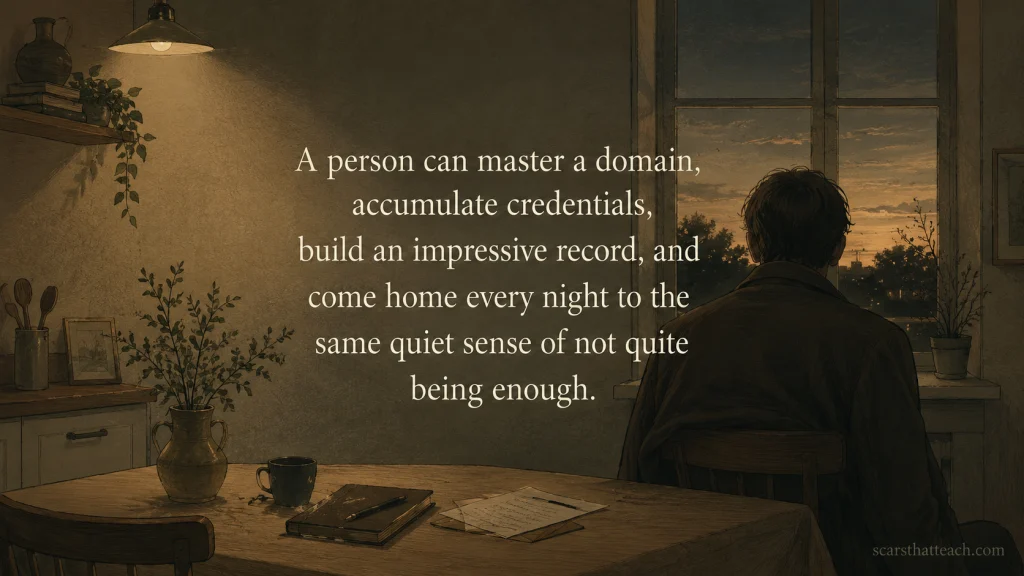
Unlike confidence, self-esteem does not grow primarily through skill acquisition. A person can master a domain, accumulate credentials, build an impressive record, and come home every night to the same quiet sense of not quite being enough. Confidence is built through what you do. Self-esteem is shaped more by how you have been seen, especially early, especially by people whose opinion felt like a verdict on your basic worth, rather than an assessment of your ability.
This is also why self-esteem tends to be more stable, and more resistant, in both directions. A person with a reliable underlying sense of worth does not lose it entirely when a project fails or a relationship ends. The foundation holds. And a person whose self-esteem has been thin for a long time does not recover it by achieving more, however much more they achieve. The achievement goes somewhere different. It does not reach the place where the question actually lives.
Why You Can Have One Without the Other
The difference between self-confidence and self-esteem becomes clearest when you look at the combinations that are actually possible in the same person. The table below is not a quiz. It is a map of two distinct things that have been treated as one.
| Self-Confidence | Self-Esteem |
|---|---|
| Situational: tied to specific abilities and contexts | General: underlying sense of overall personal worth |
| Can vary widely across different areas of life | Tends to function more as a stable baseline |
| Built through practice, experience, and evidence of ability | Shaped more by relationships and how you were seen |
| Answers the question: Can I do this? | Answers the question: Am I worth doing it for? |
| Can be high in one domain and low in another | Less domain-specific; more foundational |
Four combinations play out in real life, and all four are recognizable.
High confidence, high self-esteem: the person who is genuinely capable in specific domains and also carries a reliable sense of their own worth independent of how any given day goes. This combination tends to produce a kind of steadiness that is noticeable precisely because it does not depend on external confirmation.
Low confidence, high self-esteem: the person who knows they cannot do something yet and is at peace with that. Genuinely uncertain about their ability to handle a new situation, and still carrying a clear enough sense of themselves to believe the attempt is worth making. This was the second confession I heard in those hospice rooms. Not arrogance. Just a quiet foundation that uncertainty had not touched.
High confidence, low self-esteem: the most common among high achievers, and the combination that produces the most specific kind of suffering. Capable in certain domains, recognized for it, and still carrying something the recognition has never reached. I will come back to this one.
Low confidence, low self-esteem: both the belief in ability and the sense of worth are thin. This is the heaviest combination to be inside, and also the one where the two things feel most like a single problem, because they are pointing in the same direction at the same time. If you are trying to understand what low confidence specifically looks like in practice, there is a closer look at what low self-confidence is and how it shows up that covers that territory in more depth.

The Fragility Trap: When Confidence Has No Foundation
The high-confidence, low-self-esteem combination deserves more than a line in a list because it produces a very specific vulnerability that is poorly understood, especially by the people inside it.
When a person’s sense of worth is constructed almost entirely from competence and achievement, their inner stability becomes directly dependent on having those things on display. The skills need to keep performing. The recognition needs to keep coming. Not because the person is greedy for it, but because without it, there is nothing else to stand on. They have built a very tall structure on a foundation that was never laid. The structure holds as long as the performance does. Most of life is not a performance.
This is why high-achieving people so often describe a hollowness after accomplishing something significant. The promotion arrives. The book comes out. The award is given. And for a moment, or an afternoon, or a week, there is relief. The evidence came through again. Then it wears off. The question reasserts itself. Not enough surfaces again, because the achievement answered a question about what you can do, not about whether you are enough for being here at all. Those are different questions, and they require different answers.
I watched this pattern surface in people who, by any external measure, should have felt settled. People whose records were genuinely impressive. People whose colleagues deferred to them, whose families were proud. And inside the same person: a persistent, low-grade uncertainty about whether any of it added up to something real. Not despair, not crisis. Just the specific quiet of someone who has never quite been able to land in themselves, regardless of what the record said.
The fragility tends to show up in particular moments:
- When the relevant skills are not on display. At a party, in a new relationship, on a vacation where there is nothing to produce or perform.
- When the recognition stops or reverses. A bad review, a period of failure in the one domain where confidence was high.
- When the competence itself is threatened. Aging, illness, a shift in the field, the arrival of someone younger and faster.
- When the achievement arrives and the expected feeling does not. The moment after accomplishment when numbness is there instead of the satisfaction that was supposed to follow.
What makes this pattern difficult to address from the outside is that it does not look like a problem. The person is functioning. They are often functioning very well. The suffering is internal and quiet, and it tends to be dismissed, including by the person experiencing it, because the evidence in the room says there is nothing to complain about.
If you have noticed that your sense of yourself rises and falls more than you would expect, tracking closely with results, it may be worth reading about why self-confidence comes and goes, because that instability often has more to do with what is underneath the confidence than with the confidence itself.
Final Thoughts: Why Keeping These Separate Changes What You Do
The practical reason to keep self-confidence and self-esteem distinct in your thinking is that they require different things to actually change.
Confidence, because it is situational and built on evidence of ability, responds to practice. You can work at it in a specific domain and see real results. The mechanism is reliable within its scope. What it cannot do, on its own, is reach the more foundational question of worth. For that, something different is usually required, something more relational, more about being seen and received as worthy independent of performance, over time. This is why the approaches that build confidence in a skill set tend to produce only surface-level relief when the underlying question is a deeper one.
This is not the place to lay out how to build either in full. There is a piece specifically on how to build self-confidence that covers the practical side in more depth, and that is the better place to start if that is where you are.
What I can say from twenty years of watching people account for their lives is that the ones who seemed most settled were not necessarily the most confident. They were the ones who had found some version of an answer to the more foundational question. Sometimes late. Sometimes without the vocabulary to name what they had found. The answer was not in the record, not in the recognition, not in what they had produced. It was somewhere underneath all of that, and it held regardless of what the record said on any given day.
There is a collection of quotes on self-worth and self-acceptance that gets at some of this indirectly, in the way a particular phrase sometimes lands where a longer explanation cannot. And if you want a fuller picture of what the territory of self-confidence actually covers, including how it connects to esteem, worth, and the rest of the landscape, that is a reasonable place to continue.
FAQs
🔍 What is the difference between self-confidence and self-esteem?
Self-confidence is situational: it refers to belief in your ability to handle a specific task or context. Self-esteem is more general: it is an underlying sense of personal worth that does not depend on performance. A person can have high confidence in specific domains and low self-esteem overall, and the two problems require different things to address.
🤔 Can you have high self-confidence and low self-esteem at the same time?
Yes, and it is one of the more common combinations among high achievers. A person can be genuinely competent and widely recognized for it while still carrying an underlying sense of not quite being enough that their accomplishments have never touched. The achievements answer a different question than the one that is actually open.
💬 Are self-esteem and confidence the same thing?
They are related but not the same. Confidence is tied to ability and context, and can be high in one area and low in another. Self-esteem is a more foundational sense of worth that is not tied to performance. The fact that both get described with similar language is part of what makes the confusion so persistent and so costly.
⚖️ Which matters more, self-confidence or self-esteem?
They serve different purposes, so the comparison does not quite hold. Confidence helps you act in specific situations. Self-esteem provides a more stable foundation for what life feels like from the inside. A person can function effectively on confidence alone for a long time. Whether that is enough depends on what they are asking of themselves.
🏆 Why do successful people sometimes still feel like they are not enough?
Because achievement answers the confidence question, not the self-esteem question. If the underlying sense of worth was thin to begin with, recognition and accomplishment add to the record without touching the foundation. The feeling of not enough persists because it was never located in the record in the first place.
🌱 Can you build self-esteem the same way you build confidence?
Not in the same way. Confidence responds well to practice, repetition, and accumulated evidence of ability. Self-esteem is shaped more by relational experience, by being seen as worthy independent of performance, and that tends to change more slowly and through different conditions than skill-building does.