
Some people keep showing up for an effort long after the people around them stopped believing in it, and others stop once that belief disappears. This piece looks at what actually produces that difference, and it isn’t a fixed personality trait the way most explanations suggest. It comes down to a small set of learnable conditions: a clear enough reason for the effort, a sense of meaning that doesn’t depend on anyone else noticing, and the accumulated memory of having continued before. None of it means the people who stop are weaker, and none of it guarantees that building these conditions will make every effort succeed.

The Question Underneath the Question
There’s a real difference between the people who keep going without anyone cheering them on and the people who stop once the support disappears. It’s tempting to call that difference strength. I don’t think that’s what’s actually going on, and figuring out why some people keep going without support and others don’t has more to do with conditions than character. I used to get asked, fairly often, how someone managed to keep going when nobody around them believed it would work. Almost nobody had a clean answer to that. What I heard underneath it, more often than the question itself, was something quieter: whether they had always been the kind of person who could do that, or whether something along the way had made them that way.
That second question is the one worth answering, because it changes what you can actually do about your own situation. If sustained effort were just a trait some people are handed and others aren’t, there would be nothing useful to say to the people who don’t have it yet. But that isn’t what I watched happen across hundreds of conversations. What looked like willpower from the outside almost always had a more specific shape underneath it once you asked the right questions.

What Looks Like Willpower From the Outside
The people who kept going without external support tended to share three things, and none of them are personality traits in the way that word usually gets used. The first was clarity: they could tell you, specifically, why the effort mattered to them, in language that didn’t borrow from anyone else’s expectations. The second was an internal source of meaning, something the effort gave them regardless of whether anyone noticed or approved. The third, and the one people underestimate the most, was accumulated evidence. They had continued through something difficult before, even something small, and that memory functioned as proof that continuing was possible for them specifically.
None of those three things are fixed at birth. Clarity can be built by sitting with a harder question than most people bother to ask themselves: not what you want, but why you want it, and whether that reason survives contact with other people’s doubt. Internal meaning gets built the same way trust gets built with another person, through repeated small experiences that confirm the thing is worth doing on its own terms. And accumulated evidence is just what happens when you let yourself notice the times you already continued, instead of discounting them as luck or as not counting because nobody was watching.
Why “Grit” Isn’t a Full Explanation
Most of what gets written on this subject reaches for words like grit, resilience, or willpower, then stops there, as if naming the trait explained where it came from. It doesn’t. That’s the gap in most explanations of why some people succeed without support: they describe what got observed, not what produced it. Calling someone resilient describes what you saw in them. It doesn’t tell you what built it, and it quietly suggests that the people who don’t have it are simply missing something the resilient person has and they don’t. That framing is common, and I think it’s incomplete in a way that actually discourages the people who need a better explanation the most.
The more useful framing is that what looks like a trait is usually a specific combination of conditions: clear meaning, accumulated self-trust, and limited exposure to environments that repeatedly dismiss a person’s attempts before they get anywhere. That last part matters more than people give it credit for. A person who has been told, directly or through silence, that their effort doesn’t matter, tends to invest less in the next attempt, not because they lack resilience as a trait, but because something real happened to their expectation of what effort produces.
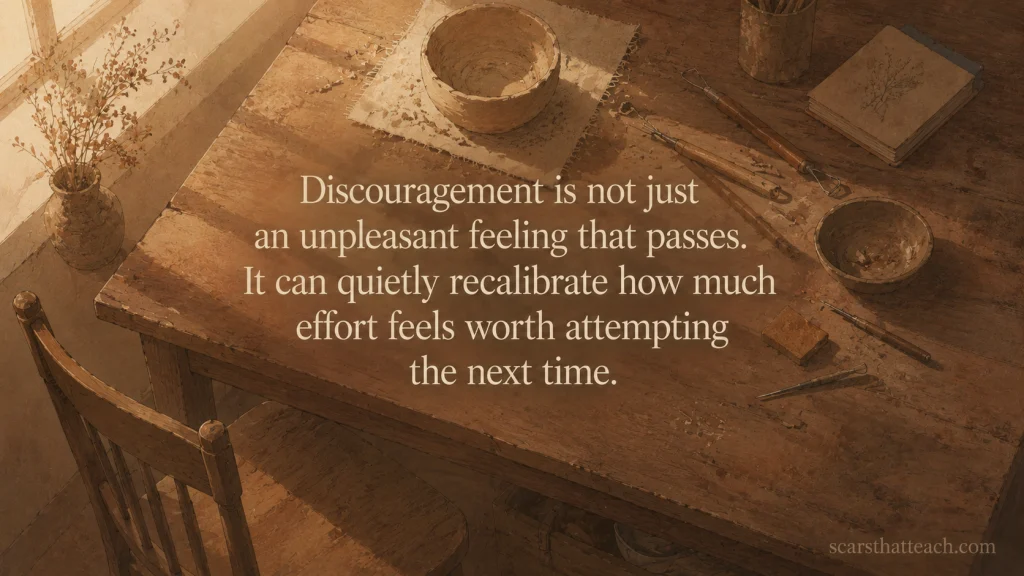
There is a concept from psychology called learned helplessness that sits near this idea, and it is worth naming carefully rather than reaching for it as a full answer. It describes how repeated experiences of failure or being dismissed can lower a person’s expectation that future effort will work. It was developed to explain a more specific and repeated kind of failure than what most people experience when a family member doubts a personal goal, so I would be careful applying it directly to your exact situation. What it does illustrate, even loosely, is that discouragement is not just an unpleasant feeling that passes. It can quietly recalibrate how much effort feels worth attempting the next time, which is closer to what is actually happening for most people who feel like they’ve lost their drive without support.

Building the Conditions Instead of Waiting for the Trait
If sustained effort comes from conditions rather than a fixed trait, the practical question becomes what to actually build, not what to wait around for. A few patterns showed up often enough in the people who managed to keep going that I think they’re worth naming as a starting point rather than a formula:
- A specific, personal reason for the effort that you could state without referencing anyone else’s approval or opinion of it.
- At least one small memory of having continued through something hard before, even if it felt minor at the time.
- A way to notice the effort’s value while it’s happening, rather than only at the end, since waiting for a finished result to feel meaning is a long wait.
- Distance, even temporary, from the specific people or rooms that consistently treat the attempt as pointless.
- A willingness to count the small continuations as evidence, instead of dismissing them because no one else saw them happen.
What makes people keep going rarely looks dramatic from the outside. It tends to be smaller and more repeatable than that. I sat with a man once, a composite drawn from several conversations rather than any one person, who said the only thing that kept him working on something nobody in his family supported was a one line note he kept rereading, a sentence he had written for himself early on about why it mattered. He hadn’t thought of it as a strategy. It just turned out to be the clearest thing he had when the doubt around him got loud.
Final Thoughts: This Isn’t About Who’s Stronger
I want to be clear about what this isn’t saying. The people who stop when support disappears are not weaker, and resilience without external validation is not a moral achievement that some people earn and others fail to. Most of the time, it comes down to whether the reason was clear enough, whether you’d let yourself count what you’d already survived, and how much dismissal got in before you ever got started. None of that is something to feel behind on. Building those conditions can help. It does not guarantee that the specific thing you’re working toward will succeed, and I’m not going to tell you otherwise.
If the doubt you’re carrying comes specifically from people close to you rather than from inside the effort itself, it might help to look at how to believe in yourself when no one else does, or, if you’re trying to build the internal meaning piece on its own, at how to stay motivated without external validation. For more on what actually keeps people moving when nobody around them is convinced, there’s a broader collection under staying motivated when no one believes in you. And if you want the shorter version of all of this in someone else’s words, there’s also a collected set of motivational quotes worth sitting with, the kind that hold up after you’ve actually lived through what they’re describing.
FAQs
🔥 Why do some people keep going without support and others don’t?
It usually comes down to three learnable conditions rather than a fixed trait: a clear personal reason for the effort, an internal sense of meaning that doesn’t depend on outside approval, and accumulated evidence of having continued before. People who have all three tend to keep going even when support disappears.
🌱 Can resilience without external validation actually be built?
Yes, though it builds slowly and through repetition rather than through one decision. It comes from noticing the small continuations you’ve already managed and treating them as real evidence, not luck.
🤔 Is it a character flaw if I need other people’s support to keep going?
No. Needing support is common and human, not a weakness. What changes the picture isn’t character, it’s whether you’ve had the chance to build clarity, internal meaning, and a track record of continuing on your own terms.
🧠 What is learned helplessness, and does it explain this?
It’s a psychology concept describing how repeated failure or dismissal can lower a person’s expectation that effort will work. It’s a useful adjacent idea here, but it was built around a more specific kind of repeated failure, so I wouldn’t apply it directly to family doubt about a personal goal.
💡 What’s the fastest way to find a personal reason that holds up?
Ask why the effort matters to you specifically, in words that don’t borrow from anyone else’s expectations, then ask whether that reason still holds once you imagine no one ever finding out you did it. If it does, it’s usually clear enough to work with.