Heartbreak after divorce is not the same size as heartbreak after a breakup, even though people often expect it to feel that way. I spent two decades sitting with people at the end of life, and I watched more than a few of them describe a divorce decades old with the same weight they gave to losing a spouse to death. What makes this kind of grief different is scale. You are not just losing a person. You are losing a shared identity, a routine, an extended family, and a version of your own future that had someone else built into it. This piece is about that scale, why the role of spouse tends to outlast the marriage itself, and what I have seen help people carry a loss this large without shrinking it down to fit a breakup-sized frame.
A Man Who Still Introduced Himself as Married
Heartbreak after divorce rarely announces itself as heartbreak at first. There was a man I sat with, years into his hospice care, who introduced himself the same way every time a new nurse or chaplain walked into the room. He gave his old job title, one he had not held in over a decade, and then, in the same breath, mentioned his wife, from whom he had been divorced for almost as long. He did not say ex-wife. He did not correct himself. Both facts came out of him as though they were still load-bearing, still part of the structure holding him up, even though neither one had been true for years.
A breakup ends a relationship. A divorce ends a relationship and also dismantles a whole world that person had been standing inside for years, sometimes decades. The wedding ring comes off. The legal paperwork gets filed and finalized. But the identity built around being someone’s spouse does not dissolve on the same schedule as the marriage did, and that mismatch is where a great deal of this particular grief actually lives.
Why Divorce Grief Is a Different Size Than Breakup Grief
A breakup, even a devastating one, usually ends a chapter. A divorce tends to end an entire world that chapter was built inside of. There is the shared last name, or the choice not to share one. There are in-laws who became, in some real sense, your own family, and who you now have to figure out how to relate to, or not. There is the shared home, the shared finances, sometimes shared children, and a whole calendar of routines built around two people instead of one. Losing all of that at once is a different scale of loss than losing a partner you dated for a year or two, even if the sadness in both cases is real. The emotional pain of divorce comes from that scale, not from any single moment inside it.
Grief researchers describe a kind of mourning that begins before the actual loss occurs, sometimes called anticipatory grief, and divorce often carries a long stretch of exactly that. Many marriages do not end cleanly on a single day. They end slowly, over months or years of growing distance, before the legal ending ever arrives. By the time the paperwork is signed, a person may have already grieved the marriage privately for a long stretch, which can make the outside world’s expectation, that grief should now begin, feel strange and out of sync with where that person actually is inside.
A Loss With Almost No Ritual Attached to It
When someone dies, the people around you generally know what to do. There are services, gatherings, a shared understanding that you need space and support. Divorce carries almost none of that structure, even though the loss underneath it can be just as disorienting. Friends send a few sympathetic messages in the first week or two, then quietly expect you to be functioning again. Family members sometimes take sides, which adds a layer of social complication that death rarely brings. The person you lost is often still alive, still visible, sometimes still present at school events or family gatherings if there are children involved, which keeps reopening a wound that never quite gets the chance to close in the way a more final loss might.
This is part of why divorce grief so often gets minimized, by other people and by the person living through it. Nobody died, so it can feel almost embarrassing to grieve this hard. But the size of what ended, a shared life, a shared identity, a shared set of plans for the years ahead, does not shrink just because the loss lacks a funeral. The absence of ritual does not mean the absence of loss. It just means you are carrying it without the scaffolding that other losses come with.
The Role That Outlasts the Marriage
Here is the part of this grief that I think gets talked about the least. Most divorce content either walks people through the legal and financial logistics, or it repackages generic breakup advice for an older audience. Neither one addresses what actually happens to a person’s sense of self when a role they answered to for years, spouse, no longer applies, while the practical scaffolding of that role keeps quietly persisting in the background.
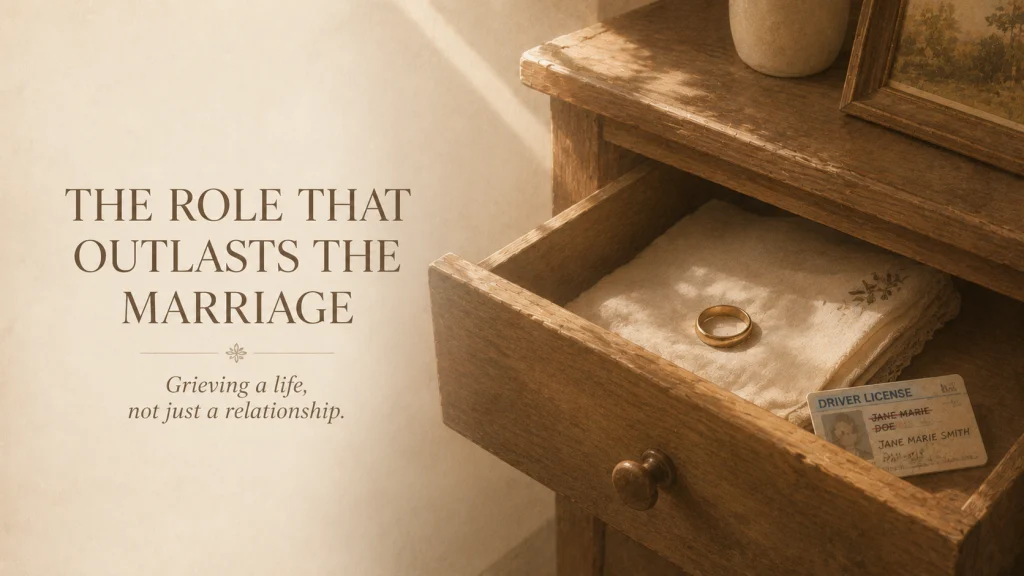
A shared last name might stay on a driver’s license for months after the divorce is final, simply because changing it takes effort nobody has energy for yet. In-laws who became genuine family over the years do not disappear from a person’s life just because a marriage did, and untangling that relationship, or choosing to keep it, is its own separate grief entirely. A wedding ring might sit in a drawer rather than get sold or put away for good, not out of hope for reconciliation, but because deciding what to do with it means deciding, all over again, that the marriage is really over. All of that scaffolding tends to outlast the grief’s sharpest edge, which means a person can look, from the outside, like they have moved on, while quietly still carrying pieces of a role that no longer technically exists.
Signs You Are Grieving a Life, Not Just a Relationship
Divorce grief does not always look like sadness over missing a specific person. More often, it shows up as a kind of quiet disorientation about who you are now that a place you lived inside for years is gone. These patterns tend to show up often enough that they are worth naming directly.
- You still refer to your ex by their relationship to you, “my husband” or “my wife,” before catching yourself mid-sentence.
- You feel a strange grief over losing in-laws or extended family, separate from any grief over losing your former spouse.
- Routines built around being married, holidays, weekend plans, who calls whom first, still ache even though the marriage does not.
- You avoid dealing with practical remnants, a shared last name, a wedding photo, a joint account, because handling them means facing how final things actually are.
- You hesitate over the marital status box on a form, unsure whether “divorced” fits how you actually feel yet.
- You are not sure whether to take down the family photos on the wall or leave them up a little longer.
- You feel unsure how to introduce yourself, professionally or socially, in a way that reflects who you are now rather than who you were.
None of this means you are handling the divorce poorly. It means you are grieving something with more moving parts than a single relationship, and those parts do not all finish grieving on the same timeline.
What People Get Wrong When They Try to Rush This
The most common mistake I have watched people make is treating divorce grief like it should follow the same shape and timeline as a breakup, just scaled up slightly. They expect that once the legal process ends, the emotional process should wrap up shortly after. When it does not, when they are still catching themselves saying “we” months or years later, or still setting two coffee cups out of habit before remembering there is only one person to make coffee for now, they read that as a sign something is wrong with how they are coping.
What actually explains it is simpler than that. A divorce asks a person to grieve several losses that happen to be bundled together, a partner, a shared identity, an extended family, a version of the future, and each of those pieces can finish grieving on its own separate schedule. The clearer path is not to expect a single finish line. It is to notice which specific piece is still aching on a given day, the person, the role, the family, the imagined future, and to let that piece have its own time, rather than treating the whole thing as one grief that either is or is not finished.
Final: What I Would Tell Someone Sitting With This
I would tell them that there is no single day when a divorce finishes ending. It ends in pieces, at different speeds, and most of those pieces do not announce themselves when they are done. The name gets changed on a form without ceremony. The ring finally gets put away in a box instead of a drawer. And then, one day, without planning it, you introduce yourself somewhere new and your former spouse simply does not come up, not because you are avoiding the subject, but because it genuinely was not the first thing your life reached for anymore.
That is closer to what healing after divorce actually looks like than any finish line. Not a moment where the grief is declared over, but a quiet accumulation of moments where the old role stops being the thing your sentences reach for first. The man I mentioned at the start never had that moment, even decades on. He is not a cautionary tale. He is simply proof of how long a role can keep speaking for someone if nobody ever gently sets it down. If any part of what you are carrying involves legal decisions, finances, or custody arrangements, that is not territory this kind of reflection can responsibly cover, and a family law professional is the right person for that part. What this can offer is the other half, the quiet, unannounced work of becoming someone whose sentences no longer need the marriage to explain them.
If this loss is only one part of a larger heartbreak you are trying to make sense of, it may help to see how this sits alongside the other ways heartbreak shows up, since a divorce rarely grieves in the same shape as a shorter relationship ending. And if part of what you are carrying involves a marriage that was not just difficult but genuinely harmful to be inside, that calls for a different kind of reckoning, one covered in the collection on toxic relationships.
FAQs
💔 Why does divorce grief feel heavier than a regular breakup?
A divorce ends more than a relationship. It dismantles a shared identity, an extended family, and a built life, so the grief carries the weight of several losses at once, not just one.
🏠 Why do I still feel married even after the divorce is final?
The legal ending and the identity ending rarely happen on the same schedule. A shared name, in-laws, or old routines can persist long after the marriage itself is over, which keeps the role feeling present.
👪 Is it normal to grieve losing my in-laws too?
Yes. In-laws who became real family over the years are a separate loss from the marriage itself, and grieving that relationship on its own timeline is common and not a sign anything is wrong.
🕰️ How long does heartbreak after divorce usually last?
There is no fixed timeline, and it is normal for it to take longer than a breakup would, since several different losses are bundled into one ending. Each piece, the person, the family, the identity, may finish grieving at its own pace.
📋 Should I get legal or financial advice for my divorce?
For anything involving custody, property, or finances, a family law attorney is the right person to help with those decisions. This kind of reflection stays focused on the emotional and identity side of divorce, not the legal one.
🌀 Why do I sometimes miss being married more than I miss my ex specifically?
That is a common and separate grief from missing the person. It usually means you are mourning the structure and identity of being married, not necessarily the specific relationship that ended.