
Most people know the growth mindset versus fixed mindset framing as a personality label: you are either the kind of person who believes you can improve, or you are not. That is not what Carol Dweck’s research actually says. She has been explicit that everyone carries a mixture of both, and that certain situations reliably pull even a growth-oriented person back into fixed-mindset thinking. I have spent two decades watching what people believe about their own capacity for change, usually at the exact moment it stops mattering how the label sounded on a poster. What follows is the distinction as Dweck herself describes it, and why the tidier version of it costs people more than they realize.

What Fixed Mindset and Growth Mindset Actually Mean
I sat with a man in his late seventies who spent the last conversation I had with him talking about a business he never started. Not one he tried and lost. One he never let himself attempt, because somewhere in his thirties he had decided he was not the kind of person who succeeded at that sort of thing. He did not call it a growth mindset vs fixed mindset problem. He did not have that language. But that is exactly what he was describing: a belief, held for four decades, that his ability to build something was fixed rather than something he could have developed.
Carol Dweck’s research defines a fixed mindset as the belief that intelligence and ability are essentially fixed traits you either have or do not, ones that effort cannot meaningfully change. A growth mindset is the belief that ability can be developed over time, through effort, strategy, and the willingness to keep learning after failing. That is the whole distinction at its core. It is simple enough to fit on an index card, which is part of why it gets flattened the way it does. The kind of effort that actually moves someone from one side of that line to the other rarely looks like what gets described in what real discipline looks like when it is not about forcing yourself, and that gap between the popular version and the practice is worth sitting with.
The Fixed Mindset Meaning People Usually Skip Past
The fixed mindset meaning that gets lost in most explanations is not the definition itself. It is what the belief actually does to a person once it takes hold. If you believe your abilities are carved in, every challenge becomes a referendum on whether you are good enough rather than a chance to get better. Failure stops being information and starts being a verdict. I watched this in patients who had spent entire careers avoiding rooms where they might not look competent, and I watched it in their adult children, who inherited the same wiring without ever being told where it came from.
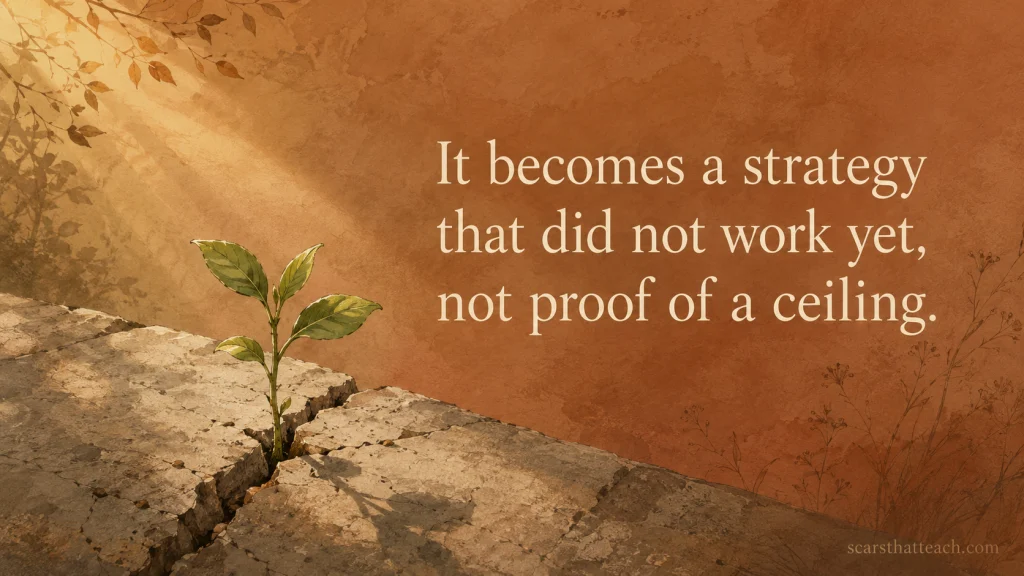
A growth mindset definition, by contrast, treats a setback as data rather than a sentence. The person who holds it still feels the sting of failing. Dweck’s work is not claiming otherwise. What changes is what the failure is allowed to mean. It becomes a strategy that did not work yet, not proof of a ceiling. That distinction sounds abstract until you watch two people receive the same piece of hard news and walk away with completely different relationships to what comes next.
A person can hold this belief about one narrow corner of life without it touching anywhere else. I sat with a woman who had run three restaurants, negotiated commercial leases without flinching, and rebuilt her business twice after it nearly folded. She still described herself, in the same conversation, as someone who was simply “not creative,” because a teacher had said something dismissive about her drawings when she was eleven years old. Decades of evidence had built a growth mindset around risk and money. One offhand sentence from childhood had never once been revisited, and it still ran her relationship to anything artistic.

Why Dweck Calls It a Continuum, Not a Category
Here is the part that most content built around this topic leaves out entirely. Dweck has directly addressed the oversimplification of her own framework, acknowledging that her team spoke about growth mindset and fixed mindset as if they were two distinct worlds partly for the sake of simplicity, and that the simplification created a false picture. Her actual position is that mindset operates on a continuum, and that the same person can hold a growth mindset in one domain of life while defaulting to a fixed one in another. A surgeon confident in her ability to master a new technique in the operating room can still believe, without examining it, that she is simply bad with money and always will be.
What I noticed, more times than I can count, is that the domain where someone gets stuck in a fixed mindset is rarely random. It tends to be the domain tied to an old wound, an early humiliation, or a comparison that got made once and never got questioned again. A person does not wake up one day and decide they are permanently bad at public speaking. Usually something happened, once, at a vulnerable age, and the belief calcified around it quietly enough that they stopped noticing it was a belief at all.
What keeps a belief like that in place for forty years is not usually stubbornness. It is avoidance, and avoidance is quiet enough that most people never notice they are doing it. Once someone decides a domain is not their strength, they stop putting themselves in situations that could prove otherwise. No new evidence comes in, so the old evidence never gets outweighed. I watched this play out in a man convinced he was simply bad at relationships after one difficult marriage in his twenties, a belief he had never once tested again across three decades of choosing not to get close to anyone. I watched it in a woman certain her career had a ceiling, because one manager years earlier had passed her over, and she had never applied for another promotion since to find out if that manager had simply been wrong. Neither of them thought of themselves as afraid. They thought of themselves as realistic.
Dweck’s own writing points to specific triggers that tend to activate the fixed mindset even in people who generally lean toward growth. A few of the ones that show up most often in the situations I have watched people work through:
- Being compared directly to someone else, especially in front of others
- Facing a challenge in the exact area where an old failure or embarrassment happened
- Receiving feedback that feels like it is about who you are rather than what you did
- Entering a high-stakes moment where the outcome feels like it will define your worth, not just the task
Recognizing which of these apply to you does more than any amount of general encouragement to “believe you can grow.” It tells you where to actually look. This is the part the tidier version of the framework cannot offer, because it was never built to explain your specific pattern. It was built to explain the concept in general, which is also why whether the growth mindset research actually holds up is a fair question to ask before taking any of this on faith.
What People Get Wrong When They Try to Apply This
The most common mistake I see is someone deciding they have a fixed mindset, full stop, based on one area of life where they consistently avoid risk. That single data point becomes an identity rather than a pattern worth examining. The opposite mistake happens just as often: someone declares they have a growth mindset because they read the book and liked the idea of it, without ever noticing the specific rooms where their own fixed thinking still runs the show. Dweck herself has warned about this exact failure mode, describing it as a kind of false growth mindset, where people adopt the language without doing the harder work of noticing their own triggers.
This sounds simple until you are the one holding it. Most people can nod along with the idea that mindset is situational. Naming your own specific trigger, the one tied to the thing you actually avoid, is a different exercise entirely. It usually requires being honest about an old moment you would rather not revisit, which is exactly why so many people settle for the label instead of the work.
I am not going to tell you which domain that is for you. I do not know your history, and pretending a general framework can diagnose your specific situation would be dishonest. What I can tell you is that the domain exists, and that finding it is more useful than any amount of repeating “I have a growth mindset” to yourself before a hard conversation or a difficult task. Once you have actually named it, practical ways to build a growth mindset stop being generic advice and start being something you can actually use.

Final Thoughts: The Distinction That Actually Helps
The man I mentioned at the start did not need a growth mindset seminar. He needed someone to ask him, plainly, when he first decided he was not the kind of person who built things. He could not answer right away. When he finally did, decades later, in a hospice room, it was not the business he grieved most. It was the four decades he spent treating a belief as a fact.
You still have time to ask yourself that question, which is more than most of the people I sat with had left. None of this is about willpower, and it is not about gritting your teeth through something you hate. It is closer to patience with yourself, applied to the one domain you have been avoiding without quite admitting it. If you are working through other questions about how belief and capacity actually interact, there is more on that in questions about growth mindset and how it actually works.
FAQs
🧠 What is the actual difference between a fixed mindset and a growth mindset?
A fixed mindset is the belief that your abilities are set traits you cannot meaningfully change. A growth mindset is the belief that abilities can be developed through effort and strategy over time. Both describe beliefs about capacity, not fixed personality types.
🔄 Can someone have a fixed mindset in one area and a growth mindset in another?
Yes, and this is closer to Dweck’s actual position than the popular version of the framework. Most people lean toward growth in some parts of life and default to fixed thinking in others, usually in the area tied to an old failure or comparison.
❓ What is a fixed mindset, in plain terms?
It is the quiet belief that you are simply not the kind of person who can improve at something, so trying feels pointless or risky. It often forms around one specific failure early on and gets treated as permanent evidence rather than a single data point.
🚫 Is having a fixed mindset in one area always a bad thing?
Not automatically. It becomes a problem when it stops you from attempting something you actually want, or when it gets mistaken for a fact about who you are rather than a belief worth questioning.
🔍 How do I know which area of my life still runs on a fixed mindset?
Look for the place where feedback feels personal rather than practical, or where you avoid a challenge specifically because you are afraid of what failing there would say about you. That reaction usually points to the domain worth examining.
💬 Did Carol Dweck really say her own framework gets oversimplified?
Yes. She has directly addressed the binary version of growth and fixed mindsets as an oversimplification of her actual research, and has described mindset as a continuum where situational triggers matter more than a fixed label.