How to get over a situationship is a strange question to have to ask, because half the difficulty is convincing yourself the grief is even allowed. I spent two decades sitting with people at the end of life, and some of the hardest losses to watch someone carry were the ones nobody else had agreed to call real. This piece is about why an undefined connection can hurt like a real relationship without ever earning the name of one, what actually makes this kind of ending so hard to close, and what I have seen help people stop arguing with themselves about whether their pain has permission to exist.
Grief Nobody Else Agreed to Name
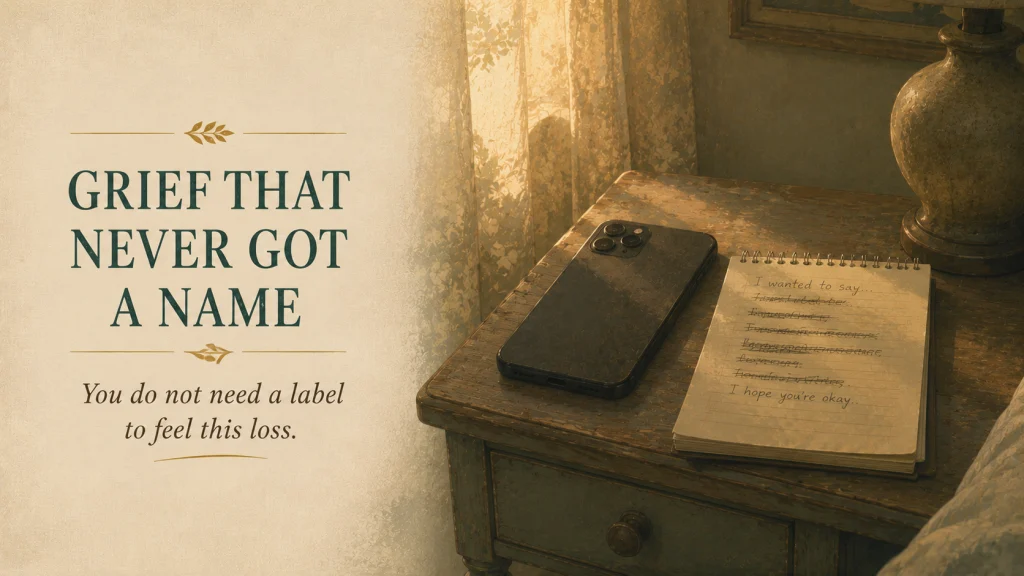
Over the years, I sat with a number of people who carried old losses that had never been spoken aloud to anyone, not because the losses were small, but because no one else involved had ever agreed the thing even had a name. Getting over a situationship carries some of that same quality. The other person never called you their partner. There was no title to lose, no anniversary to grieve, no one to send condolences over something that, on paper, never officially existed. And yet the loss can sit in a person’s chest with a weight that has nothing to do with what anyone agreed to call it.
This is one of the loneliest shapes grief can take. Not because the feeling itself is unusual, but because the person carrying it often has to argue for its legitimacy before they can even begin to feel it fully. Real intimacy, real hope, real emotional investment can exist entirely inside something that was never given an official shape, and losing it can hurt just as much as losing something the world agreed to recognize, while offering none of the built-in permission an official ending comes with.

What Actually Makes a Situationship So Hard to Define
A situationship is a romantic connection that carries real emotional or physical closeness without ever settling into a clear label, a clear exclusivity, or a clear future. There may be regular contact, real vulnerability, even a version of intimacy that looks a great deal like a relationship from the outside. What is missing is the shared agreement about what the connection actually is. One person might quietly consider it something building toward more. The other might consider it something comfortable precisely because it asks for nothing definite.
That gap between the two private understandings is where most of the pain later lives. Because nothing was ever formally agreed to, the ending often does not arrive as an event either. There is rarely a conversation that closes it out. More often it fades through slower replies, less frequent contact, and a quiet mutual understanding that neither person ever says out loud, until one day it has simply stopped. That kind of ending leaves nothing to point to and nothing to properly mourn out loud, because from the outside, there was never anything there to lose.
The Grief You Have to Justify Before You Can Feel It
Most of what gets written about situationships treats the pain as a problem to fix, something to solve with better boundaries or clearer communication next time. That is useful advice for the next connection. It does very little for the grief sitting in front of a person right now. The deeper truth, the one that gets left out most often, is that this kind of loss asks something extra of the person carrying it. Before they can even start processing the pain, they usually have to convince themselves, and often other people, that the pain is allowed to exist at all.
Friends mean well when they say things like “it wasn’t even a real relationship” or “you’re better off, it was never going anywhere.” What they are usually trying to offer is comfort. What it often does instead is put the grieving person in the position of having to defend something they are still trying to understand themselves.
Why an Unclear Ending Is Harder for the Mind to Set Down
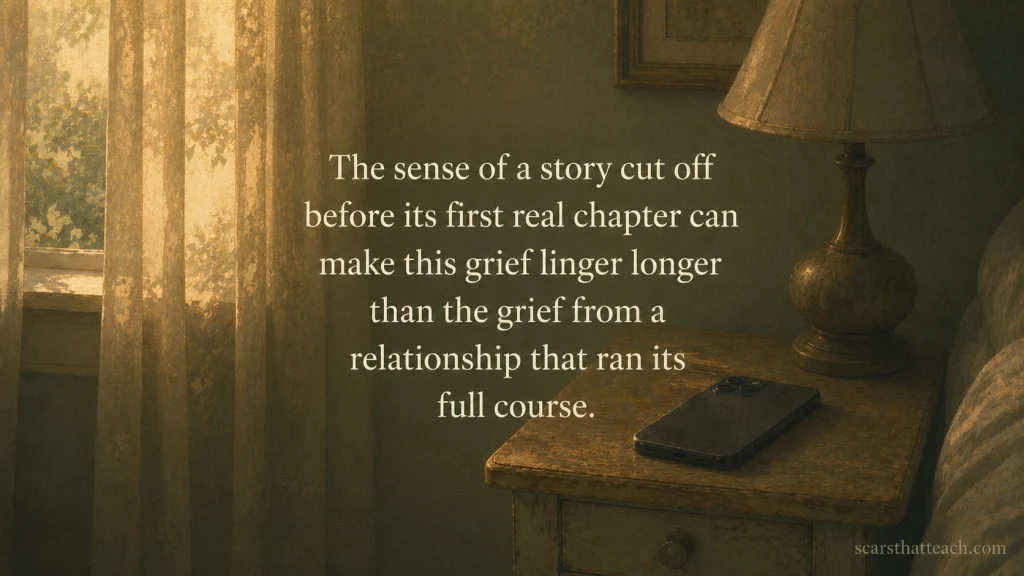
There is a particular kind of ache unique to this ending. Because nothing was ever confirmed, the connection can feel like it never got the chance to become what it might have, and that unfinished quality can make this grief linger longer than the grief from a relationship that ran its full course and ended for a clear reason. The mind tends to hold onto open questions in a way it does not hold onto closed ones. A relationship that ends with a clear cause gives you somewhere to file the memory. An ending with no clear cause keeps getting pulled back out, turned over, and examined again, because some part of you is still waiting for the missing piece that would let you finally set it down.
This is also why the replaying so often centers on the ambiguity itself rather than on the person. You are not always missing them specifically when their name crosses your mind at two in the morning. Often you are mourning a future you built quietly in your own head, one that was never confirmed or denied, just left open long enough for you to furnish it with real hope. Missing a person and mourning an imagined future can feel identical from the inside, but they call for different things. Missing a person softens with time and distance. Mourning an imagined future softens only once you let yourself admit that the future was yours alone, built without their agreement, and that grieving it does not mean you were wrong to have wanted it.
It is also worth saying plainly why other people so often make this harder without meaning to. Someone who has never sat inside an undefined connection tends to measure loss by its label, because a label is the only evidence they know how to look for. When they cannot find one, they assume there is nothing there to grieve, and they say so, gently or not, in ways that can leave the grieving person feeling foolish for hurting at all. That reaction says more about how unfamiliar this kind of loss is to talk about than it does about whether your pain makes sense.
Signs You Are Grieving Something Left Unspoken
This kind of loss shows up in ways that are easy to miss or dismiss, both by the person feeling it and by the people around them. A few patterns tend to repeat often enough to be worth naming plainly.
- You rehearse a version of the story that sounds more “official” before telling anyone, because the real version feels too flimsy to justify how much it hurts.
- You keep checking whether they have posted anything new, not out of curiosity, but because there was never a clean goodbye to close that loop.
- You catch yourself missing a future you built in your head, one the other person may never have agreed to or even known about.
- You feel a flash of shame alongside the sadness, as though grieving this proves you misjudged what it was.
- You find yourself replaying the ambiguity itself, wondering what you were to each other, more than replaying any specific memory.
None of this means you were foolish for feeling what you felt. It means you were emotionally present inside something that never got the structure to hold your feelings properly, which is a very different thing from feeling something that was not real.
How This Differs From Other Kinds of Heartbreak
It helps to be clear about what this grief is not, because the wrong comparison can make it harder to sit with honestly. If the other person never returned your feelings at all, that is a different and separate ache, closer to the pain of loving someone who never loved back. A situationship is not that. There was mutual intimacy here, even if there was never a mutual agreement about what it meant.
It is also worth naming if this connection kept ending and restarting, fading out only to pick back up again weeks or months later, again and again. That particular pattern carries its own specific exhaustion, closer to a relationship that keeps cycling apart and back together. What this piece is about is narrower than either of those: an ending, whether sudden or slow, of a connection that was emotionally real without ever being declared.
What People Get Wrong When They Try to Move Past This
The most common mistake I have seen is trying to reason the feelings away instead of letting them run their course. People tell themselves it does not count, that they have no right to be this affected by something that was never official, and then they get frustrated with themselves when the logic does not make the ache go away. Logic rarely works on grief of any kind, and this kind is no exception. Reminding yourself constantly that “it wasn’t even real” does not close the loop. It just adds a layer of self-judgment on top of a pain that was already hard enough to sit with honestly.
What actually helps is closer to the opposite. Naming the connection honestly, to yourself first, as something that carried real closeness and real hope, even without a label, tends to do more good than minimizing it ever does. The clearer path is not to prove the relationship was legitimate enough to justify your grief. It is to accept that grief does not require a certificate. If something mattered to you, that is reason enough to let yourself feel its absence.

Final: What I Would Tell Someone Sitting With This
I would tell them that the hardest part of this grief is rarely the missing itself. It is the second job the missing comes with, the work of constantly proving to yourself that you are allowed to feel it. Near the end of their lives, most people do not sit around sorting their memories by which relationships had the right paperwork. Very few of the people I sat with measured their regrets by whether a relationship had been properly labeled. They measured them by whether something had mattered, and by whether they had let themselves feel it honestly while it was happening, and afterward.
You do not owe anyone, including yourself, a legal case for why this hurts. The absence of a name was never proof of the absence of a bond. Let the grief be exactly the size it actually is, and let it move at its own pace, the same as you would for a loss that came with a title attached.
If this loss is only one part of a larger heartbreak you are trying to make sense of, it may help to see how this sits alongside the other ways heartbreak shows up, since an unnamed ending rarely grieves in the same shape as an official one. And if part of what you are carrying involves a connection that was not just undefined but genuinely harmful to be inside, that calls for a different kind of reckoning, one covered in the collection on toxic relationships.
FAQs
💔 Why does a situationship breakup hurt so much if it wasn’t official?
The intimacy and hope inside it were real, even if the label never was. Grief responds to what was actually felt, not to whether anyone agreed to call it a relationship.
🕰️ How long does situationship heartbreak usually last?
Sometimes longer than people expect, because the lack of a clear ending or a clear reason can leave the story feeling unfinished. There is no fixed timeline for closing a loop that was never fully closed to begin with.
🤐 Why do I feel embarrassed telling people I’m grieving a situationship?
Because there is no social script for this kind of loss the way there is for an official breakup. That absence of a script does not mean the grief is any less legitimate.
🧭 How do I know if I’m getting over a situationship the right way?
There is no single right way, only whether you are letting yourself feel it honestly instead of arguing yourself out of it. Naming what it meant to you, even privately, tends to help more than minimizing it.
🌀 Is it normal to still think about what we could have been?
Yes. Situationships often end without answers, which leaves the imagined future more present than it would be after a clearer ending. That lingering “what if” is common and not a sign you are stuck.