
A false growth mindset is what happens when someone adopts the language of growth without changing anything underneath it: saying “I love a challenge” while still avoiding the ones that actually scare them, or telling themselves to keep trying without ever asking what to try differently. Carol Dweck named this problem herself, in her own writing, after watching her framework get flattened into a slogan. I have watched the adult version of this just as often as the classroom version. It sounds encouraging. It rarely helps. What follows is the difference between the two, and why the gap matters more than it looks like it should.

Encouragement That Fails Without Being Cruel
Some of the least helpful things I have ever said to a person in pain were kind. I noticed this early, sitting with families who had been told, endlessly, to stay strong and keep trying. Nobody meant harm by saying it. But telling someone to keep trying, without giving them anything wiser to try next, asks them to keep doing the thing that already was not working, just with more determination attached to it. That is not encouragement. It is a demand dressed up as support, and it tends to leave the person more discouraged than before they heard it, because now they have also failed at trying harder.
A false growth mindset works the same way. It borrows the vocabulary of growth, the talk of embracing challenges and learning from failure, without changing the actual conditions underneath the struggle. It sounds like belief in the person. It functions like abandonment with better branding.
What Dweck Actually Meant by False Growth Mindset
Carol Dweck introduced this term herself, in a 2015 piece for Education Week, after her colleague Susan Mackie noticed something troubling in schools. Educators were claiming to have a growth mindset, using all the right words, while their actual words and actions toward struggling students told a different story. Dweck wrote that a growth mindset had become the fashionable identity to claim, almost a moral position, which meant people adopted the label faster than they adopted the substance behind it. She was not describing dishonesty exactly. She was describing a gap between the vocabulary someone reaches for and what they are actually doing differently.
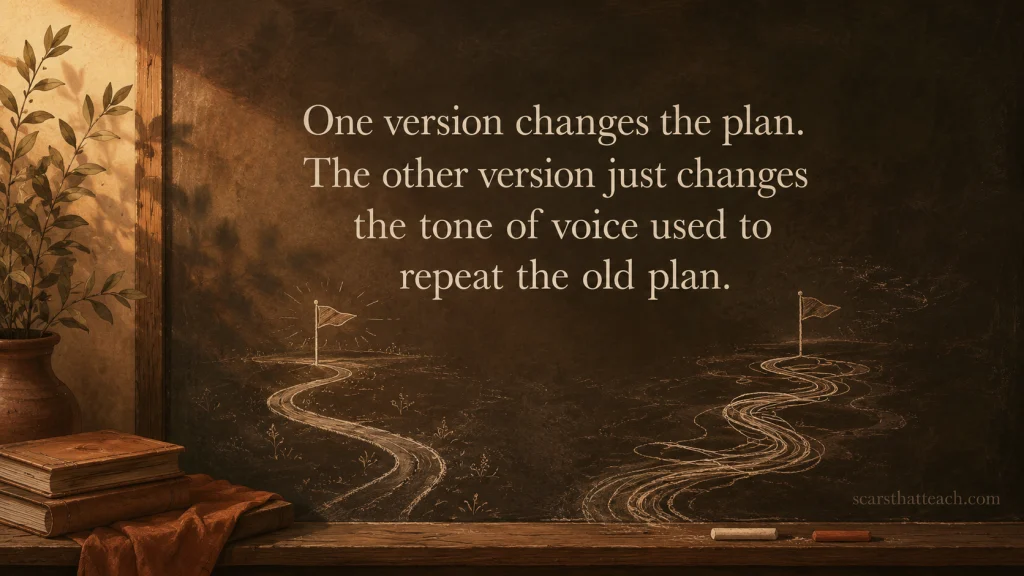
The distinction she drew is specific and worth sitting with. A real growth mindset asks what would actually help someone improve next time, whether that is a different strategy, more support, or better feedback. A false growth mindset says keep trying, and then quietly treats continued struggle as proof that the person still is not thinking about it correctly, as if the fix for a bad approach is simply more enthusiasm applied to the same bad approach. The plan stays untouched. Only the tone used to repeat it gets warmer. This is the same nuance covered from a different angle in what Dweck’s actual framework says about fixed and growth mindsets, where the binary version of her theory gets flattened in a similar way.
What a False Growth Mindset Sounds Like in Adult Life
Outside a classroom, false growth mindset rarely announces itself with a poster. It shows up quietly, in the private language people use to manage their own disappointment. It has less to do with what they say to other people and more to do with the vocabulary they hand themselves after something has not gone well, one that sounds like growth but functions as a way of avoiding the harder, more specific question underneath it.
A few places I have watched this pattern show up in adults trying to apply the idea to their own lives, without any teacher or classroom involved:
- Telling yourself “I just need a better attitude” after a project fails, instead of asking what specific part of your approach did not work
- Repeating “failure is feedback” as a private mantra without ever actually sitting down to extract what the feedback was
- Praising your own effort level as proof of growth, while quietly avoiding the one kind of feedback that would tell you whether the effort was aimed in the right direction
- Treating a growth mindset as a personality you have successfully adopted, rather than a specific practice you either did or did not apply to the situation in front of you
One version of this that shows up often enough to describe in full: someone hits a plateau at the gym after months of steady progress, and instead of asking a trainer to look at their form or checking whether their program still matches their goals, they simply tell themselves they need to want it more. They add another rest-deprived early morning session, repeat “no excuses” under their breath, and the plateau holds for another six months. The plan never changed. Only the intensity of the self-talk did. A version of this shows up just as often in therapy, where a person can leave session after session having said all the right words about growth and vulnerability, while never actually bringing up the one specific conflict the whole pattern is built around. The language of the work was present. The actual work was being quietly avoided underneath it.
In every one of those, the language is technically correct and the actual behavior has not moved an inch. That gap is the entire concept. It is not about whether someone means well. Most people applying a false growth mindset to themselves mean it sincerely. The problem is that sincerity was never the missing ingredient.

The Question That Actually Separates the Two
If you want a single test to tell the difference in your own thinking, it is this: after something goes badly, are you asking what you would try differently, or are you asking whether you tried hard enough. The first question points somewhere specific and testable. The second is a dead end dressed up as self-improvement, because effort is rarely the variable a stuck situation is actually missing. What is usually missing is a sharper approach, someone else’s help, or a clearer picture of what is not working yet.
This distinction also explains why some encouragement lands as motivating and some lands as insulting, even when the words are nearly identical. Being told to try harder when you already do not know what a better attempt would look like does not read as belief in your capacity. It reads as someone declining to think alongside you. Genuine support, in contrast, does the harder work of asking what specifically is not working, which is closer to the kind of patient, honest effort discussed in what real discipline looks like when it is not about forcing yourself than to blind repetition of the same failed approach.
It is also worth being honest that not every growth-mindset claim holds up equally well once it gets tested outside a single classroom or a single motivational talk, a question examined directly in whether the growth mindset research actually holds up.
If you have already worked through the practical side of shifting your own thinking and want to go further, the difference between real change and its counterfeit becomes especially relevant once you get into practical ways to build a growth mindset, since the counterfeit version can hide comfortably inside advice that sounds identical to the real thing on the surface.

Final Thoughts: The Words Were Never the Point
None of this is a reason to distrust encouragement itself, or to assume anyone using growth-mindset language is doing it wrong. It is a reason to check your own language against what actually changed. If the vocabulary sounds right but nothing about your approach, your support, or your feedback has moved since the last time it did not work, the words are doing decoration rather than work.
I want to be honest about something Dweck herself was honest about: she introduced this concept to correct her own framework, not to hand anyone a new way to judge themselves for not improving fast enough. If any of this reads as one more standard to fail at, that is a misuse of it too. It is meant as a question worth asking, not a verdict. There is more on the broader territory this sits inside at other questions about growth mindset and how it actually works, if you want to keep exploring it from here.
FAQs
🎭 What is a false growth mindset?
It is using growth-mindset language, like praising effort or saying failure is feedback, without changing the actual strategy, support, or feedback behind a struggle. Carol Dweck named it after seeing the gap between what people said and what they actually did differently.
💬 Did Carol Dweck really coin the term false growth mindset?
Yes. She introduced it in a 2015 piece for Education Week, crediting her colleague Susan Mackie with first noticing the pattern among educators who claimed a growth mindset without their actions reflecting it.
🔍 How do I know if I am applying a false growth mindset to myself?
Check whether anything about your actual approach has changed after a setback, or whether you have only repeated encouraging phrases to yourself. If the strategy, support, or feedback stayed the same, the language shifted but the substance did not.
🚫 Is praising effort always a form of false growth mindset?
Not by itself. It becomes false growth mindset when effort gets praised regardless of whether it was aimed in a useful direction, treating sheer trying as the goal instead of connecting it to whether the approach actually worked.
🌱 What should I ask myself instead of “did I try hard enough”?
Ask what you would specifically try differently next time, or what feedback would actually tell you whether your approach is working. Those questions point toward a change. Asking about effort alone usually does not.