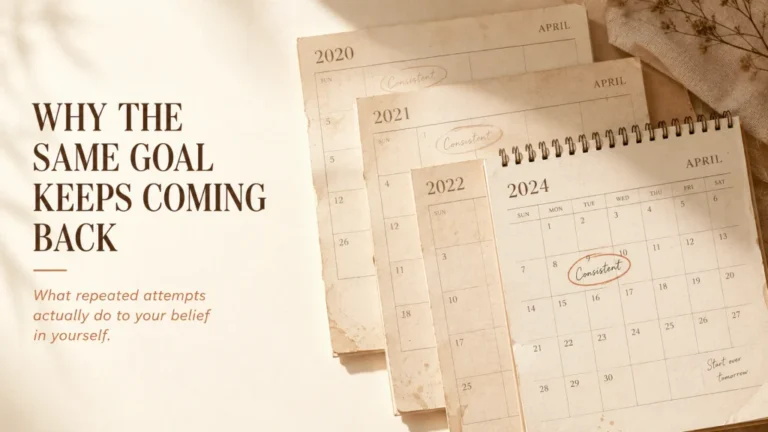
Most goal setting advice tells you how to write a goal down. Almost none of it explains why a well-written goal still gets abandoned by March. What the research actually shows is that specific, challenging goals genuinely work, but only under conditions that most people never build around them. This piece walks through what the research supports, what it leaves out, and where to look next depending on which part of the pattern you recognize in yourself.

What Two Decades of Sitting With Dying People Taught Me About Goal Setting
I did not expect goal setting to come up as often as it did in hospice rooms. But it did, almost every week, in one form or another. People near the end of their lives rarely talked about the goals they had achieved. They talked about the ones they had quietly stopped mentioning years earlier, and how strange it felt to realize they had never officially given up on them. They had just stopped.
The people I sat with who carried the least regret were not the ones who had set the most ambitious goals. They were the ones who had found some way to keep moving on something that mattered to them even after the goal itself had stopped feeling exciting. That distinction matters more than almost anything else in this conversation, and it is where most goal setting advice quietly runs out of road.
What the Research Actually Says About How Goals Work
Goal setting has real research behind it, more than most self-help territory can claim. The foundational work, built over decades by Edwin Locke and Gary Latham, found something fairly consistent across hundreds of studies: specific, challenging goals outperform vague ones like “do your best,” and they outperform easy goals too. A goal that is clear and a little uncomfortable to reach for tends to produce more focused effort than a goal that leaves room to coast.
That finding holds up well, and it is worth taking seriously rather than treating as another motivational cliche. The research also identified conditions that have to be present for the effect to hold: there needs to be some way of knowing along the way whether a person is actually moving toward the target or just feeling busy. There needs to be real commitment, not the kind performed out loud to sound disciplined. And the target needs to match what a person is actually capable of right now, not the version of themselves they hope to become eventually. Skip any one of those and a well-written goal can still go nowhere.
Two later strands of the same research fill in a piece that gets skipped constantly. One is implementation intentions, the simple act of deciding in advance exactly when and where a specific action will happen, instead of leaving it to be decided in the moment. “I will exercise more” almost never survives a busy week. “I will walk for twenty minutes after I drop the kids off on weekday mornings” has a fighting chance, because the decision already got made before the moment arrived to talk yourself out of it. The other is mental contrasting, pairing the appeal of the outcome with an honest look at what specifically tends to get in the way, rather than picturing only the finish line. People who imagine success without ever naming the obstacle tend to lose momentum faster than people who name the obstacle up front.
Where most online advice stops is at “make it specific and make it hard,” as though that alone is the whole formula. It is closer to the first third of it. The rest, the part about tracking real progress, being honest about capability, and deciding in advance how a goal will actually get acted on, gets left out constantly. That is exactly the piece most people are missing when a goal fades out somewhere around week six.

Why Goals Fail Even After You Set Them Well
Here is what almost never gets said out loud: a goal can be specific, challenging, and genuinely well written, and it can still fail. Not because the person lacked discipline. Because the thing that made the goal exciting on the day it was written is not the same thing that carries someone through the ordinary, unremarkable middle of pursuing it. Motivation is a starting fuel. It is rarely the fuel that gets someone to the end.
I watched a version of this play out with a man who had spent years planning to reconcile with his estranged brother “once things settled down.” The goal was clear in his mind. He could describe exactly what the reconciliation would look like. What he never built was any structure for what to do on the ordinary Tuesday when nothing in particular had settled down and the goal had no immediate next step attached to it. The goal stayed a goal. It never became an action, because there was nothing scheduled to make it one.
That is the pattern behind most abandoned goals I have seen described to me, in one form or another: the goal was real, the intention was sincere, and the collapse happened in the unglamorous middle, not at the starting line. A few of the more common ways that middle collapses look like this:
- The goal depended entirely on motivation, and motivation is not a renewable resource on a fixed schedule.
- There was no way to tell, week to week, whether the person was actually closer or just still hoping.
- The goal was set at a difficulty that matched who the person wanted to be, not who they actually were on an average Tuesday.
- Life changed the terms of the goal, and nobody gave themselves permission to revise it instead of quietly dropping it.
What people commonly get wrong here is assuming that abandoning a goal means something about their character. It usually does not. It usually means the goal was missing one of the conditions the research actually requires, most often feedback or a realistic read on current capability. That is a solvable problem. It is just not the problem most goal setting strategies are built to solve.

Goals Versus Systems: What Actually Keeps People Going
There is a distinction that has gotten more attention in recent years, and it holds up under scrutiny: a goal is the outcome you want. A system is what you actually do, repeatedly, whether or not you are thinking about the outcome that day. The person who wants to write a book has a goal. The person who sits down at the same time most days and writes has a system. The goal can survive a bad week. The system is what makes most weeks not bad in the first place.
This is not an argument against setting goals. The research on specific, challenging goals is real, and it still applies. It is an argument against treating the goal as though it does the work by itself. A goal without any system underneath it is a wish with a deadline attached. It feels like progress to write it down. It rarely survives contact with an ordinary week.
The goal tells you where you are trying to go. It never once tells you what to do on the day you do not feel like going there.
I sat with a woman once who had set the same goal for three years running: be more patient with her father while she cared for him at the end of his life. Each year she meant it completely. Each year it slipped, not from lack of love, but because “be more patient” had no system attached to it, no specific moment where the intention became a repeatable action. What finally worked was smaller and less inspiring than the original goal: a single, specific pause before responding when she felt her patience thinning. That was not a bigger goal. It was a system small enough to actually use.
Where to Go From Here, Depending on What You Recognize
The research above explains the shape of the problem. Which part of it applies to you depends on where things actually broke down, and that is worth being specific about rather than reaching for a general fix. If a goal has failed on you more than once and you are not sure why, it is worth reading through why goals fail even after you have set them well, which goes deeper into the specific behavioral reasons than there is room for here.
If the pattern you recognize is that you keep setting goals and never building any structure underneath them, the difference between a goal and a system is worth sitting with directly. And if the problem is closer to the opposite, where forcing yourself to feel positive about a goal seems to backfire and drain your motivation faster, there is a specific reason for that covered in why positive thinking about a goal can work against you.
For readers who have not written the goal down yet and want to get the framing right from the start, how to set goals you will actually keep walks through what to build in before you begin, not after you have already stalled. If this is not your first attempt at the same target, and it feels uncomfortably familiar every January, why you keep setting the same goal year after year looks at what usually keeps a goal on repeat.
If you are still working toward something but it is taking far longer than you expected and the distance is starting to wear on you, staying motivated when a goal takes longer than expected addresses that specific kind of fatigue. And if some part of you has started to wonder whether the goal itself no longer fits who you are, that question deserves its own honest look rather than another attempt at forcing it. Knowing when it might be time to give up on a goal covers how to tell the difference between quitting and revising.
None of these questions cancel each other out. A goal can fail for more than one of these reasons at once, and it is worth being honest about which one is doing the most damage before reaching for a fix. For the broader read on what discipline actually requires once the goal is set, what real discipline looks like over time covers the ground this piece does not have room for.
Final Thoughts on Setting a Goal That Survives an Ordinary Week
Goal setting research is not wrong. Specific, challenging goals with real feedback and honest self-assessment genuinely outperform vague ones, and that finding has held up across decades of study. What it does not promise is that writing the goal down does the rest of the work for you. The middle of any goal, the unremarkable stretch where the initial excitement has worn off and the outcome is still far away, is where most goals are actually decided.
Nobody I sat with near the end of their life regretted having set a goal that did not work out. What came up again and again was something quieter: the goals they had never revisited, never revised, and never officially let go of. They had just stopped, without deciding to. If any part of this applies to something you are carrying right now, the honest move is not always to try harder. Sometimes it is to look closely at what actually broke down, and go from there.
Related Reading on Goal Setting
Each of the pieces below goes further into one specific part of the pattern covered here. Start with whichever one matches what you actually recognized in yourself while reading.
| Title | What It Covers |
|---|---|
| Why Goals Fail | The specific behavioral reasons a well-written goal collapses after the initial motivation fades. |
| Goals vs Systems | Why the outcome you want and the routine that gets you there are not the same thing, and why conflating them backfires. |
| When Positive Thinking Backfires | Why imagining success too vividly can quietly drain the motivation needed to pursue it. |
| How to Set Goals You Will Actually Keep | What to build into a goal from the start so it survives past the first difficult week. |
| Why You Keep Setting the Same Goal | What keeps a goal reappearing year after year without ever being reached. |
| Staying Motivated Over a Long Timeline | How to keep going on a goal that is taking far longer than you planned for. |
| When to Give Up on a Goal | How to tell the difference between quitting too early and honestly outgrowing a goal. |
FAQs
🎯 What does the research actually say about goal setting?
Specific, challenging goals consistently outperform vague ones, but only when paired with real feedback and an honest read on current ability. Drop either condition and the effect weakens fast, no matter how well the goal is written.
🔄 Why do people abandon goals even after setting them well?
Most goals are set on a burst of motivation that does not last through the ordinary middle stretch. Without feedback or a repeatable system underneath it, the goal has nothing keeping it alive once the initial excitement fades.
⚙️ What is the actual difference between a goal and a system?
A goal is the outcome you want. A system is what you actually do, on schedule, whether or not you are thinking about the outcome that day. The system is usually what determines whether the goal gets reached.
📈 How do you stay motivated when a goal takes longer than expected?
Shift what you are tracking from the distant outcome to the immediate, repeatable action. Long timelines wear people down when the only measure of progress is a finish line that never seems to get closer.
🧭 When should you consider giving up on a goal?
When the goal no longer reflects who you actually are or what you actually want, not just when it has become difficult. Difficulty is normal. A goal that has quietly stopped meaning anything to you is a different problem.
🔁 Why do I keep setting the same goal every year?
Usually because the goal itself was never the missing piece. Something underneath it, a system, a condition, or an honest constraint, was never addressed, so the same unmet goal keeps resurfacing in a new year with a new deadline attached.