Why being told you are talented can backfire is not an obvious question, because being called gifted feels like nothing but a gift. I spent two decades sitting with people at the end of life, and one man told me the most damaging sentence anyone had ever said to him was also the kindest one he had ever heard: that he was naturally talented, said to him at exactly the age when he most needed to learn what he could earn through effort instead. This piece walks through Carol Dweck’s original research on praise, the specific mechanism that turns ability-praise into fear of trying, and what that legacy tends to look like once the person carrying it becomes an adult.

The Nicest Thing That Ever Hurt Him
Why being told you are talented can backfire is easiest to see through one man’s memory. He was in his sixties by the time I sat with him, and he brought this up on his own, unprompted, the way people sometimes do when they are finally taking stock. A teacher had pulled him aside as a boy and told him he was naturally gifted at math, meant as pure encouragement, the kind of thing any teacher would say to a kid who had earned it. He remembered the exact hallway, the exact tone of her voice. And he remembered, just as clearly, the moment a few years later when a harder class arrived and the ease vanished, and he dropped out of advanced math rather than let anyone watch him struggle at the thing he was supposed to be naturally good at.
He did not blame the teacher. He was clear about that. What he wanted me to understand was how something said with real warmth had quietly taught him that struggling in front of others was a kind of exposure, evidence that the label had been wrong all along. It starts exactly there, at the moment a compliment about who you are gets confused with a compliment about what you did.
What Dweck’s Original Research Actually Found
Psychologist Carol Dweck’s early studies on this exact question followed a simple design. Several hundred fifth graders completed a set of puzzles, and afterward each child received one of two kinds of praise. Some were told they must be smart. Others were told they must have worked hard. The children were then offered a choice between an easier puzzle and a harder one for the next round.
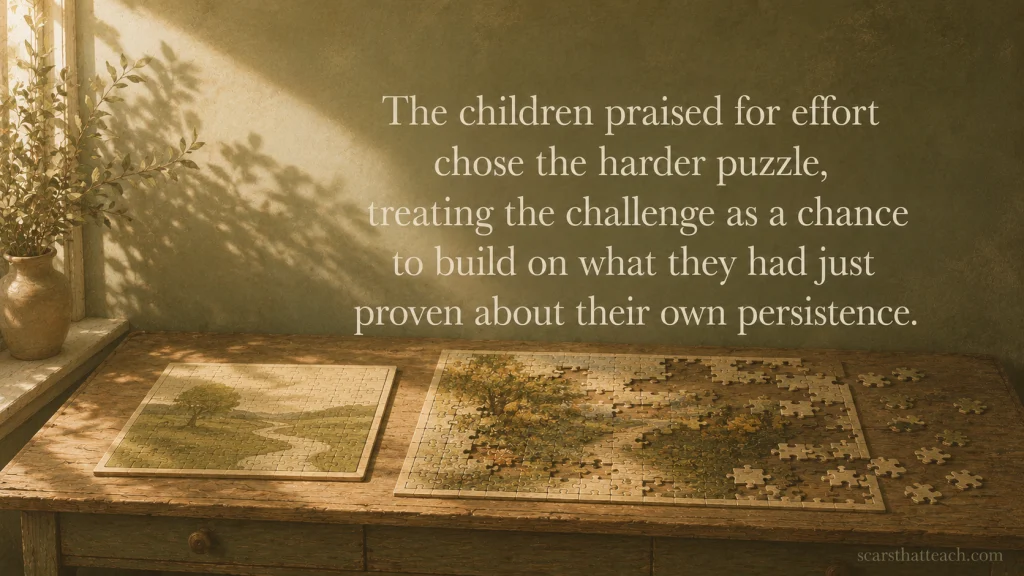
The results were stark, and they remain one of the clearest demonstrations of the difference between praising effort and praising ability. Most of the children praised for intelligence chose the easier puzzle, guarding the image they had just been handed. Most of the children praised for effort chose the harder one, treating the challenge as a chance to build on what they had just proven about their own persistence. When a later round was made deliberately difficult so every child would struggle, the ability-praised group grew visibly discouraged, described the task as less enjoyable, and performed worse on a final puzzle set even though it was no harder than the first. Some of them, when given the chance to report their scores to peers, inflated the numbers. The effort-praised group, facing the exact same difficulty, largely stayed engaged and performed as well as or better than before.
Why a Compliment About Ability Creates This Effect
Most of what gets written about this research stops at a tip for parents: praise the effort, not the ability. That distinction between praising effort and praising ability is accurate as far as it goes, but it skips the part that actually explains the link between praise and fixed mindset, which matters more than the tip itself. When a child is praised for being smart, the compliment lands on identity rather than behavior. It says something about who they are, not about what they did. That feels good in the moment, but it quietly attaches their sense of worth to a standard they did not choose and cannot control: performing well without visible effort. The same distinction sits underneath the broader question of what a growth mindset actually means, because difficulty can be treated either as evidence of a fixed limit or as information about what to try next.
Once worth is tied to effortless performance, any task that requires real struggle stops being a normal part of learning and becomes a direct threat to self-image. Picture a child who has always been “the smart one” in the family, the one who finished homework in ten minutes while a sibling struggled for an hour. The first time a subject takes real effort, hours instead of minutes, confusion instead of instant answers, the problem in front of them stops being the point. The real crisis becomes smaller and stranger: if this takes effort, does that mean I was never actually smart? If getting something right easily is what makes you smart, then needing to work hard at something suggests you might not be smart after all.
What makes this so hard to shake is that the fear underneath it is rarely about the failing itself. Most people can tolerate a bad grade or a clumsy first attempt. What they cannot easily tolerate is what a real failure would mean about a story they have been telling about themselves for years, sometimes decades. Losing at something is temporary. Having to rewrite “I am the gifted one” into something messier and more honest feels much larger, which is why so much energy goes into avoiding the situation entirely rather than risking the outcome. Effort itself starts to feel like evidence against the identity, rather than the thing that built it in the first place. Choosing the easier puzzle, or giving up after a setback, or inflating a score to a peer, all become ways of guarding a self-image that was never supposed to carry this much weight. Praise for effort avoids this trap entirely, because the compliment lands on something the child controls and can simply do more of, regardless of how the task turns out.
What This Looks Like Once the Child Becomes an Adult
Those fifth graders eventually became adults, just like everyone else who grew up hearing the same kind of praise. The pattern rarely disappears on its own. It tends to resurface as a specific and recognizable discomfort: an unwillingness to be a visible beginner at anything. Adults carrying this legacy often gravitate toward rooms where they already know they will look competent, and quietly avoid the ones where they would have to be watched while learning something new.
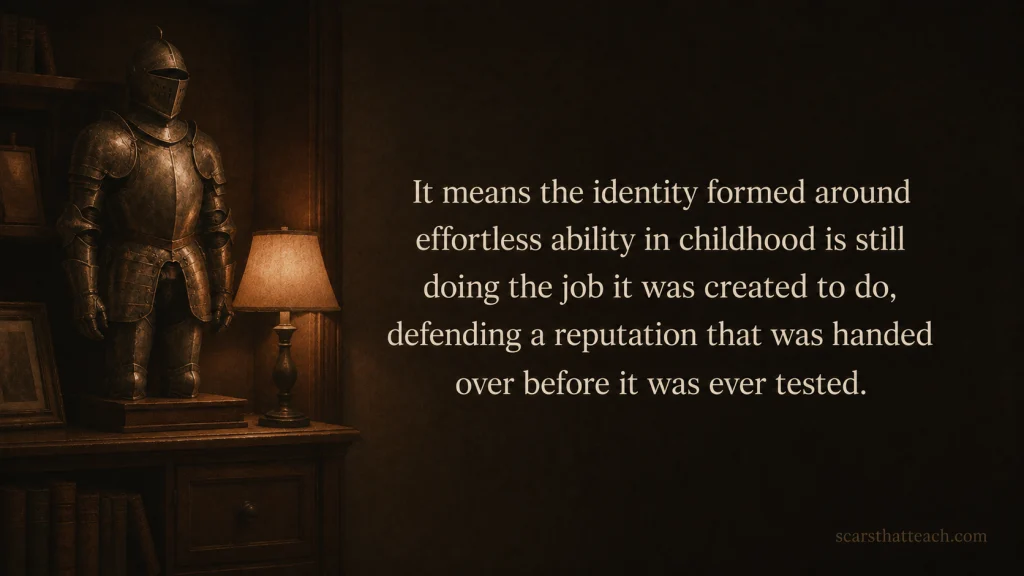
This can look like turning down a role that would require public struggle, or refusing to try a new skill unless there is privacy to fail in first, or feeling a disproportionate flash of shame at being corrected in front of colleagues. None of this means something is broken. It means the identity formed around effortless ability in childhood is still doing the job it was created to do: defending a reputation that was handed over before it was ever tested. The job just looks different in a boardroom or a hobby class than it did on a fifth-grade puzzle, but the underlying logic, that visible struggle threatens the self, has not changed at all. That is also why I am cautious with quotes about discipline and effort that praise toughness without naming the process underneath it. A line about grit can still reinforce the same trap if effort becomes another identity test instead of something a person can practice, adjust, and learn from.
Signs This Pattern Is Still Running the Show
This shows up in ways that are easy to mistake for simple preference or personality rather than a learned response to early praise. If the distinction itself still feels slippery, the difference between a growth mindset and a fixed mindset helps separate a temporary struggle from the meaning a person assigns to that struggle. A few patterns tend to repeat often enough to be worth naming plainly.
- You avoid activities where you would be an obvious beginner, even ones you are genuinely curious about.
- You feel a sharper sting than the moment seems to warrant when someone points out a mistake in front of others.
- You describe yourself using fixed, identity-level words, “I’m just not a numbers person,” rather than describing where your practice currently stands.
- You quietly stop doing things you used to enjoy the moment they stop coming easily.
- You find it easier to accept praise for outcomes than praise for the effort or strategy that produced them.
None of this means anything was permanently damaged in you. It means a piece of childhood praise, offered with real warmth, taught a lesson that nobody intended to teach, and that lesson can be unlearned the same quiet way it was learned in the first place.
The Mistake People Make Trying to Fix This
The common fix people reach for once they learn this research is to swing hard toward praising effort alone, regardless of outcome. Dweck herself has pushed back on this overcorrection. Praise for trying hard when nothing was actually learned or improved can become its own kind of hollow consolation prize, one that quietly signals low expectations rather than real encouragement. A child, or an adult, can usually tell the difference between effort that is being genuinely valued and effort that is being used to paper over a lack of progress.
The clearer path is to tie the praise to something specific and true: the strategy that was tried, the persistence through a hard section, the improvement between one attempt and the next. That kind of feedback still lands on something the person controls, which is what makes it useful, but it stays honest about the actual outcome instead of praising effort as a substitute for it. The goal was never to stop noticing outcomes. It was to stop letting outcomes alone define a person’s worth.

Final: What I Would Tell the Man From That Hallway
I would tell him what I eventually did tell him, sitting in that room decades later. The teacher was not wrong to see something in him. She simply handed him a label at the exact moment he needed a method instead, and he spent years defending that reputation rather than building the method, because nobody had told him there was a difference between the two. That is not a character flaw. It is what almost anyone would do with the tools they were given at ten years old.
This piece is not a diagnosis and it is not a reason to go looking for blame, in a teacher, a parent, or yourself. It is simply a mechanism worth understanding, because once you can see it clearly, you can start offering yourself the kind of feedback that was missing the first time around: not “you’re so talented,” but “look how far that effort just took you.”
For the broader debate about how consistently these findings replicate at scale, the honest state of the growth mindset evidence covers that territory directly. If giving up under difficulty is the piece that resonates most, why hard moments make people want to quit looks at that pattern on its own.
FAQs
🧩 Being called smart backfires for a lot of people. Why?
It ties a person’s worth to performing well without effort, which turns any real struggle into a threat to that identity rather than a normal part of learning. Praise for effort avoids this because it lands on something the person controls.
🧪 What did Dweck’s original praise study actually find?
Children praised for intelligence tended to choose easier tasks afterward, gave up more easily on harder ones, and sometimes misrepresented their scores. Children praised for effort chose harder tasks and stayed engaged even after a setback.
🙋 How does this show up in adults instead of children?
It often looks like avoiding being a visible beginner at anything, even things a person is genuinely curious about. The same instinct to protect that identity, learned in childhood, simply moves into adult settings like work or hobbies.
🛠️ Is praising effort instead of ability always the right fix?
Not on its own. Praising effort that produced no real progress can become a hollow consolation prize. The effort vs ability praise divide matters, but the clearer approach ties praise to specific, honest details, the strategy used or the improvement made, rather than effort in the abstract.
🌱 Can this pattern actually change later in life?
Yes. It was learned quietly through repeated messages, and it can shift the same way, by noticing the pattern and practicing feedback that rewards effort and strategy instead of fixed labels.