Gratitude practice has real research behind it, yet plenty of people try it honestly and still end up with a flat, performative emptiness where relief was supposed to show up. The mechanism behind that gap is not that the science is wrong. It is that the same practice meant to add appreciation alongside hard feelings often gets used instead to push those hard feelings out of the room entirely. What follows traces where the research on gratitude actually holds up, what goes wrong when gratitude gets used to bypass grief or frustration instead of sitting beside it, and how to tell the difference in your own life before giving up on something that might still be worth keeping.
Why a Gratitude Practice Can Stop Working Even When You Are Doing Everything Right
I spent two decades watching what people reached for when their lives had narrowed down to a hospital room, and gratitude showed up constantly, in two completely different forms. The people who found it genuinely useful had never tried to summon it on command. It arrived sideways, while they were doing something else, and they let it sit next to whatever they were already feeling instead of replacing it. The people for whom gratitude felt hollow were almost always doing something different without realizing it. They were in the middle of something real, a grief, a fear, a resentment that had not finished saying what it needed to say, and the practice was quietly asking them to look away from it before it was ready to be looked away from.
That difference is not just a feeling. It turns out to be close to the exact mechanism researchers have started naming directly, and it explains why a gratitude practice can stop working even when you are doing everything the lists tell you to do. Understanding which version you are actually practicing matters more than finding a better prompt or a nicer journal, because the gap between the two is not really about gratitude at all. It is about what gratitude is being asked to do.
The Research Behind Gratitude Practice Actually Holds Up
The research behind gratitude practice is not thin or anecdotal. Robert Emmons, a psychologist who has spent decades studying gratitude specifically, ran controlled studies where people kept a gratitude journal for as little as three weeks. The people who did reported more positive emotion, better sleep, and more energy than people who journaled about neutral or stressful events instead. None of that is in dispute, and none of it should be, because the benefit shows up reliably enough that gratitude practice has become one of the more evidence-backed tools in the broader field of positive psychology.
What that research describes, though, is a fairly specific act: noticing something good and naming it, alongside whatever else happens to be true at the time, not instead of it. Emmons himself has described gratitude as a kind of affirmation, a way of registering that something genuinely good happened or was given, which is a narrower claim than the version of gratitude practice most people actually attempt. Most people are not trying to notice one good thing. They are trying to feel better, faster, by crowding out everything else that is also true in that moment. That substitution is where the research and the practice quietly part ways.
Why Gratitude Journaling Stops Working Once It Starts Doing a Different Job
That substitution is close to the heart of why so many people find gratitude journaling stops delivering anything real, even among people doing the exercise correctly on paper. Psychologists who study what gets called toxic positivity have started naming this specific failure mode directly: gratitude becomes a problem not because it is weak, but because it gets recruited to do something it was never built to do, which is make a real negative feeling disappear before it has finished saying what it came to say. One trauma-focused clinician writing for Psychology Today described this plainly, noting that gratitude can minimize and invalidate a person’s actual emotional experience when it gets used to outrun grief, frustration, or anger rather than sit beside them.
This is the same reason the practice tends to fail hardest precisely when people need it most. A bad diagnosis, a layoff, a fight with someone you love: these are precisely the moments when the instinct to list three good things kicks in, and precisely the moments when that instinct is most likely to function as avoidance instead of appreciation. The emotion underneath has not gone anywhere. It has simply been told to wait outside while something more presentable takes its seat at the table. That wait does not resolve the feeling. It usually just adds a second feeling on top of it, something closer to guilt or quiet shame at not feeling grateful enough, which is the opposite of what the practice promised to deliver.
“They can coexist.”
Dr. Justin Puder, quoted in Wondermind
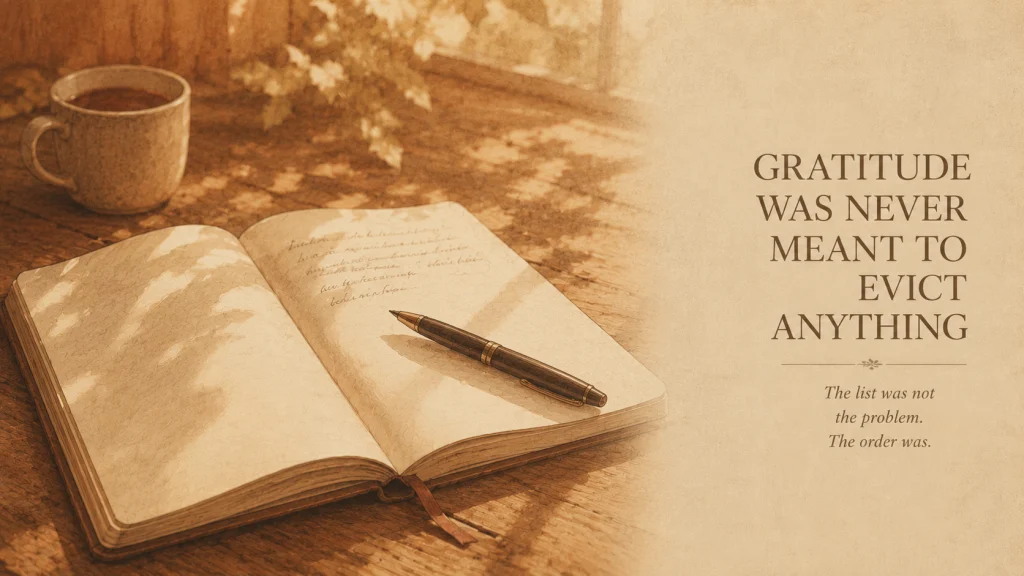
Puder was making a specific point: that feeling grateful and feeling devastated at the same time is not a contradiction, and that trying to resolve the tension by eliminating one of the two is what breaks the practice. That line is close to the entire correction in three words. Gratitude was never supposed to evict whatever else you were feeling. It was supposed to keep it company.
A few signs tend to show up once gratitude has slid into the wrong kind of use:
- Reaching for a gratitude list specifically to stop feeling something uncomfortable, rather than alongside it
- Feeling more guilt or quiet shame after the practice than before it, rather than less
- Writing items that feel generic or interchangeable rather than specific to that particular day
- Comparing your situation to someone worse off as the reason you are not allowed to feel what you are feeling
I sat with a woman once who kept a gratitude list faithfully every night for months after her husband died, and she told me, near the end of that stretch, that she felt worse than when she started, not better. She had not done anything wrong. She had simply been using the list to skip past the grief instead of letting the list sit beside it, and the grief had not gone anywhere in the meantime. It had just gotten quieter and angrier from being ignored. Six months later, once she let herself feel the anger underneath the loneliness for the first time instead of writing past it, the gratitude list started working the way it was supposed to: as a companion to what was already true, not a cover for it.
What This Looks Like in an Ordinary Week, Not Just a Crisis
You do not need a death or a diagnosis for this to show up. A man stuck in a job he is quietly miserable in starts a gratitude journal because a friend recommended it, and every night he writes that he is grateful for his health, his apartment, his coffee maker. None of those things are untrue. None of them touch the actual problem, which is that he dreads Monday mornings in a way that has started leaking into Sunday afternoons. The list keeps him from looking at that directly, which is exactly why gratitude practice feels fake to him within a few weeks. It is not lying. It is aiming at the wrong target. A list aimed at the wrong target will keep producing the same hollow result no matter how faithfully it gets filled out.
That same dynamic shows up constantly in close relationships, where one person’s cheerful gratitude becomes the unspoken price of the other person’s silence about something that actually needs to be said out loud. I have written more specifically about how that overlap tends to play out in how toxic positivity hides inside gratitude habits, because the relational version of this pattern deserves its own room.
None of this means the answer is abandoning gratitude practice altogether. The difference between a practice that lasts and one that quietly turns into another way to avoid feeling things usually comes down to sequencing: naming the hard feeling first, then making room for what is also true. The specifics of what that looks like day to day are covered more fully in building a gratitude habit that actually holds up, once you are ready to try again with the order reversed.
What Carries Forward
None of this is an argument against gratitude. The problem was never the practice itself. It was a specific, common misuse of it, one that is genuinely easy to fall into without noticing, especially when you are hurting and reaching for any tool that promises relief. If you want to see more of where that misuse shows up across other situations, the broader collection at more of where gratitude practice tends to break down covers ground this piece does not have room for.
If what you are actually after is a wider sense of what makes a life feel worth appreciating in the first place, rather than one technique for getting there, the broader collection at quotes about what makes a life feel worth living is a reasonable next stop. Whatever you decide to do with a gratitude list going forward, give the hard feeling its turn first. It was never the thing standing between you and gratitude. It was just waiting to be let back into the room.
FAQs
🪞 Why does gratitude practice not work for some people?
It usually is not that gratitude itself fails. It is that the practice gets used to push a hard feeling out of the way instead of sitting beside it, which produces a flat, performative result instead of real relief.
😔 Why does a gratitude journal feel forced or fake?
A gratitude journal tends to feel fake when it is reaching for relief on command rather than noticing something specific and true. Generic entries written to escape a bad mood often feel hollow because they are doing exactly what they were asked to do: avoid the mood rather than sit with it.
🧠 What is toxic positivity, and how does it connect to gratitude?
Toxic positivity is the habit of insisting on a good mood regardless of what is actually true. Gratitude practice slides into a version of it when it gets used to deny or rush past a real negative emotion instead of allowing that emotion any space.
💛 Is gratitude practice actually backed by research, or is it just self-help advice?
It is genuinely backed by research. Studies on gratitude journaling have found real improvements in mood, sleep, and energy, even over windows as short as three weeks. The research is not the part that fails. How the practice gets used sometimes is.
🌧️ Can you feel grateful and sad, angry, or scared at the same time?
Yes, and psychologists who study this directly say the two are not in competition with each other. Gratitude was designed to sit next to a hard emotion, not replace it, so feeling both at once is not a contradiction.
✍️ Should I quit journaling if gratitude practice starts to feel hollow?
Not necessarily. It is worth trying a different order first: name the hard feeling honestly before reaching for what you are grateful for, rather than using the gratitude list to skip past it. Many people find the practice starts working again once the sequence changes.