Gratitude is one of the most researched practices in psychology, and the research holds up. The problem is not the concept. The problem is what happens when the practice is handed to someone who is genuinely struggling and told to use it like a prescription. Most people who find gratitude hollow or exhausting are not doing it wrong. They are doing it in a context where it was never designed to work. This is an honest look at why standard gratitude advice fails, what the actual mechanism behind that failure is, and what a practice built on real emotional honesty looks like instead.
The Word Had Started to Taste Like an Instruction
The people I sat with who found gratitude practice most difficult were not the ones who had nothing to be grateful for. They almost always had something. Children who were healthy. A house. Work that paid. The problem was not scarcity. The problem was that the word “grateful” had been handed to them so many times as an instruction, so many times as a corrective, that it had lost the quality of a feeling entirely. It had become a performance. And performing gratitude when you do not actually feel it is one of the lonelier experiences a person can have.
I watched this pattern often enough across two decades in hospice that I stopped being surprised by it. Someone would mention that they had tried keeping a gratitude journal, or counting their blessings before bed, and that it had made them feel worse, not better. Hollow. Sometimes vaguely ashamed, as though their inability to feel genuine thankfulness was a character flaw they had confirmed in writing. The research on gratitude is strong. Robert Emmons at UC Davis, the field’s leading researcher, has documented real, measurable benefits: higher positive emotions, better sleep, more energy, greater life satisfaction. The research is not the problem. The delivery is.
The Mechanism Behind Why It Stops Working
Gratitude practice fails most reliably when it is used to suppress or bypass genuine negative emotions rather than to hold positive ones alongside them. That distinction matters more than most gratitude content admits. There is a difference between pausing to notice something good while still holding something hard, and being told that noticing something good should make the hard thing feel smaller. The first is honest. The second is suppression dressed in nicer language.
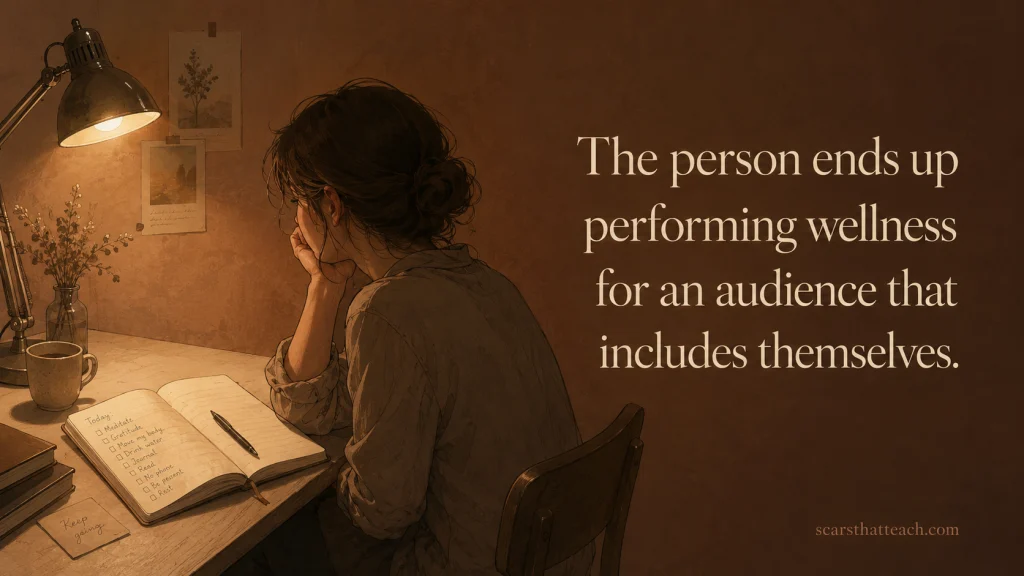
Clinical psychologists who work with trauma and complex emotional histories have written about this directly. When gratitude is deployed as a tool to override pain rather than to exist beside it, it can cause real harm: it can make a person feel invalid, can reinforce the sense that their pain is an overreaction, and can deepen the isolation that comes from believing no one wants to hear what is actually wrong. The person ends up performing wellness for an audience that includes themselves.
There is also the question of timing. Gratitude research consistently shows benefits in people who are not currently in acute distress. Handing a gratitude journal to someone in the middle of grief, or a painful estrangement, or a period of sustained exhaustion, is not the same intervention it would be for someone in a more stable moment. The same practice lands differently depending on what the person is carrying. That nuance almost never makes it into the advice.
When “Counting Your Blessings” Becomes a Way to Not Feel Anything
I have sat with families who used gratitude as a kind of household rule. A father who insisted on going around the table each night and naming something good. Children who learned, early, that the correct response to a hard day was to locate something it gave them. On the surface this looks like discipline and perspective. What it often produced, in the people I spoke to decades later, was a deep discomfort with their own negative emotions. They had been trained to skip past them. And by the time they were sitting with me, they had been skipping for so long they had lost contact with what they actually felt.
This is not an argument against teaching gratitude to children. It is an argument for paying attention to what the practice is doing in a specific person in a specific context. Gratitude used to produce resilience is one thing. Gratitude used to avoid pain is something else. They can look identical from the outside.
How Gratitude Gets Corrupted Into Something That Harms
Gratitude and toxic positivity are not the same thing. But gratitude is one of the most common vehicles toxic positivity travels in. “At least you have your health.” “Other people have it so much worse.” “Think about what you do have.” These are gratitude-adjacent statements. They are also, in certain moments, a way of telling someone that their pain is not appropriate to express. And when a person internalizes that message often enough, they stop expressing it. They stop feeling entitled to feel it. What gets built, over time, is not resilience. It is suppression with a pleasant name.
The line between genuine gratitude and forced positivity is not always obvious, and most of the content that exists on this topic does not help people find it. What I observed, again and again, was that real gratitude always had room for the hard thing. It did not require the person to minimize what was wrong in order to notice what was right. When a practice requires minimizing, it is no longer gratitude. It is something more like self-management. And people can feel the difference, even when they cannot name it. The feeling is usually a kind of flatness, a going-through-the-motions quality that leaves them wondering whether something is wrong with them for not being able to do it right.

What Gratitude Actually Is, Before the Advice Gets to It
Gratitude, in the research that Emmons and others have built over decades, is not a technique. It is an orientation. A way of attending to the world that acknowledges gift, or benefit, or care received, and attributes that to something or someone outside oneself. It is relational at its core. It is not a transaction you make with yourself at the end of the day. It is a recognition that something good existed and that you were the recipient of it. That recognition can be practiced. But it cannot be forced. Forcing it does not produce the thing. It produces the performance of the thing.
This distinction gets lost fast once the practice gets turned into content. Journal prompts, morning routines, five-things-before-bed exercises. These can be useful scaffolding for people who already have a relationship with genuine appreciation and need a structure to make it regular. For people who have been through a lot, or who grew up in environments where positive emotions had to be performed on schedule, this scaffolding can land wrong. It can feel like homework. And homework rarely produces the emotional state it was designed to create.
“The practice that helped people most was almost never the one they had been assigned. It was the one they had quietly started doing on their own, without a name for it, usually because it was the only version that felt true.”
What a Real Practice Looks Like When Life Is Actually Hard
The people I knew who had built something durable out of gratitude had almost all arrived at it through difficulty, not through ease. They were not grateful because things had gone well. They were grateful because they had been through something that showed them, in unmistakable terms, what mattered and what did not. That kind of gratitude does not require a prompt. It arrived when they stopped trying to feel it on schedule and started paying attention to what was still present in the middle of what was gone.
For someone in the middle of something hard, the most honest version of a gratitude practice is not about feeling grateful. It is about noticing. What is still here. What has not changed. What someone did that they did not have to. These observations do not need to be amplified into a positive feeling. They just need to be acknowledged. The feeling, when it comes, is quieter than what the advice columns promise. But it is real, and the difference between something real and something performed is something a person can live inside without feeling like a fraud.
- Gratitude that starts with what is genuinely hard rather than bypassing it tends to last longer and feel more grounded.
- Frequency matters less than honesty. One genuine moment of noticing is worth more than a daily practice that feels hollow.
- Practices built around obligation, whether to a routine, a journal, or someone else’s expectations, reliably produce flatness over time.
- Noticing something small and specific is almost always more effective than reaching for something large and general.
- Gratitude and grief can exist in the same moment. They do not cancel each other out. People who believe they have to resolve the grief first before the gratitude is valid usually wait much longer than necessary.
These are not rules. They are patterns I watched play out across enough different people in enough different circumstances that I stopped thinking of them as coincidences. Your specific situation may have details that change what applies. The only honest thing I can tell you is what I saw, not what you should do with it.
The Specific Questions This Covers
Most people who arrive here with frustration about gratitude have a more specific question underneath the general one. The five areas below address the questions I see most often, the ones that do not get answered by the general advice. If you know which one is closest to what you are actually carrying, that is probably the better place to start than reading everything in order.
| Topic | What it addresses |
|---|---|
| Why gratitude practice stops working | The specific psychological mechanisms behind why a practice that helped at first can begin to feel hollow or even counterproductive over time. |
| Toxic positivity and gratitude | How gratitude gets weaponized into a tool for emotional avoidance, and how to tell the difference between genuine appreciation and pressure to perform it. |
| Building a gratitude practice that actually lasts | What the research on sustained gratitude practice shows, and what a durable version of it looks like for someone who has been through something real. |
| Why gratitude is so hard when life is hard | Why the people who most need the benefits of gratitude are often the least able to access them, and what to do when the feeling genuinely will not come. |
| What gratitude actually is | A closer look at the concept before it became content: what the research says gratitude is, what it is not, and why the distinction matters if you want to practice it honestly. |
Final Thoughts: What Gratitude Owes You
Gratitude does not owe you a transformation. It does not owe you a morning feeling or a quieter mind or a more gracious response to difficult people. What the research shows is that a genuine practice, built over time, tends to shift something in how a person attends to their life. That is not nothing. But it is also not the thing that gets promised in the advice. And the gap between what gets promised and what the practice can actually deliver is exactly where people get discouraged and conclude that something is wrong with them.
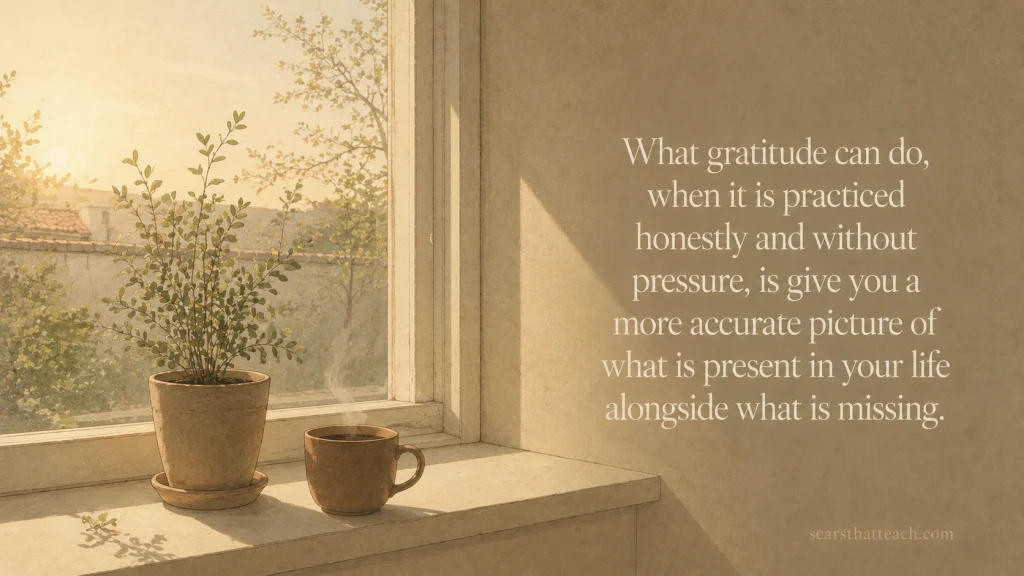
Nothing is wrong with them. The advice was oversimplified. The practice was handed over without the context that makes it work. And the person in the middle of something genuinely hard was told that the solution was to notice something good, as though the problem were only ever one of attention. If you have tried this and it has not worked, that is not a failure of character. It is a reasonable response to an incomplete instruction. What gratitude can do, when it is practiced honestly and without pressure, is give you a more accurate picture of what is present in your life alongside what is missing. That is a modest promise. It is also a true one. If you want to explore what the research actually says about happiness and how gratitude fits into a larger picture, the deeper look at what lasting happiness requires covers the territory that gratitude alone does not.
FAQs
🤔 Why does gratitude practice not work for me even though I try?
The most common reason is that the practice is being used to bypass something difficult rather than to coexist with it. Genuine gratitude does not require you to minimize what is wrong. When the practice feels hollow, that is often a sign it is asking you to perform something you do not actually feel yet.
😔 Is it normal to feel worse after trying to practice gratitude?
Yes, and it is more common than most gratitude content admits. When a practice requires you to override real emotions rather than acknowledge them, it can deepen the sense that your pain is not acceptable to feel. That is a reasonable reaction to an incomplete tool, not evidence that you are doing something wrong.
💬 What is the difference between gratitude and toxic positivity?
Real gratitude has room for the hard thing alongside the good one. Toxic positivity requires you to minimize or dismiss the hard thing in order to focus on the good. The clearest sign you have crossed into toxic positivity is when the gratitude is being used to tell someone, including yourself, that their pain is not warranted.
📖 Does the research on gratitude actually hold up?
Robert Emmons’s work at UC Davis is among the most replicated in positive psychology. The benefits are real: higher positive emotions, better sleep, stronger relationships. What the research does not support is the idea that a forced or performative version of the practice produces those same outcomes. The benefits belong to genuine gratitude, not the performance of it.
🌱 How do I start a gratitude practice when I am going through something really hard?
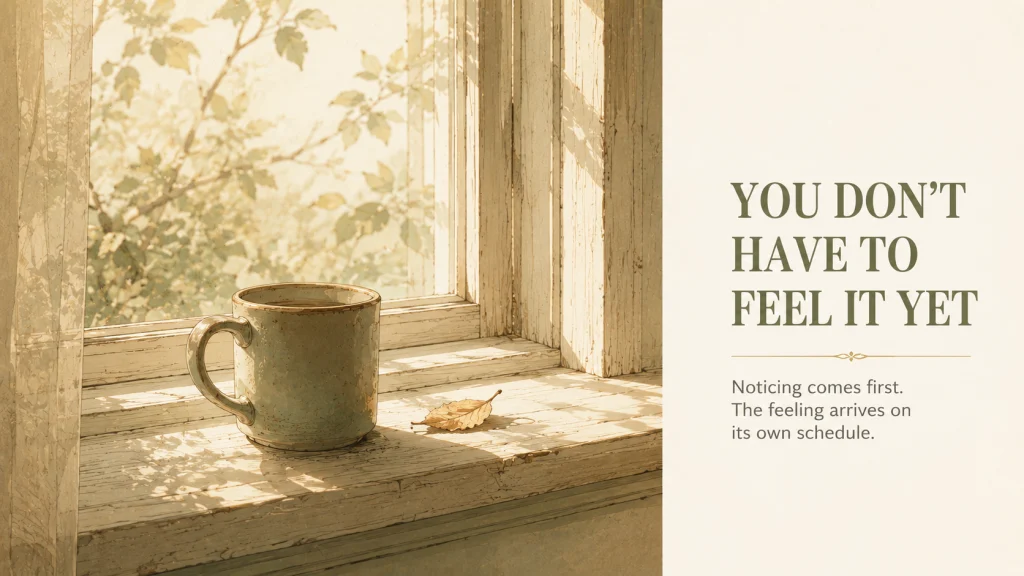
Start smaller than you think you need to. Not a list of five things. One thing that was present today that did not have to be. You do not have to feel grateful to notice it. The noticing comes first. The feeling, when it comes, tends to arrive on its own schedule.
⏳ How long does it take for gratitude practice to make a difference?
The research suggests consistent practice over weeks rather than days. But the more useful question is whether the practice feels honest, not whether it has been long enough. A hollow practice maintained for months produces less than an honest one sustained for a few weeks.