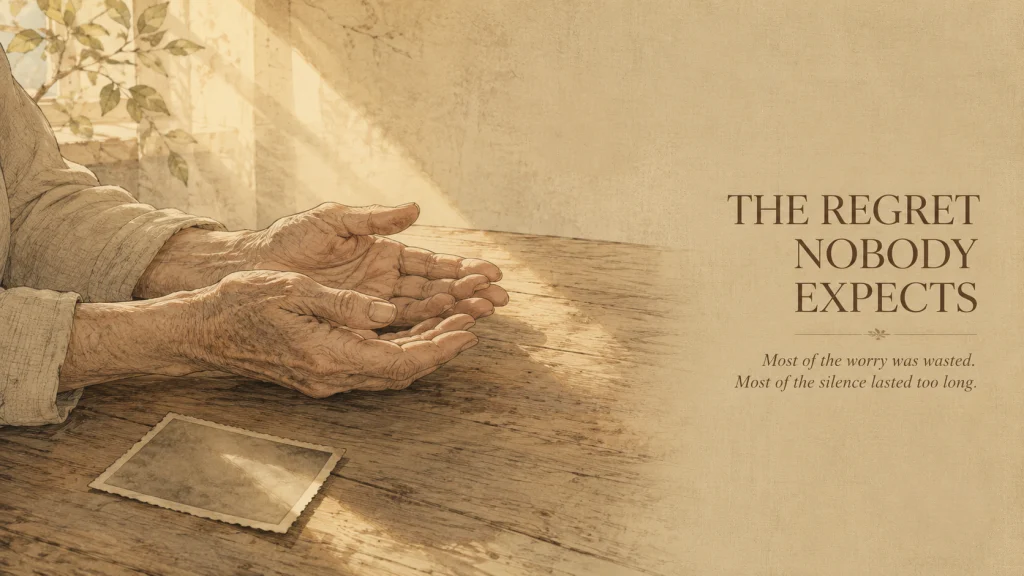
Most people assume they already know what elderly people say matters most: family, gratitude, the same handful of answers inspirational content always reaches for. What a decade of structured interviews with over a thousand older Americans actually found looks different and more specific than that. The regret that surfaced most consistently was not financial loss or a missed career opportunity. It was time spent worrying about things nobody could control, and relationships left unrepaired simply because nobody moved first. What follows traces where that research came from, where most online wisdom about aging tends to get it wrong, and what it actually looks like to recognize these patterns in your own life before you run out of time to use them.
What Elderly People Actually Say Matters, Once You Ask Them Directly
When people ask what matters most to those who have lived the longest, they usually imagine a tidy list: family, health, gratitude, the usual furniture of inspirational content. I spent over two decades sitting at bedsides where those answers should have shown up if they were going to, and what actually surfaced was stranger and more specific than that. The most consistent surprise was never that very old people carried regrets. It was that the regret almost never matched what I expected to hear walking into the room. I expected affairs, money mistakes, broken careers. What I heard instead, more often than anything else, sounded much smaller and far harder to fix.
That gap between expectation and reality is not just something I noticed informally. It is close to the exact finding that emerged when a Cornell researcher sat down with more than a thousand older Americans and asked them, one by one, what they wanted younger people to know. The pattern that surfaced from those structured interviews looked almost nothing like the pattern people assume before they start asking. Understanding that difference matters more than collecting another quote about gratitude, because it tells you something true about where your own attention should go right now, while there is still time to act on it.
The Legacy Project: What a Decade of Interviews Actually Found
The research behind this came from Karl Pillemer, a gerontologist at Cornell who spent years interviewing older Americans for what became known as the Legacy Project. He did not ask leading questions or hand people a list of categories to choose from. He asked one open question: what are the most important lessons you have learned over your life. Then he let people answer in their own words, across interviews with well over a thousand respondents whose average age sat in the late seventies, some past one hundred. Many had lived through the Great Depression, the Second World War, and earlier pandemics, which means their answers carry the weight of having tested those lessons against genuinely hard conditions rather than imagining them from a comfortable distance.
What matters most to old people, according to that body of interviews, rarely centered on career success or financial security, even among people who had lived through real poverty. The responses grouped instead around a small number of repeated ideas: that time moves faster than you expect, that holding onto a grudge costs more than it ever returns, and that happiness has to be something you choose in spite of your circumstances rather than something you wait to receive once your circumstances improve.
“I wish I had not spent so much time worrying.”
Cornell Legacy Project respondents, Harvard Gazette, 2013
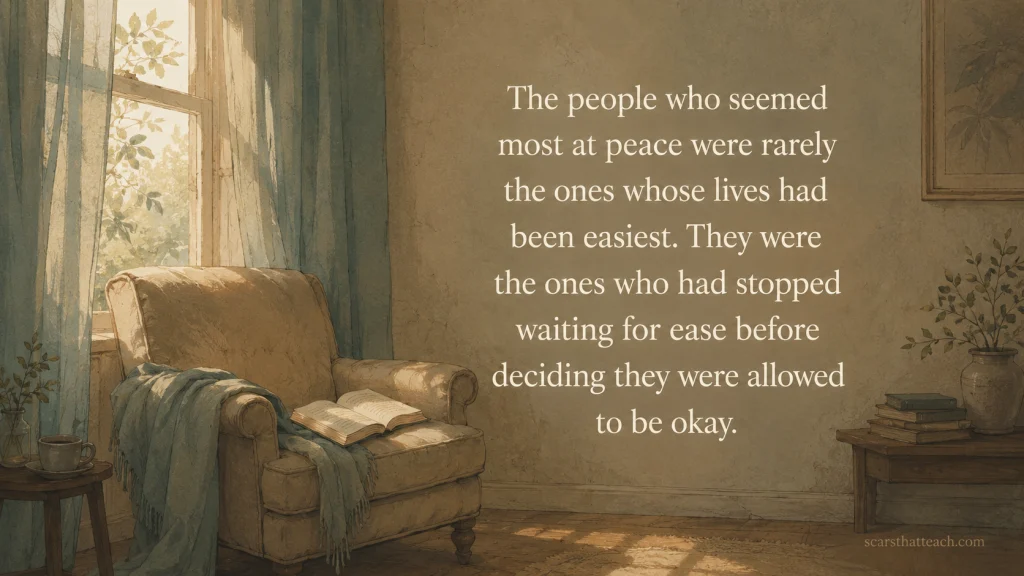
That answer came back almost unanimously when Pillemer asked his interviewees to name their single biggest regret. Not affairs. Not addiction. Not a shady business deal gone wrong. It is the kind of finding that does not fit neatly onto a quote graphic, because it indicts something almost everyone does quietly every day rather than something dramatic enough to make a good cautionary tale. I watched a version of that same quiet indictment play out in hospice rooms more times than I can count, where the people who seemed most at peace were rarely the ones whose lives had been easiest. They were the ones who had finally stopped rehearsing disasters that never arrived.
Why Most Lists of Elderly Wisdom Get This Wrong
Knowing that worry topped the list of regrets does not mean it shows up that way in most places people go looking for elder wisdom. Search for what do old people regret and you will find no shortage of content, but almost none of it leads with something as ordinary as worry, because worry does not photograph well next to a stock sunset and an inspirational font.
Almost all of it falls into one of two categories: an inspirational list of quotes attributed to anonymous “wise elders,” or a compilation of end-of-life advice with no clear source behind it at all. Both formats can feel comforting to read, but neither one tells you whether the wisdom actually came from asking real people real questions, or whether someone simply wrote down what sounded plausible and called it ancient knowledge. The distinction sounds minor until you notice how often the quotes contradict each other once you read enough of them in one sitting.
The mistake most people make here is not malicious. It is a shortcut. A curated quote is easier to produce and easier to share than a structured interview project, so the internet fills up with the former and starves the latter. The cost of that shortcut is that readers walk away with something that feels wise without being specific to any real pattern of lived experience. Research built from systematic interviews looks different. It rarely hands you a single beautiful sentence to repeat at dinner. It hands you a recurring shape across hundreds of different lives, which is a much harder thing to fake and a far more useful thing to actually use.
A few of the specific patterns that kept resurfacing across those interviews looked like this:
- Regretting time spent worrying about things outside their control, more often than regretting any single bad decision
- Wishing they had repaired a strained relationship while the other person was still able to respond to it
- Choosing a career for meaning over income, and rarely regretting that trade decades later
- Treating happiness as something built from small daily moments rather than one large achievement off in the future
A man in his early sixties once told me, almost offhand, that he had spent fifteen years waiting for retirement before he let himself enjoy anything in the present tense. He assumed the elders he would eventually become would confirm that the patience had paid off. When he finally asked them directly, what came back was closer to the opposite: the waiting itself was the regret, not the thing he had been waiting for.
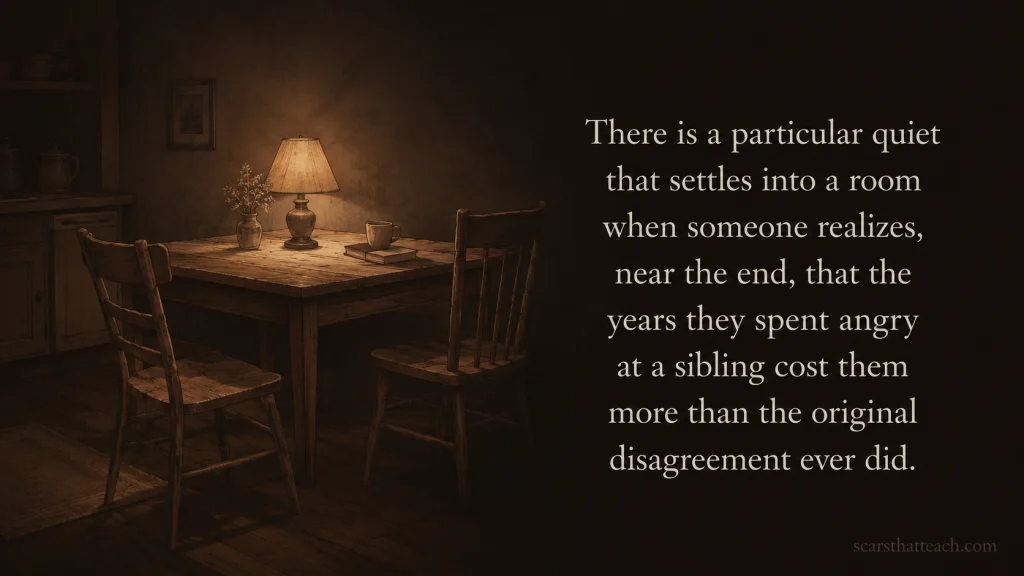
There is a particular quiet that settles into a room when someone realizes, near the end, that the years they spent angry at a sibling cost them more than the original disagreement ever did. I watched that quiet happen often enough to stop thinking of it as one family’s story and start recognizing it as a pattern.
I recognized every one of those four patterns from rooms I sat in personally, long before I ever read Pillemer’s research, even though none of the people I sat with had read it either. That recognition is part of why I put together more of what the longest-lived tend to say once you actually ask them, gathered at more of what older people tend to say. Reading enough of those side by side makes the recurring shape easier to see than reading any single quote in isolation ever could.
What This Sounds Like When You Are the One Still Listening
This is what elderly wisdom on life actually looks like up close, not a quote on a poster but a specific regret handed across a kitchen table. Picture the version of this that shows up in an ordinary family rather than a hospital room. A grown daughter visits her eighty-four-year-old father every Sunday. He has started repeating the same observation lately: that he wasted thirty years worried about a layoff that never happened, a marriage that turned out fine, a son who eventually found his footing. She used to treat this as a sign of decline, the same story on a loop. It is not decline. It is the single clearest insight he has, and he is trying to hand it to her before he runs out of chances to say it.
A different shape of the same lesson shows up in siblings who stopped speaking decades ago over something neither one can fully reconstruct anymore. By the time one of them is dying, the other often wants to fix it and discovers there is very little time left to do the fixing carefully. The elders in Pillemer’s interviews were specific about this: waiting for the right moment to repair a relationship usually just means waiting until there is no moment left at all. I have written more directly about what that pattern looks like in lessons on repairing relationships before it’s too late, because it deserves more room than a single section here can give it.
Time shows up just as often, wearing a different costume. The same urgency that drives someone to finally call a sibling also drives the quieter decision to stop postponing a trip, a conversation, or an apology that has been sitting half finished for years. The version of this that focuses specifically on how older people describe time’s actual speed lives at how older people describe time running faster, if that particular thread is the one pulling at you right now.
If you want to test whether one of these patterns already has a foothold in your own life, the question worth asking is not whether you have regrets yet. It is whether you can already name the thing you would say if someone like Pillemer knocked on your door today and asked what you wished you had known sooner. Most people answer that faster than they expect to, and what comes out first is usually closer to the truth than anything they would have planned to say. If the answer that surfaces is about worry, a grudge, or time you keep meaning to make for someone, you are not imagining a pattern. You are watching it arrive early.
What Carries Forward
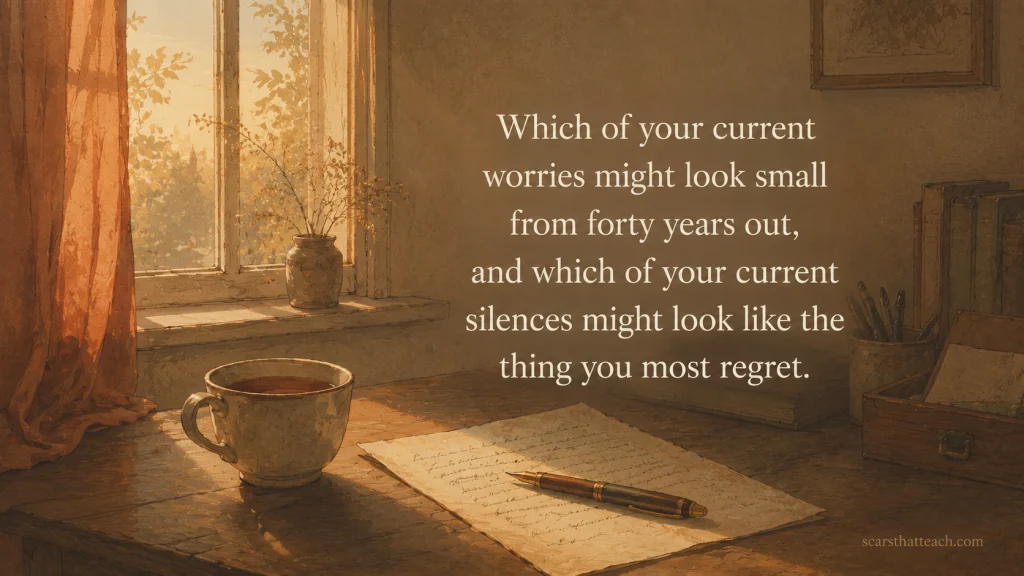
None of this works as a universal prescription. The specific weight of a worry, a grudge, or a delayed apology depends on details only you know about your own relationships and your own history. What the research offers is not a script to follow but a frame: a way of noticing, while you still have room to act, which of your current worries might look small from forty years out, and which of your current silences might look like the thing you most regret. That distinction is worth sitting with honestly, even when the honest answer is uncomfortable to reach.
If you want to see how this kind of pattern recognition applies across other situations entirely, from quiet regrets to outright estrangements, the broader collection at life lessons drawn from quotes worth trusting is a reasonable next stop. Whatever you take from any of it, take it slowly enough to actually use it. That is the one thing every person mentioned here ran out of before they were ready to.
FAQs
💭 What do elderly people say matters most in life?
Across structured interviews with over a thousand older Americans, the most repeated answers centered on relationships, time, and choosing happiness in spite of circumstances rather than waiting for circumstances to improve first. Career success and money came up far less than most people expect going in.
😊 What did older Americans say about choosing to be happy?
Many described happiness as something they had to choose in spite of hardship, not something they waited to receive once circumstances finally improved. That shift, from waiting for happiness to choosing it anyway, came up often enough across the interviews to count as one of the clearer patterns.
📚 Is the wisdom older people share backed by real research, or is it mostly anecdotal?
Some of it genuinely is. Karl Pillemer’s interviews with over a thousand older Americans followed a consistent method, which sets it apart from the curated quote collections you typically find online. That distinction matters if you want patterns you can actually trust rather than ones that simply sound good.
⏳ Why do older people so often say that life is short?
It is not a cliche to the people saying it. Once you have lived long enough to watch decades pass the way other people watch seasons change, the speed of it becomes something you have actually felt, not something you have only heard about secondhand.
🗣️ Should I always follow advice from an older relative just because they have lived longer?
No. Lived experience is valuable, but it is not universal. What worked in someone else’s marriage, career, or family does not automatically apply to yours, and the honest move is to weigh their pattern against your own actual situation rather than treating their word as final.
🤝 How do I respond when an older relative keeps repeating the same regret, without dismissing it?
Try treating the repetition as information instead of decline. If a parent or grandparent keeps returning to the same regret, ask them directly what they wish had gone differently, and let them answer in their own words instead of reassuring them out of the conversation.