
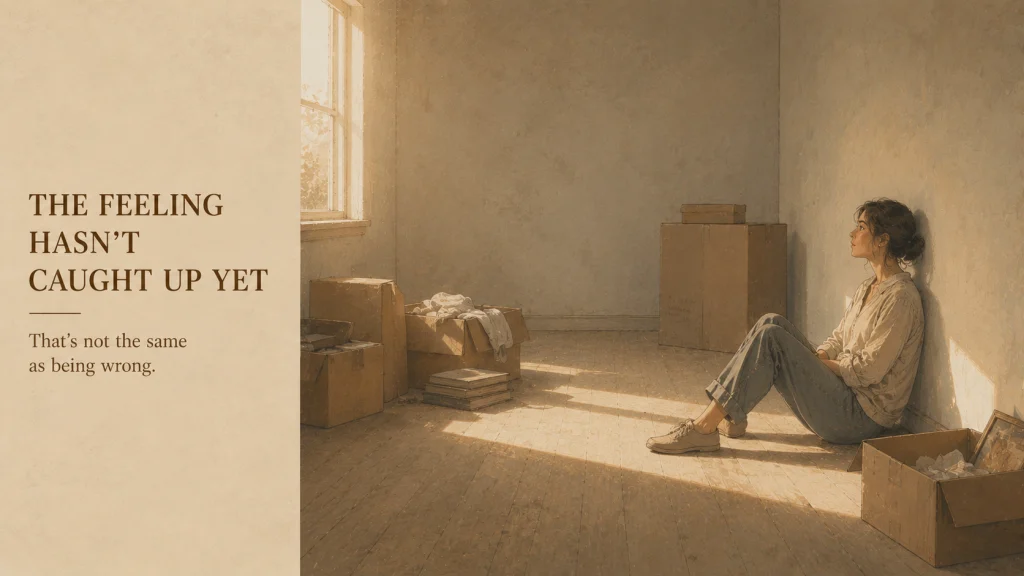
Making a major change and still feeling unsteady, lost, or wrong in the aftermath is one of the most disorienting experiences people describe, partly because so little prepares them for it. Starting over changes external circumstances first. The emotional interior catches up later, on a slower and less predictable schedule. What I saw across two decades of hospice work was that the absence of immediate relief after a real change is not evidence that the change was wrong. It is information about how long identity and internal patterns take to adjust, even after the life around them has already shifted.
The Part No One Warned You About
Most people do not say it out loud right away. They describe it instead as a kind of quiet dread, a sense that something is still off that they cannot name. They expected to feel different. They made the change. And yet the question of what to do when everything still feels wrong after starting over is sitting right there, unasked, because they did not expect to need to ask it. They thought the change would take care of that part.
I heard versions of this more times than I can count, and not from people still in the middle of a bad situation. From people who had already gotten out of one. They had left the relationship, or the city, or the job that had been costing them something real. They had done what they had told themselves for years they needed to do. What they reported, sometimes months later, was a sense of wrongness they had not anticipated. Not regret, exactly. Something quieter and harder to name. The feeling of still being themselves, when they had half-expected to become someone different.
That gap between the change and the feeling is where a lot of people quietly lose confidence in their own decision. Not because something has gone wrong, though it feels that way. Because no one told them the gap was part of it.
Why Your Circumstances Change Faster Than You Do
External circumstances can change quickly. A decision made on one day can alter where you live, who you live with, how you spend your hours, within weeks or months. The structure of a life can be rearranged faster than most people expect once they commit to rearranging it. That speed is sometimes mistaken for a sign that everything else will follow at the same pace.
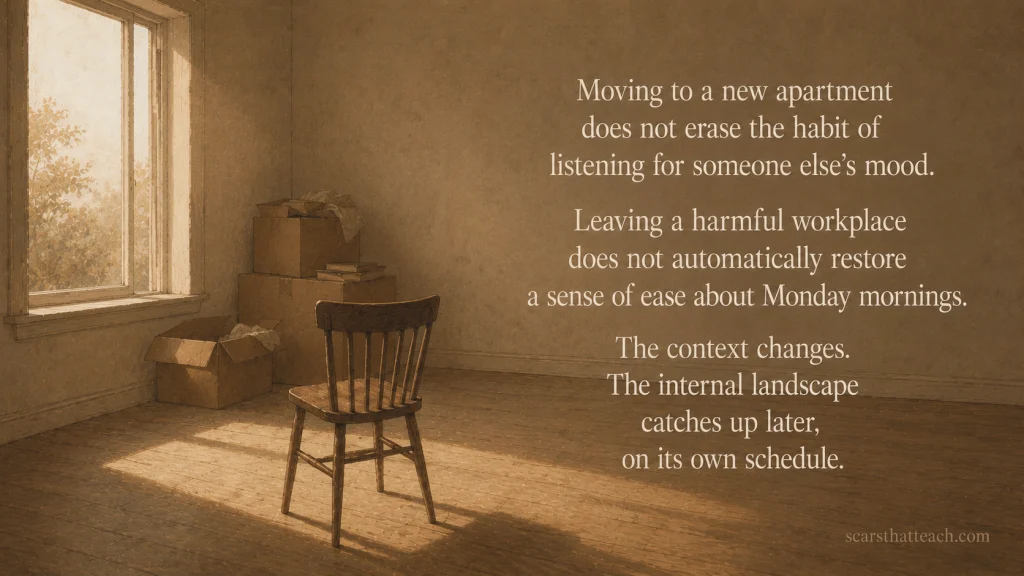
Identity does not work that way. The habits, the thought patterns, the emotional reflexes built up inside a particular situation, the ones that helped you survive what you were surviving, those do not dissolve when the situation ends. They are written into the body at a different level than circumstances are. Moving to a new apartment does not erase the habit of listening for someone else’s mood. Leaving a toxic workplace does not automatically restore a sense of ease about Monday mornings. The context changes. The internal landscape catches up later, on its own schedule, and rarely the one you imagined or hoped for.
The emotional timeline of recovery consistently lags behind the timeline of circumstantial change. That lag is not pathological. It is what adjustment actually looks like, from the inside, during the period when people most want evidence that they made the right call. For people working through the deeper process of how identity rebuilds after a major loss, that work takes even longer than people expect, and the middle period can look deceptively similar to the very beginning of starting over.
The Middle Period No One Has a Name For
There is a period in the middle of starting over that almost no one is prepared for and that almost nothing addresses directly. You are no longer in the old life. You are not yet at home in the new one. The change is real, the situation is different, and yet nothing feels settled. This is not the beginning of the restart, when there is a sense of motion and relief at having finally moved. This is after that. This is the part where the initial energy of the decision has worn off and you are still not sure you belong in the life you just built.
People in this period describe the same things repeatedly: a flatness where they expected feeling, a loneliness they did not anticipate, a sense of going through motions in a context that should feel better than it does. Some describe life still feeling wrong even though nothing is technically wrong anymore. That is a precise description of what this period actually is. The wrongness is not in the circumstances. It is in the gap between where you are externally and where you are internally. The two have not caught up with each other yet.
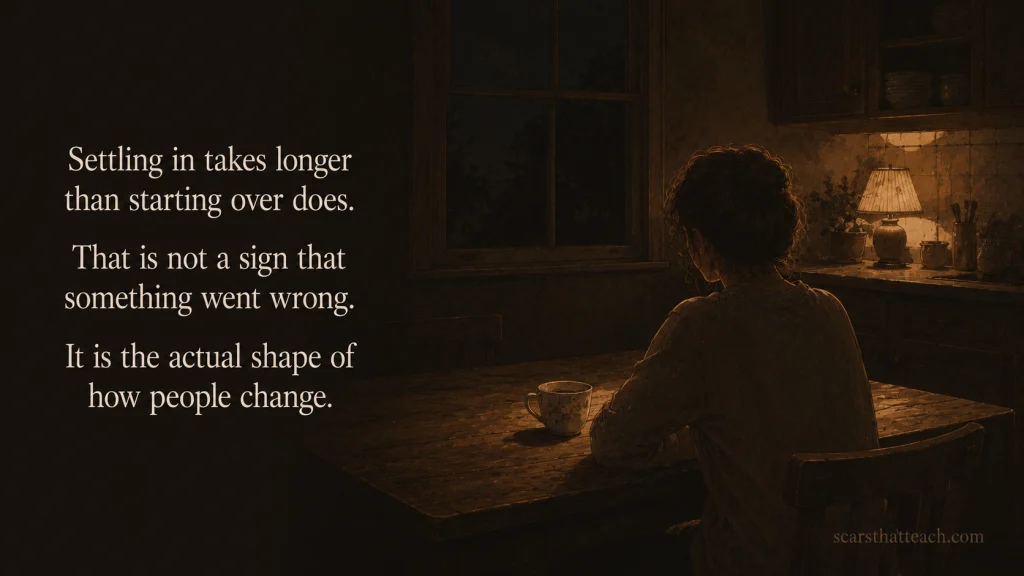
“Settling in takes longer than starting over does. That is not a sign that something went wrong. It is the actual shape of how people change.”
I have sat with enough people at the end of their lives to know that this middle period, the unmoored one, the one where the change is done and the relief has not arrived, is one of the loneliest things people carry. Not because it lasts forever. Because it is almost impossible to explain to someone who is not inside it, and because the people around you are often still congratulating you on a decision whose aftermath looks nothing like what anyone expected.
If you are still feeling lost after starting over, you are not in the wrong period. You are in the right one. It is just harder than what the expectation prepared you for.
What People Get Wrong About This Period
The most common mistake I have seen in this period is treating the absence of relief as evidence that the change was a mistake. If it was the right decision, the thinking goes, it should feel right by now. If starting over does not feel better yet, something must have gone wrong. This is one of the more damaging conclusions a person can draw at this particular moment, and it is remarkably easy to draw, because it has the surface logic of cause and effect behind it.
It happens partly because the narrative around starting over is almost entirely aspirational, and aimed at the beginning of the restart. Most of the content that exists to help people make a major change is focused on the moment of decision and the early weeks of action. Very little follows people into the months after, when the newness has worn off and the settling has not yet arrived. People who are still feeling unmoored look around, find material aimed at people who have not yet made the leap, and conclude that their situation is a deviation from the expected path, when it is actually the path. Understanding why starting over is this hard in the first place can help clarify why the middle period is even harder than the decision itself.
Starting over not feeling better, at least not yet, is not a sign of failure. It is not a sign that you made the wrong choice. It is a sign that you are in a period that takes longer than the decision, and that the emotional interior is doing slower work than the external life already did. The people I watched navigate this most clearly were not the ones who had resolved the question. They were the ones who had stopped using the feeling as a verdict on the decision. The adjustment was still in progress. That did not mean the change had been wrong. They had learned to stop treating one as a refutation of the other.
What Actually Helps in the Middle
There is no procedure for shortening the adjustment period, and I want to be direct about that before saying anything else. What helps during this period is not a set of techniques that accelerate the timeline. It is a set of framings that make the timeline less likely to be misread as evidence of failure.
- Name what is actually happening, separately. You made a real change. The emotional interior is still adjusting. Those are two separate facts. Holding them separately, rather than collapsing them into a single verdict about whether you made the right call, is the most useful thing you can do in this period.
- Lower the pressure on the new life to immediately feel better. A new situation does not owe you relief on a specific timeline. Expecting it to tends to make the absence of relief feel like failure rather than lag, and that confusion tends to compound the disorientation rather than resolve it.
- Notice what has actually changed, even neutrally. Not because positive thinking accelerates adjustment, but because the mind in this period tends to scan for what is still wrong. Deliberately observing what is different, even without declaring it better, can interrupt that loop.
- Watch for distress that significantly impairs daily life. The adjustment period is real and it takes time. But if things are not shifting at all after an extended stretch, or if the weight of it is genuinely getting in the way of functioning day to day, that is worth discussing with a professional. Recognizing the adjustment period for what it is does not mean nothing more is ever needed.
That last point matters enough to say plainly. This site is not a substitute for a therapist or counselor. What I observed across two decades is a set of patterns, not a clinical assessment. If what you are carrying feels like more than a normal adjustment period, it very possibly is, and a professional can help you figure out the difference in a way that I cannot.
The broader terrain of starting over raises questions that rarely travel alone, and the adjustment period is only one of them. If you are sitting with more than just the waiting, that wider context may be worth having.
Final Thoughts: The Feeling Has Not Caught Up Yet. That Is Different From Being Wrong.
I want to close with something I know to be true from having sat with people at the end of their lives who had made major changes and navigated the unsteady period after. Almost none of them described the middle period as proof the change had been a mistake. What they described was how long trust takes. How long it takes to feel at home in a life that is genuinely different from the one you left. That is not nothing. But it is a very different thing from regret.
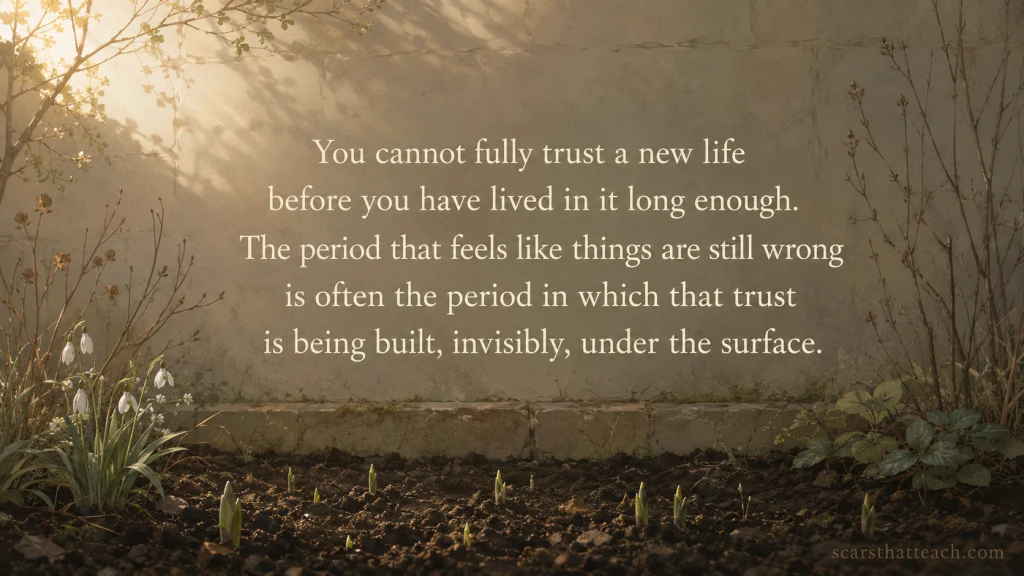
Trust takes time because it is earned through experience, not decided into existence. You cannot fully trust a new life before you have lived in it long enough. The period that feels like things are still wrong is often the period in which that trust is being built, invisibly, under the surface. The feeling lags because the evidence is still accumulating. You are not behind. You are in the middle.
What I have noticed over the years is that people who are hardest on themselves during this period often confuse the difficulty of the middle with evidence that they have failed. There is a real difference between a hard transition and a failed one. If that distinction is something you are working through, what people have said about failure and difficulty may offer a useful frame for separating the two.
The people I watched carry this most clearly were not the ones who forced themselves to feel better faster. They were the ones who could hold two things at once: I made a real change, and I have not fully settled into it yet. Both of those things can be true, and neither one is a verdict on the other.
FAQs
😶 Why do I still feel empty after starting over?
Because external circumstances change faster than internal patterns do. The situation is different, but the emotional habits built inside the old one are still adjusting. Emptiness in this period is often the absence of the old adrenaline, not proof that the new life lacks meaning.
⏳ How long does it take to feel normal again after a major life change?
There is no fixed timeline, and anyone who gives you one is guessing. What I can say is that emotional adjustment consistently takes longer than most people expect, often months, sometimes longer. The gap between circumstantial change and felt change is real. It does not mean something has gone wrong.
🤔 Is it normal to feel worse after making a big life change?
It is more common than people admit, and significantly more common than starting-over content prepares you for. The relief people expect often arrives later than the change does. Feeling worse before you feel better is not evidence you made the wrong call. It is often a feature of the middle period, not a verdict on the decision.
😔 What if starting over just doesn’t make me feel better at all?
The first question worth asking is how long it has been. The adjustment period is real and slow. If an extended stretch has passed and daily functioning is genuinely impaired, that is worth discussing with a therapist or counselor. The absence of relief is not always just lag. Sometimes it is a sign that something else is happening that belongs in a different kind of conversation.
🌫️ Does the feeling of wrongness after starting over ever go away?
For most people, yes, though not on the timeline they hope for. What I watched over two decades was that the feeling of wrongness after a real change tends to lift as the new life accumulates enough experience to begin feeling familiar. That familiarity builds slowly. It rarely announces itself when it arrives. You notice it mostly in retrospect.
💬 How do I know if this is a normal adjustment period or something more serious?
The clearest signal is impairment. A difficult adjustment period is hard, but you are still able to get through the day, make decisions, and function at a basic level. When daily functioning becomes genuinely impaired, when decisions feel impossible, sleep is significantly disrupted over a long stretch, or ordinary responsibilities become unmanageable, that is the signal to talk to a professional rather than wait it out.