When a major life role ends, a marriage, a career, a long-held purpose, the loss is not only of the thing itself. It is of the daily structure that told you who you were. Most people going through this expect to grieve what they lost. Fewer expect to feel genuinely uncertain about who they are now that it is gone. This is about that second loss: how it happens, why it catches people off guard, and how identity gets rebuilt, not discovered, but re-authored, from what was always there beneath the role.
The Question Nobody Expects to Be Asking
The strangest question I ever heard someone ask in the middle of a major life change was not “what am I going to do now?” It was “who am I going to be?” What surprised me was not the question itself. It was that asking it seemed to catch them off guard. As though they had not known it was in them until it came out.
I have sat with enough people at turning points to know that this question is not unusual. It surfaces whenever something that defined a person’s daily life, a marriage, a career, a role they held for decades, comes to an end. The practical questions follow quickly: where to live, how to manage money, what to do next. But underneath all of those, quieter and harder to name, is the identity question. And most people are not prepared for how disorienting it is.
How to rebuild your identity after loss is not the kind of problem that yields to a checklist. But it does respond to clarity about what actually happened to your sense of self, and what the process of getting it back actually involves.
What the Role Was Actually Doing
Most people underestimate how much a single role, spouse, professional, caregiver, parent in an active household, was doing for their sense of self. Not because the role was everything they were, but because it provided a continuous structure. Every day, it told you something about who you were in relation to the world. You had a context. You had a place. You knew what was expected and roughly how to meet it. That structure is not glamorous, but it is stabilizing in ways you do not fully notice until it is gone.
When the role ends, the structure goes with it. What remains is a kind of disorientation that is easy to mistake for grief alone. And grief is certainly part of it. But the particular weight that lingers, the one that makes it hard to answer simple questions about yourself, hard to know what you want, hard to recognize the person looking back at you in the mirror, that is identity disruption. It is what happens when the narrative frame that organized your daily life disappears before a replacement has formed.
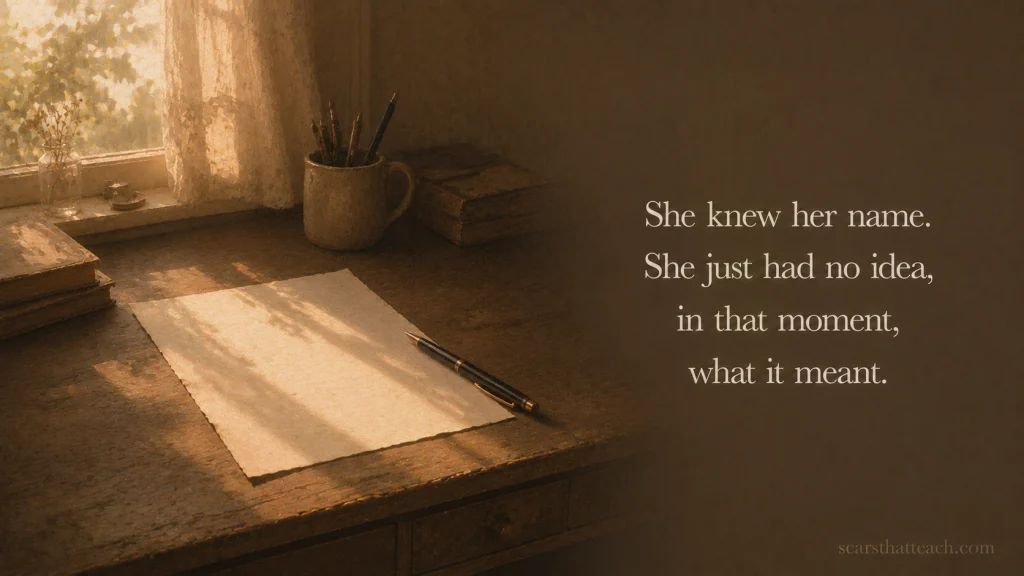
A woman I sat with once, years into a career that had consumed most of her adult life, described what happened when that career ended as feeling like she had been handed a blank page and told to write her name on it. She knew her name. She just had no idea, in that moment, what it meant.
Why the Narrative Disappears
Roles do not just give us things to do. They give us a story to live inside. The story has a structure: a direction, recurring characters, a sense of what matters and why. When the role ends, the story does not automatically continue. The next chapter does not write itself. And for a period, sometimes a short one, sometimes a long one, the person is standing between stories, without the language to explain what that feels like or the framework to know that it is a recognizable human experience and not evidence of some personal failure.
This is the part that most advice about rebuilding after loss gets wrong. The practical advice arrives too early, focused on what to do next before the person has had time to understand what they have actually lost. The more useful question, and the harder one, is: what was the role holding that now needs to come from somewhere else?
What Was Always There and What Remains
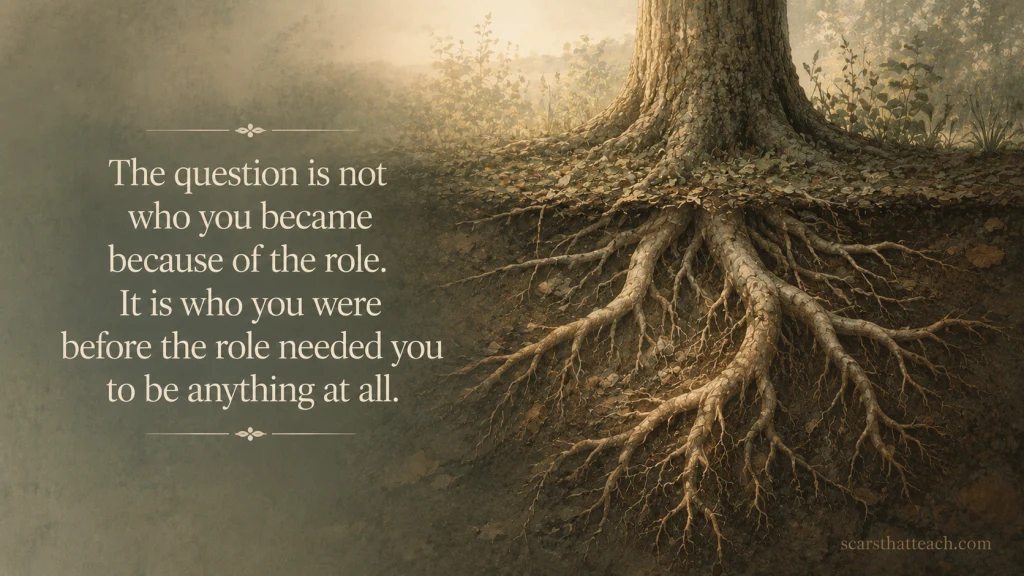
Here is the thing about identity that the generic version of this conversation tends to skip: it was never only the role. The role was one expression of something. Beneath it were values, tendencies, ways of being in the world that preceded the role and will outlast it. The person who spent twenty years as a devoted caregiver did not become caring because of the role. The role drew on something already present. The same is true of the person who built a career on precision, or on creativity, or on the ability to hold difficult situations without flinching. Those qualities are not gone because the context that made them visible is gone.
What I observed, more times than I can count, is that people in the middle of an identity crisis tend to look for themselves in the wrong place. They look for the next role, the next structure, something external to step into and organize them again. That search is understandable. But it tends to produce a fragile sense of self, one that is dependent on circumstances staying stable. The more durable foundation is built differently.
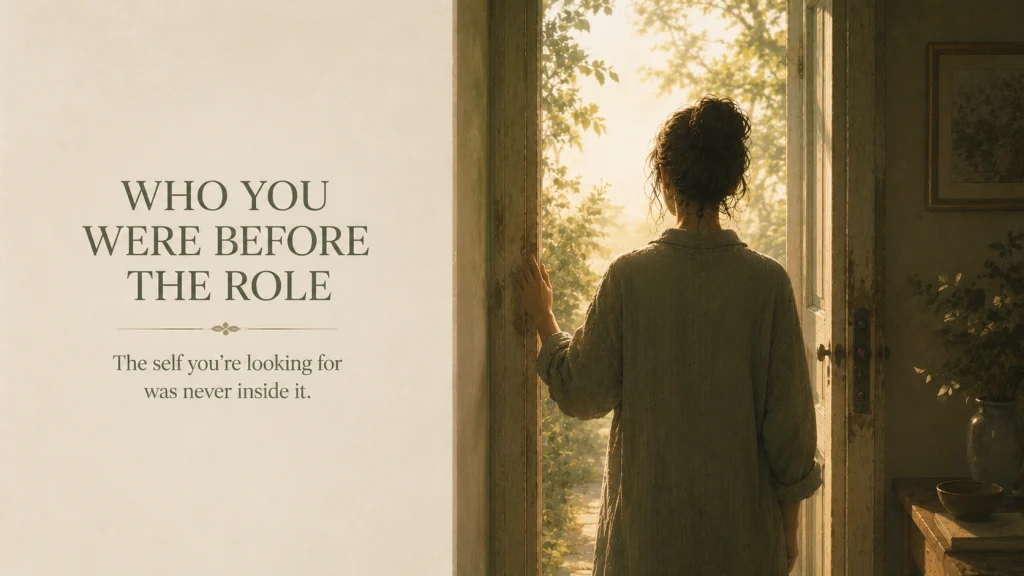
“The question is not who you became because of the role. It is who you were before the role needed you to be anything at all.”
The practical version of this is less poetic and more useful. It involves taking an honest inventory of what you have valued and practiced throughout your life, not only in the role that ended, but in everything that preceded it too. What did you consistently choose when you had a choice? What did you care about even when no one was watching? What did you find yourself returning to, again and again, even when it was inconvenient? Those patterns are not accidents. They are the material that a rebuilt identity is made from.
Several things tend to characterize people who navigate this process with more clarity than others:
- They resist the pressure to define themselves through the next role before they are ready to. They tolerate the uncertainty long enough to examine what is actually there.
- They distinguish between the skills and behaviors the role required and the values that made them want to do it well in the first place. The values are the more durable thread.
- They recognize that the identity they rebuild will not be identical to the one they had before. It will be different, and that is not a failure of recovery. It is what recovery actually looks like.
- They allow the process to be slow. Not because they are stuck, but because re-authoring who you are is not something that happens in a season of reflection and then resolves cleanly.
That last point matters more than people are told. The timeline for this kind of work is not predictable. What moves it forward is not urgency but a willingness to keep asking, even when the answers are incomplete, what has consistently been true about who you are.
What People Commonly Get Wrong
The most common mistake I have watched people make when they are trying to rebuild their identity is conflating reinvention with recovery. These are not the same thing, and treating them as though they are causes real confusion. Reinvention implies becoming something new. Recovery implies returning to something essential. The truth of what actually happens tends to live in between, but the framing matters, because it shapes what the person is even looking for.
Someone who believes they need to reinvent themselves from scratch will feel an enormous pressure to produce a new self, new interests, new direction, new personality if necessary, as evidence that they have moved forward. This pressure is exhausting, and it tends to produce a self that feels performed rather than inhabited. The person has assembled an identity rather than grown into one, and on some level they know it.
A man I sat with, some time after a long marriage had ended, told me he had spent months trying to become someone he thought he was supposed to be now. He had taken up things he did not care about, adopted an energy that was not his, built a version of himself that looked like starting over. It was not until he stopped performing the new chapter that he found what had been there the whole time: a quietness he had always preferred, a handful of things he had always valued, a way of being with people that the marriage had made harder to access. The rebuilt identity was not new. It was more truly his than the one he had been maintaining.
That is not a universal story. Some people do discover genuinely new parts of themselves in the aftermath of a major loss, and that is real too. But the search does not have to begin with the assumption that everything familiar must be discarded. The continuities are usually where the foundation is.
Final Thoughts: What Stays When Everything Else Changes
There is a version of this that sounds reassuring and another that sounds harder. The reassuring version is that you were always more than the role you lost. The harder version is that finding out what that means takes longer, and is less straightforward, than most people are prepared for when they are standing at the beginning of it.
What I can say, without overstating it, is that the material is there. The values you have carried without always naming them, the ways of being in the world that persisted even when circumstances were working against them, the things you returned to not because a role required it but because something in you needed to, that is the material. The work is not to create it. The work is to look at it honestly and write forward from it. If you are working through the broader question of what starting over actually involves, much of what makes identity so hard to rebuild connects to the same losses that make the whole process harder than people expect.
The rebuilt self will not be the same as the one you had. But it will be yours in a way that the performed version never quite was. That is not a small thing, even when it does not feel like enough yet.
What often helps clarify the continuities, in my experience, is looking back at the full span of what you have valued, not only inside the role that ended. The lessons that surfaced in the hardest rooms I sat in were almost always lessons about what had been true for a long time without being named. For more on the patterns that tend to surface when people reflect on what they actually carried through life, the broader perspective on failure and what it teaches is worth sitting with.
FAQs
🪞 How do you figure out who you are after losing something that defined you?
Start with what was true before the role existed, not only what the role asked of you. Values, tendencies, the things you kept returning to even when they were inconvenient, those are more durable markers of who you are than the role itself was. The answer is not somewhere new. It is usually somewhere older.
⏳ How long does it take to rebuild your identity after a major loss?
Longer than most people are told to expect, and not in a straight line. What I observed is that the people who came through it with a solid sense of self were almost always the ones who stayed inside the uncertainty rather than rushing to close it. There is no reliable timeline. What moves it is honesty, not urgency.
😶 Is it normal to not know who you are anymore after a divorce or job loss?
Yes, and it is more common than people admit. A role does not only give you something to do, it gives you a daily narrative about who you are in the world. When it ends, that narrative goes with it. The disorientation is not a sign that something is wrong with you. It is what identity disruption actually feels like.
🔁 Do you have to reinvent yourself completely after a major life change?
No, and the pressure to do so tends to make things harder. Reinventing from scratch usually produces a self that feels performed rather than inhabited. What most people find, when they look carefully, is that the foundation was already there, in what they valued before the role, not only inside it.
💬 What do people regret most about how they handled losing their identity after a big change?
The most common thing I heard was wishing they had given themselves more time. People rushed into the next structure, the next role, the next version of themselves before they had looked honestly at what was already there. The rebuilt identity that lasts tends to be slower to arrive than the one that was assembled under pressure.