
Most people who want to stop worrying about things they cannot control are not trying to care less about what happens. They are trying to stop being consumed by outcomes they already know they have no hand in. Worry about genuinely uncontrollable things activates the body’s stress response without giving you anything actionable to do about the source, which means you carry the cost of anxiety without any of the adaptive benefit that stress is designed to provide. The people who find a more functional relationship to uncertainty do not stop paying attention to the future. They get more precise about which part of it they can actually affect.

The Energy We Spend on Futures We Cannot Affect
Wanting to stop worrying about things you cannot control is rarely a wish to care less. It is a wish to stop being consumed by something already known to be unchangeable, which is a harder problem than it sounds, because caring and controlling have nothing to do with each other, and the mind does not automatically treat them that way.
A hospice chaplain once described the most common form of wasted energy he had witnessed in decades of work, and it was not the forms most people would name first. Not overwork, not excess, not even grief that had gone on longer than it should. The most common thing he saw was people spending real effort managing imagined futures that would never arrive in the form they had prepared for, while the actual future arrived unrehearsed and had to be met without the preparation they had exhausted themselves building. This is not a small thing. The accumulated cost of years spent in that pattern showed up plainly in the rooms where he sat with people, and it showed up differently than people expected when they arrived at the end of them.
The point here is not to suggest you should stop thinking about the future, or stop taking seriously the things that matter to you. The point is to look clearly at what worrying about uncontrollable things is actually doing, what it costs, and what a more precise approach looks like in practice.
What Worrying About Things Out of Your Control Actually Does to You
There is a meaningful difference between productive concern and unproductive worry, and the distinction comes down to whether any action is available. When you are concerned about something you can genuinely influence, the stress response is doing what it was designed to do. It sharpens your focus, keeps the stakes in view, and prepares you to move. That kind of concern has a function. Worry about things out of your control is structurally different. The same stress response activates, the same physiological preparation occurs, but there is no action available to address the source. You are prepared for a move that cannot be made.
Over time, that gap between preparation and available action is genuinely costly. Not because worry is a moral failing, but because chronic activation of the stress response without resolution or outlet accumulates in ways that tend to show up gradually, in how depleted a person feels, in how much capacity they have left for the things that are actually in front of them. Research on locus of control and anxiety has documented this pattern: when people perceive their outcomes as consistently beyond their influence, the psychological toll compounds in ways that go beyond the immediate discomfort of any single worry.
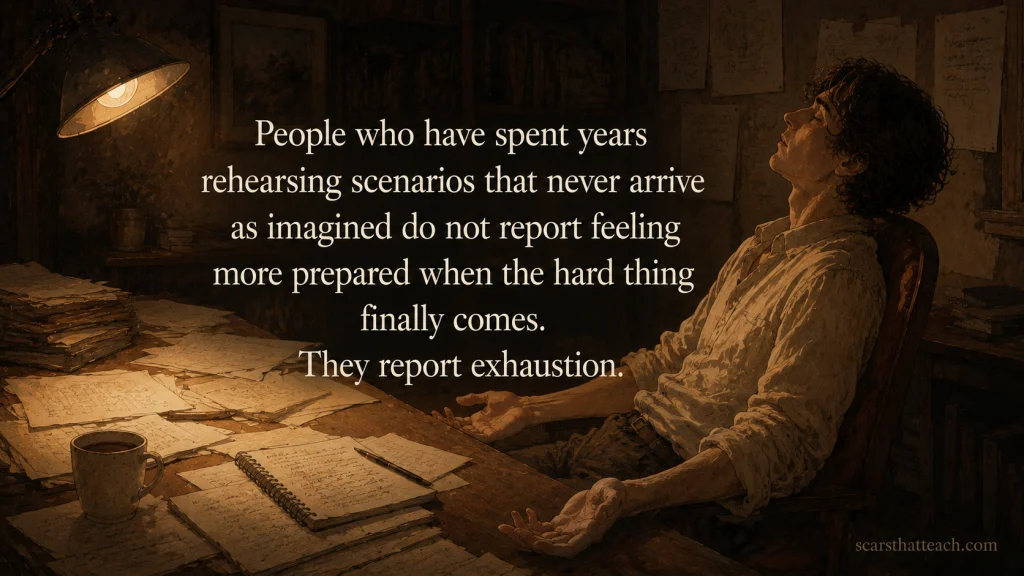
This pattern shows up often enough that it stops being a surprise to anyone who looks closely. People who have spent years rehearsing scenarios that never arrive as imagined do not report feeling more prepared when the hard thing finally comes. They report exhaustion, and a quiet recognition that the rehearsal did not purchase what they thought it would. Much of that rehearsal rests on a hidden assumption: that mentally preparing for an outcome is itself a form of influencing it. That assumption is worth examining directly, since it is often where the illusion of control does its quietest work. That is not a failure of character. It is what happens when energy is spent without any channel through which it can actually do something.
Why the Standard Advice on Worry Tends to Miss
Most of what gets written about how to accept what you cannot control arrives at the same general destination. Breathe. Be present. Practice gratitude. Let go of what is not yours to carry. These are not wrong, exactly, but they describe the destination without explaining the route. Telling someone who is actively worrying about an uncontrollable outcome to simply be more present is a reasonable instruction that does not help you get there from where you are. The problem is not the framing. It is that the mechanism generating the worry has not been addressed.
Positive reframing has the same limitation. It asks you to replace a worried thought with a less worried one, which requires overwriting the concern without addressing what generated it. For some people and some situations, this works well enough in the short term. For worrying about uncontrollable things specifically, it tends to be a temporary fix. The original concern does not dissolve. It gets pushed down and resurfaces, often with more force than before, because the act of suppressing it has added effort to what was already costly.
What is actually more effective, according to research on approaches like Acceptance and Commitment Therapy, is not suppressing or reframing the concern but redirecting the energy it carries toward the specific elements of the situation that are genuinely within the person’s reach. This is not a semantic difference from mindfulness. It is a different mechanism: not moving your attention away from the worry, but sorting the worry into what can be acted on and what cannot, and then deliberately engaging only the first category. The sorting is where most generic advice skips a step, and that missing step is where most people get stuck.

The Distinction That Actually Changes Something
The move that tends to work is a sorting exercise, not a reframing exercise. You take the thing you are worrying about and you ask, as precisely as you can: what part of this situation can I actually do something about, and what part is genuinely beyond anything I do? Then you put your energy only into the first category. Not as a way of pretending the second category does not exist or does not matter. As a deliberate reassignment of effort toward the place where effort can actually land.
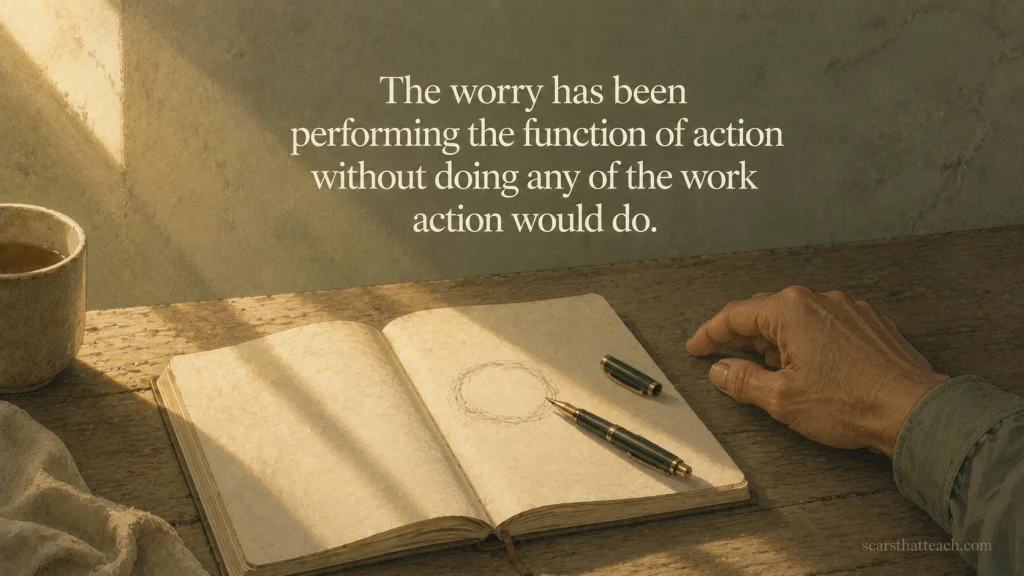
This sounds straightforward, and the concept is. The honest difficulty is in making the sorting precisely rather than approximately. Most people, when they first try this, find that the controllable category is smaller than the worry suggested, and that they have already done most of what was actually available to do. When that is true, the worry has been performing the function of action without doing any of the work action would do. Recognizing that plainly, naming it, does something that generic reassurance does not. It gives the worry somewhere to go, or more accurately, it shows that there is nowhere left for it to go that is worth the cost of sending it there.
What This Looks Like Across Recognizable Situations
The sorting does not need to be elaborate to be useful. Most people find that writing it down helps, because it forces more specificity than turning it over in the abstract. Take the worry, break it into two columns, and ask what is genuinely within your reach and what is genuinely not. Then look at the first column and ask what you have actually done about those things, or what you could still do. A few examples of how this plays out in situations people actually find themselves in:
- Someone waiting to hear whether they got a job. What is in their control: how they prepared, whether they followed up appropriately, how they handle the next step regardless of the result. What is not: the hiring decision. Worrying about the decision does not move it. Thinking through what comes next in either scenario is controllable, and actually useful.
- Someone whose adult child has made a decision they cannot agree with. What is in their control: what they say, how they say it, whether they leave the relationship open for when it matters. What is not: the child’s choice or its outcome. The relationship lives in the controllable column. The decision does not.
- Someone managing a parent’s declining health. What is in their control: the conversations they initiate, the practical arrangements they look into, how they use the time that is available. What is not: the progression of the illness. Most of the worry tends to land on the uncontrollable piece. Most of the available energy belongs in the other column.
- Someone braced for how a difficult conversation will go. What is in their control: what they say, when they choose to say it, how they prepare themselves. What is not: how the other person responds. Rehearsing the other person’s response is not preparation. Knowing what they want to say and why is.
None of these examples resolves the underlying situation. The outcome is still uncertain. What the sorting does is give the concern somewhere to direct itself other than circulation. The worry does not vanish, but it starts to have somewhere to go, and somewhere to stop.
What Redirecting Energy Actually Requires Over Time
The language of letting go has become so common that it no longer does much work. Most people who are worrying about uncontrollable things have already been told to let go, and they have tried, and the worry came back. This is not because they are bad at it. It is because letting go is not a single act. It is a repeated redirection, done each time the worry resurfaces, back toward what you can affect and away from what you cannot. The first time you do it, nothing sticks. Done consistently, it begins to become a habit that operates with less deliberate effort. That does not mean it becomes effortless. It means the effort required decreases over time.
Among the people who do this work, not perfectly but functionally, a common shift appears: they stop expecting the concern to go away entirely. They stop treating worry about an uncertain outcome as a problem that needs to be solved before they can move forward. The concern is still present. They have simply stopped feeding it with energy it cannot use. That is a different relationship to the same feeling. It is also more honest than the version that promises the worry will eventually disappear if you reach some level of mindfulness or acceptance or positive thought. For most people, it does not disappear. It becomes something they carry differently.
If you notice that this same kind of worry returns across different situations, that the specific thing you are worried about changes but the pattern of being pulled toward what you cannot control stays constant, that is usually a sign that the pattern itself is worth looking at directly. That pattern often traces back to a deeper need to feel in control of outcomes generally, something worth examining on its own terms in why you feel the need to control everything. The specific worries are often expressions of something broader. Working through the wider questions around letting go of control tends to address the pattern more durably than managing each instance on its own.
Final Thoughts: Clarity Is Not the Same as Peace, but It Is Less Expensive
I want to be honest about what the approach described here is and is not. Sorting what you can affect from what you cannot, and redirecting your energy accordingly, is not a cure for worry. It is not a path to indifference about outcomes that matter. Some things that cannot be controlled are genuinely worth worrying about. The question is whether the worry is doing anything useful, or whether it has become a habit that costs more than it returns. That is a question worth sitting with honestly, not defensively.
If worrying about things out of your control is significantly impairing how you function, not just uncomfortable but genuinely disrupting sleep, relationships, or your ability to show up for the parts of your life that are within your reach, that is worth bringing to a professional. There is a difference between a habitual pattern of unproductive worry, which is what this piece has addressed, and an anxiety disorder that requires proper clinical support. That distinction is not something to settle on your own, and this is not a substitute for that kind of help.
What seems most consistent, across the people who have worked through this kind of uncertainty in the hardest circumstances, is that the ones who found a more functional relationship to what they could not control were not the ones who stopped caring. They were the ones who got clearer about where their caring could actually do something. That clarity is not the same as peace. It is still uncomfortable to hold uncertainty about things that matter. But it is less depleting than the alternative, and it tends to leave more of a person available for the parts of life that are genuinely theirs to affect. That is about as close to a practical answer as this question has. For what those harder patterns teach across a lifetime, the broader collection of life lessons drawn from hard experience is worth your time.
FAQs
🧠 Why do I keep worrying about things I cannot control?
Because worry feels like doing something. When an outcome matters and you cannot affect it, the mind keeps searching for an action that will help. Worry fills that space. It is not irrational. It is a habit that formed because sitting with genuine uncertainty is harder than it looks, and the mind prefers the sensation of working on a problem, even one it cannot solve.
😮💨 How do I actually stop worrying about things out of my control?
The most effective move is not suppressing the worry but sorting it. Ask specifically: what part of this can I actually do something about, and what part is genuinely out of my hands? Then put your energy only into the first category. The worry does not disappear, but it stops circling territory where no action is available.
😔 Is it normal to worry about things you cannot change?
Yes. It is one of the most consistent patterns that shows up across people working through difficult and uncertain circumstances. Normal does not mean costless, though. Chronic worry about genuinely uncontrollable things carries a real toll, even when the underlying concern is entirely understandable.
🔎 What is the difference between productive concern and unproductive worry?
Productive concern has an action available. It sharpens focus toward something you can actually do about the situation. Worry about uncontrollable things activates the same stress response, but nothing you can do will address the source. You pay the cost of anxiety without any of the adaptive benefit stress is designed to provide.
💭 How do I accept what I cannot control when it genuinely matters to me?
Acceptance here is less a single decision and more a repeated redirection. Each time the worry pulls you back toward what you cannot affect, you redirect toward what you can. Over time this requires less effort. It rarely becomes effortless, but it does become more automatic. Expecting the concern to disappear entirely tends to make the process harder than it needs to be.
🩺 When should I talk to a professional about worry that will not stop?
If worry about uncontrollable outcomes is significantly disrupting your daily life, not just uncomfortable but interfering with sleep, work, or relationships, that is worth bringing to a mental health professional. There is a difference between a persistent habit of unproductive worry and an anxiety disorder. A professional can help you understand which you are dealing with and what kind of support fits.