What thinking about death actually does to a person is more complicated, and more hopeful, than most accounts of it suggest. Research on mortality awareness has spent decades documenting the defensive side of this experience, the fear and the rigidity it can produce. Far less attention has gone to the other side: that a real confrontation with mortality, the kind that comes from illness, a near-miss, the death of someone close, or simply age catching up, often makes people more specific about what they want, not more afraid to want it. This piece covers both sides honestly, and what tends to separate the people who came out of that confrontation more frightened from the people who came out of it more clear.
What Thinking About Death Actually Does to a Person
The people I sat with who had looked most directly at their own mortality, not an abstract reminder of it but a real, unavoidable confrontation, did not, on the whole, become more afraid of living. They became more specific about what they wanted to do with the life still in front of them. A woman recovering from a stroke that had nearly killed her told me, three months in, that she had stopped attending a weekly gathering she had dreaded for years out of obligation and had started spending those evenings with her granddaughter instead. Nobody had told her to make that trade. The stroke had simply made the cost of the wrong choice visible to her in a way it had never been before.
That pattern surprised me the first dozen times I watched it. It stopped surprising me after that. What surprised me more was learning, later, that the research on this had documented the same thing, and that almost none of the popular writing on confronting mortality ever mentions it.
The Defensive Side Research Has Long Documented
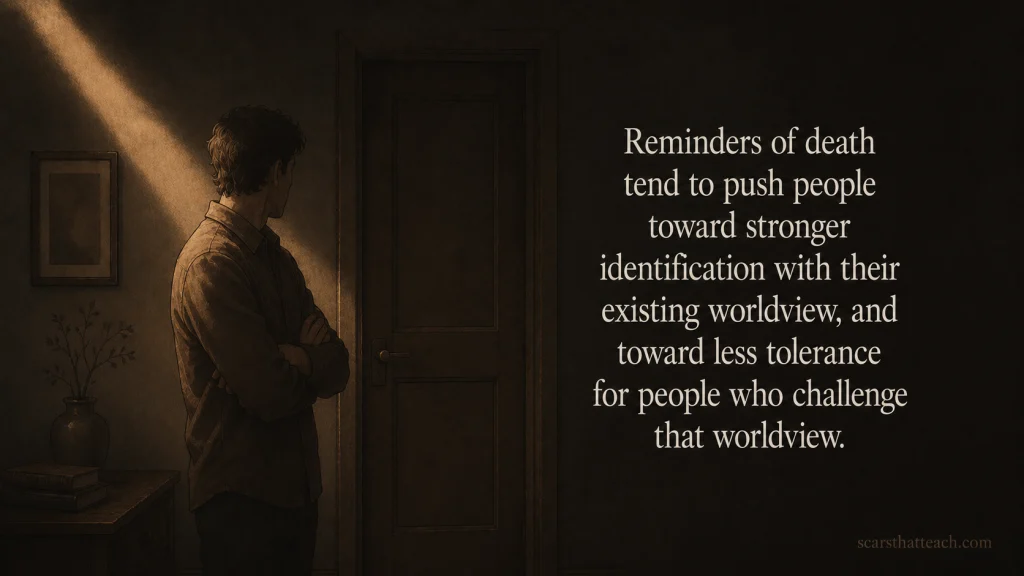
Terror management theory researchers have spent decades documenting what happens when people are reminded of their own death, a state researchers call mortality salience. The earliest and most consistent finding is defensive: reminders of death tend to push people toward stronger identification with their existing cultural worldview, and toward less tolerance for people who challenge that worldview. People become more protective of their identity, their sense of meaning, and their self-esteem, sometimes in ways that show up as increased prejudice or rigidity toward outsiders. This is the side of mortality awareness that gets the most attention, and for good reason. It is real, well-documented, and worth taking seriously.
But it is not the whole picture, and treating it as the whole picture leaves out something that matters just as much to anyone actually living through a confrontation with their own mortality right now.
The Side Most Content Leaves Out
A 2012 review by researcher Kenneth Vail and colleagues, drawing together research across multiple universities, examined what they called the positive trajectories of mortality awareness, the side of this research that rarely makes it into popular writing on death and dying. Their findings describe mortality awareness motivating people toward several distinct, constructive shifts: greater investment in physical health, a reordering of priorities toward growth-oriented goals rather than status-oriented ones, stronger and more deliberate investment in supportive relationships, and a more open-minded, charitable posture toward the world rather than a defensive one.
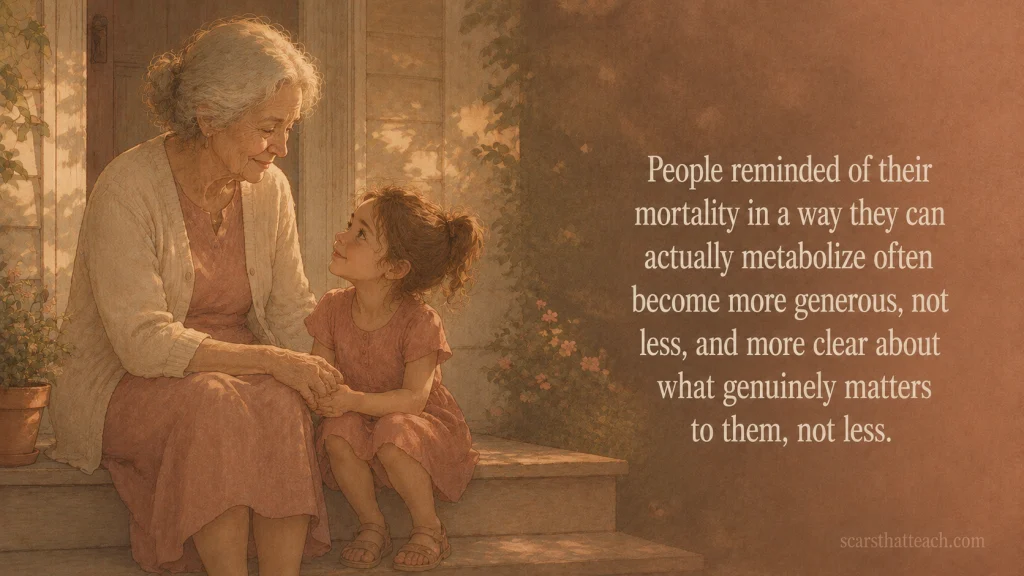
That last finding runs directly against the popular assumption that confronting death makes people more closed off and afraid. It can do that. The research is also clear that it does not have to, and that under the right conditions, it tends to do something closer to the opposite. People reminded of their mortality in a way they can actually metabolize, rather than one that simply overwhelms them, often become more generous, not less, and more clear about what genuinely matters to them, not less.
What Seemed to Separate the Two Responses
I am not a researcher, and I want to be careful not to overstate what twenty years of watching people gave me license to conclude. But across the people I sat with, the ones who ended up somewhere closer to clarity rather than fear tended to share something specific: they had some way of processing the confrontation rather than simply absorbing the shock of it alone. That sometimes looked like a conversation with someone who could sit with the fear without rushing to fix it. Sometimes it looked like time, simply enough of it passing for the initial terror to settle into something a person could actually think about rather than just survive.
I noticed something more specific underneath that pattern, the kind of detail that does not always make it into a single sentence of explanation:
- The woman who started spending evenings with her granddaughter had a daughter who sat with her through the worst of the recovery, asking nothing of her except presence.
- A man who faced a cancer diagnosis in his fifties had spent years volunteering at a shelter before his diagnosis, which gave him something concrete to redirect his remaining energy toward rather than having to invent a sense of purpose from nothing.
- People whose confrontation came suddenly, with no time to process before having to function, tended to show more of the defensive, fearful response, at least at first, simply because there had been no room yet for anything else to surface.
None of this means a frightened response is a failure or a sign of weakness. Fear is a reasonable thing to feel when facing your own death. What the pattern suggests is that fear is rarely the final word on what a confrontation with mortality does to a person, given enough support and enough time to let the confrontation settle into something other than raw shock.
Your Response Will Not Look Like Anyone Else’s
I want to be honest that not everyone who confronts their mortality arrives at clarity, and not everyone who responds with fear is doing something wrong. Some people sit with a frightening diagnosis for years and never feel anything close to the growth-oriented shift the research describes, and that does not mean they have failed at facing death correctly. There is no correct way to respond to something this large. What the research offers is not a guarantee, but a wider range of what is actually possible than most people have been told, and permission to notice if something in you is reaching toward clarity rather than assuming fear is the only available response.

Final Thoughts: The Confrontation Can Become a Compass
If you have recently had your own confrontation with mortality, through illness, a close call, the death of someone near you, or simply the slow accumulation of years, I want you to know that whatever you are feeling right now, frightened, numb, strangely clear, or some combination that does not have a name, is a reasonable response to something genuinely enormous. Give it time before you decide what it means about you. The clarity, if it comes, often arrives later than the fear does, and it tends to arrive more easily when you are not facing the confrontation entirely alone.
For a closer look at why so much of daily life is organized around never having this confrontation at all, my piece on why we avoid thinking about death in the first place goes further into that pattern. And for a wider view on the kind of clarity hard truths can offer, the collection on life lessons worth carrying into the hardest seasons covers ground this piece only touches on.
FAQs
🧠 What does confronting your own mortality actually do to you?
Research finds it can produce both defensive reactions, like rigidity and stronger in-group identification, and constructive ones, like clearer priorities, stronger relationships, and better health habits.
😨 Does thinking about death always make people more afraid?
Not necessarily. Fear is a common first response, but research has found that with time and support, mortality awareness can also motivate growth-oriented changes rather than ongoing fear.
🌱 Can thinking about death actually be good for you?
Research on positive trajectories of mortality awareness suggests it can motivate healthier behavior, stronger relationships, and clearer priorities, though this is not guaranteed for everyone.
🤝 Why do some people respond to mortality awareness better than others?
Having support while processing the confrontation, and having some existing sense of personal values, both seem to relate to more constructive responses rather than purely defensive ones.
⚖️ Is it wrong to feel only fear after a confrontation with death?
No. There is no single correct response to facing mortality. Fear is reasonable, and it does not mean you are handling the experience incorrectly.