Patience is almost universally presented as a virtue, and it often is. What most writing on the subject skips is the question of whether what someone is practicing is actually patience, or avoidance that has borrowed patience’s name. The two look identical from the outside and feel surprisingly similar from the inside, which is what makes the distinction so easy to miss and so worth examining.
The Virtue That Covers the Most Ground
In my years as a chaplain, I heard people invoke patience more than almost any other virtue. And I noticed something about how it was used. Of all the qualities people credited themselves with practicing, patience was the one I most often saw doing a second job it was not well suited for. It covered a lot of ground. It covered genuine equanimity. It covered acceptance of things that could not be changed. And, more often than the people invoking it seemed to realize, it covered fear.
Not the fear of waiting. The fear of acting. The conversation not started. The decision not made. The relationship not addressed. Patience, in those cases, was not the explanation. It was the justification after the fact, the word that transformed avoidance into something that sounded like wisdom.
I am not saying patience is not a virtue. It is, and a significant one. I am saying it is also a word that can be applied to two very different states of mind, and the difference between them matters more than most writing on the subject acknowledges.
What Patience Actually Is, According to the Research
Sarah Schnitker, a psychologist whose work on patience is among the most cited in the field, defines it not as passivity but as a form of active emotional regulation. The patient person is not withdrawing from the situation. They are engaged with it, managing their response to the delay or difficulty, while remaining oriented toward a purpose. According to research summarized by the Thrive Center, patient people are not less assertive than their less patient counterparts. They are not less likely to pursue their goals. They tend, in fact, to achieve their goals more successfully. The patience is not instead of action. It is a regulated relationship to the timing of action.
That framing changes the question considerably. If patience is an active state, then the question is not “should I be patient or should I act?” The question is whether what you are calling patience meets that description. Are you regulated, engaged, and still oriented toward something? Or are you withdrawn, avoiding engagement, and using the language of patience to explain why you have not moved?
The American Psychological Association’s coverage of Schnitker’s research describes patience as a form of emotional regulation specifically, not a disposition toward inaction. That is a meaningful distinction. It means patience requires something from you. It is not a resting state. It is a managed one.
Where Patience Ends and Passivity Begins
The line between patience and passivity is not always obvious, which is part of why people cross it without noticing. Passivity, in this context, means withdrawal from engagement: not waiting with purpose, but simply not acting, and calling the not-acting patience because that framing is more comfortable than the alternative. It is more comfortable to say “I am being patient” than to say “I am avoiding this because I do not know what will happen if I address it.”
Passivity dressed as patience tends to have a particular texture. The waiting has no direction. There is no sense of what the patience is for, no outcome being allowed to develop, no process being trusted to unfold. There is only the deferral, and the deferral has been going on for longer than the situation seemed to require. The person may feel, when pressed, that they are waiting for a sign or waiting until the time is right, but those formulations, when examined, often turn out to mean waiting until the discomfort of acting has somehow resolved itself on its own.
It rarely does. Which is one of the more reliable ways to distinguish genuine patience from avoidance: genuine patience tends to have an end in view, even a vague one. Avoidance tends to have an indefinite horizon that retreats as you approach it.
The Practical Test: Active Waiting vs. Passive Withdrawal
Most content on patience presents it as a practice to cultivate without providing any way to evaluate whether what you are currently practicing qualifies. The framework that tends to be most useful is not about the length of the wait or the difficulty of the situation. It is about the quality of the waiting itself.
Active waiting has a few distinguishable features. There is a purpose to the delay: something is being allowed to develop, information is being gathered, circumstances are being assessed, or a process is being given the time it actually requires. The person waiting is still engaged with the situation, still thinking about it, still monitoring it, still capable of responding if the situation calls for it. The waiting is chosen and bounded, even loosely. It does not feel like being stuck. It feels like holding still while something moves.
Passive withdrawal looks different from the inside, though the surface behavior may be identical. The person is not engaged with the situation. They have, in a meaningful sense, turned away from it, while maintaining the fiction of waiting. There is discomfort when the situation is raised, not the productive discomfort of someone sitting with difficulty, but the sharper discomfort of someone who does not want to look at something directly. The “waiting” has no defined scope. It has been ongoing without any clear sense of what would signal that it was time to move.
A few questions worth asking honestly, not as a checklist but as pressure tests:
- What is the waiting for? Is there a specific thing being allowed to unfold, or has the answer to that question become vague over time?
- Are you still engaged with the situation, still tracking it, still capable of acting if something changed? Or have you effectively withdrawn from it?
- If someone asked you what would need to be different for you to act, could you answer specifically? Or does the honest answer feel more like “I will know it when I feel ready,” with no clear sense of what ready means?
- Has the length of the wait surprised you? Did you expect to still be here?
These questions do not produce a verdict. They produce information. The purpose is not to reach a conclusion about whether you should act or wait, because that conclusion depends on specifics only you have access to. The purpose is to make visible whether what you have been calling patience meets the definition of patience, or whether it is something else that has been borrowing the name.
When Patience Is Genuinely the Right Answer
None of this is to say that patience is overrated or that action is preferable to waiting. The case for genuine patience is real. There are situations where acting too quickly forecloses possibilities that would have emerged given more time. There are relationships where pressing for resolution before the other person is ready produces a worse outcome than waiting would have. There are processes, external to you, that require time to develop and that cannot be usefully accelerated. In those situations, the discipline of staying regulated while you wait, and not acting out of discomfort or impatience, is exactly what the moment requires.
Schnitker’s research indicates that patient people achieve their goals more successfully, which is the opposite of what a naive reading of patience as passivity would predict. If patience were simply inaction, it would produce worse outcomes, not better ones. The explanation is that genuine patience is not withdrawal. It is the capacity to maintain engagement and purpose through a delay, which is a skill with real practical value.
I saw this clearly in the people I sat with who had navigated genuinely difficult periods of uncertainty without being consumed by them. The ones who came through those periods well were not the ones who acted fastest or who waited longest. They were the ones who could distinguish, while in the middle of it, between the parts of the situation they could influence and the parts that required time.
They waited on what required time and moved on what they could move. That combination, rather than a general disposition toward either patience or action, was what served them.
The harder cases, the ones worth thinking about honestly, are the ones where that distinction has collapsed. Where the person is no longer sure whether they are waiting because the situation requires it or because acting feels too uncertain. That collapse is where the framework becomes most useful, and where the question “is patience always the right answer?” stops being rhetorical. For a fuller picture of what patience looks like as a practice in the day-to-day, the approaches covered in how to be more patient sit alongside this question rather than replacing it.
Final Thoughts: The Honest Accounting
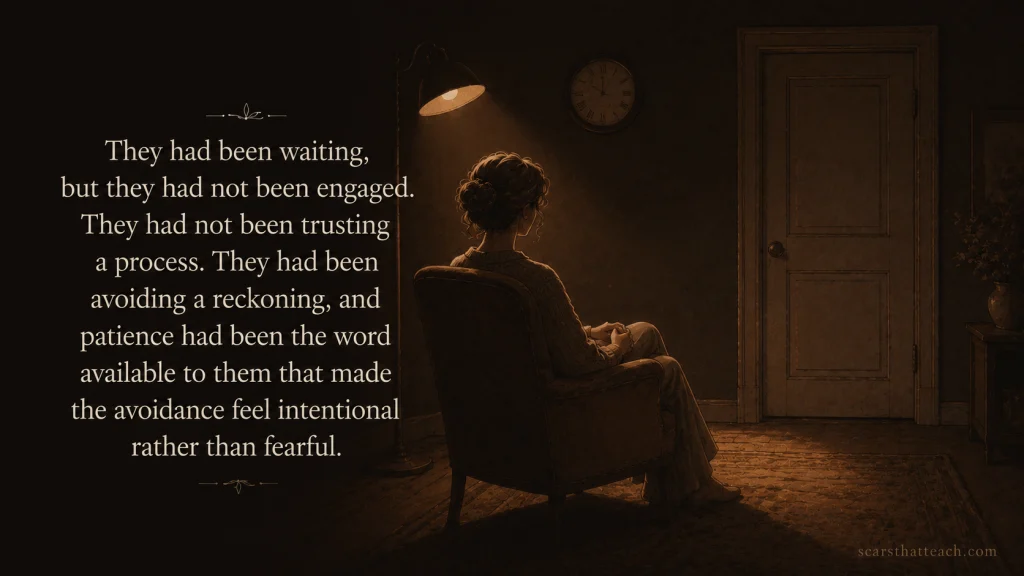
I have sat with people who, looking back at long stretches of their lives, described what they had called patience at the time as something they understood differently in retrospect. They had been waiting, but they had not been engaged. They had not been trusting a process. They had been avoiding a reckoning, and patience had been the word available to them that made the avoidance feel intentional rather than fearful.
That recognition did not come easily to most of them, and it came late. What made it possible, when it did come, was being willing to look honestly at what the waiting had actually been for, and to answer that question without the framing they had put around it for years.
Patience is not always the right answer. But the cases where it is not are not usually obvious from the inside, which is precisely why the question is worth asking. Not because action is better than waiting as a general principle, but because the virtue of patience is only available to someone who is actually practicing it, and some of the things that go by its name are practicing something else. What people who have thought carefully about how to navigate difficulty have said about timing and acting tends to land differently than the abstract arguments, and life lessons that come from experience rather than theory are where most of that is.
FAQs
🤔 Is patience always a virtue?
Not always. Patience is a virtue when the waiting is purposeful, engaged, and directed toward something. When it becomes a way of avoiding action that a situation actually requires, it is no longer patience in the meaningful sense, even if that is the word being used for it.
🔍 How do I know if I am being patient or just avoiding something?
The most reliable indicator is whether you can say specifically what you are waiting for. Genuine patience has a direction, even a vague one. Avoidance tends to have an indefinite horizon that retreats when you approach it. If pressed, you cannot quite name what would need to be different for you to move.
⚖️ When should you be patient vs. take action?
That depends on specifics only you can assess. The more useful question is whether your current waiting is active, meaning you are still engaged with the situation and could respond if it called for it, or passive, meaning you have withdrawn from it while maintaining the appearance of waiting.
🧠 What is the difference between patience and passivity?
Patience, as researchers like Sarah Schnitker define it, is a form of active emotional regulation. The patient person is engaged with the situation and still moving toward something. Passivity is withdrawal from engagement. The surface behavior looks the same. The internal state is different.
😔 Is it okay to be impatient sometimes?
Impatience is information. It is not always a problem to manage away. Sometimes it is telling you that the waiting has gone on longer than the situation actually requires, which is worth paying attention to rather than suppressing.