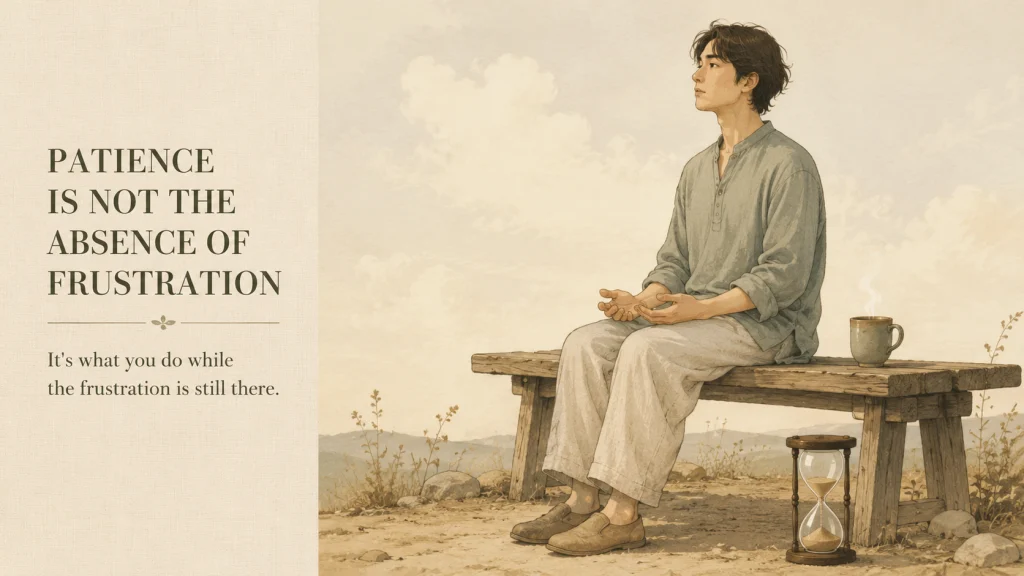
Patience is not the absence of frustration. It is the ability to stay present inside frustration without letting it make your decisions for you. Research in positive psychology has begun to confirm what most people who have actually developed patience already know: it is an active skill, not a passive state of waiting without complaint. This piece covers what patience actually is, why it is genuinely difficult to build, and what the research shows works when you try. It also points toward the specific patience challenges that tend to be hardest, if you want to go deeper on any one of them.
The Most Patient People I Met Were Not the Calmest Ones in the Room
Over twenty years as a hospice chaplain, I sat with a lot of people who were waiting. Waiting for test results, for a family member to arrive in time, for a body that had stopped cooperating, for some resolution to something that refused to resolve. If you are trying to understand how to be more patient, the place I would start is not technique. It is a shift in what patience actually means. Because the people I met who had genuinely developed it were not suppressing frustration. They had learned, usually through years of hard experience, to feel the frustration and not let it govern what they did next.
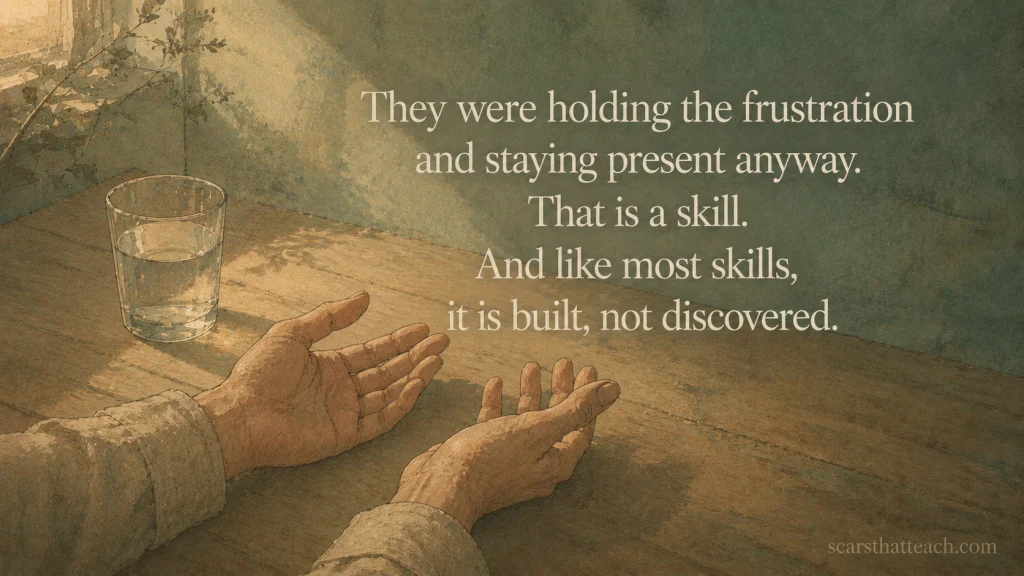
That distinction matters more than most patience advice ever acknowledges. The version of patience that circulates most widely treats it as a kind of emotional flatness: keep your voice even, wait it out, do not show how much you want this to move faster. The people I sat with who were actually patient were doing something far more demanding than that. They were holding the frustration and staying present anyway. That is a skill. And like most skills, it is built, not discovered.
What Patience Actually Is
Dr. Sarah Schnitker, a professor of psychology and neuroscience at Baylor University, has spent years studying patience as a psychological construct. Her research defines patience not as emotional blankness but as active emotional regulation: the capacity to remain calm in the face of frustration, adversity, or delay, not by eliminating the emotion but by working through it without being ruled by it. That is a meaningfully different thing from what most people mean when they tell someone to be more patient.
Schnitker’s research identified three distinct contexts in which patience gets tested. The first is life hardships, the larger circumstances that are genuinely beyond a person’s control: a chronic illness, a prolonged period of financial difficulty, a family situation that cannot be resolved on any comfortable timeline. The second is interpersonal interactions, the friction that comes from other people, their pace, their choices, their different ways of operating in the world. The third is daily hassles, the smaller irritants that are individually minor but collectively draining: traffic, slow service, a line that is not moving, technology that will not cooperate. These are not the same kind of patience, and they do not automatically build one another. Someone who handles major hardship with real steadiness can still lose their composure in traffic. Most of us know this about ourselves.
People who are patient are not less assertive, they are not passive, and if anything they actually achieve their goals more successfully.
Dr. Sarah Schnitker, Baylor University
That last point is worth sitting with. The cultural shorthand for patience tends to frame it as a form of resignation: you are patient because you have stopped trying to change things. Schnitker’s research finds the opposite. People who develop genuine patience tend to be more effective at pursuing their goals, not less. The emotional regulation that patience requires is the same regulation that allows for clearer thinking, longer time horizons, and less reactive decision-making. Patience is not a soft virtue. It is a practical one.
Why It Is Genuinely Hard to Develop
Most people who feel chronically impatient are not lacking willpower. They are working against a set of conditions that make patience functionally difficult: a brain that is wired to respond to frustration with urgency, a culture that has organized itself around minimizing waiting in nearly every area of life, and habits built over years of not having to tolerate much delay. When those conditions are in place, patience does not arrive through deciding to be calmer. It comes from building a different relationship with the feeling of wanting something to move faster than it is moving.
There is a pattern I noticed across many families in difficult situations. The ones who struggled most were almost never struggling because of the situation itself. They were struggling because the gap between what was happening and what they needed to happen felt unacceptable. Not uncomfortable. Unacceptable. And when something registers as unacceptable rather than simply frustrating, the nervous system treats the gap as a threat, and a threat produces urgency, not patience. One of the more important internal adjustments a person can make is narrowing that distance between “this is frustrating” and “this is intolerable.” It does not change the situation. But it changes whether the situation is running them.
The other reason patience is hard to develop is that the standard advice for it tends to be passive. Breathe through it. Remind yourself it will be fine. Wait it out. These are not useless, but they fall short for the kinds of patience that require something more active: tolerating the friction of another person’s different pace, holding steady through a period of genuine hardship, facing circumstances that may not resolve on any schedule you can plan around. For those situations, breathing through it is not a strategy. It is a delay. What is actually required is something more like learning to engage with the frustration rather than step around it.
What the Research Shows Actually Builds It
Research drawing on Schnitker’s work, including findings from the Greater Good Science Center at UC Berkeley, has identified meaningful links between patience and wellbeing. Better mental health outcomes are associated with patience, including lower rates of depression and anxiety. Physical health markers also improve, since the cost of chronic impatience, repeated stress activation over time, accumulates in ways the body registers. And goal achievement tends to be stronger among patient people, not because they are more naturally talented, but because they are consistently more capable of working through setbacks without abandoning what they were doing.
What builds patience in practice is less about controlling the emotional response and more about expanding the tolerance for the emotion itself. This distinction matters. A person who is chronically impatient in traffic is not helped much by telling themselves to feel calmer. They are helped by gradually expanding the amount of frustration they can be present with before acting on it. That is a trainable capacity. It develops through small, repeated exposure to frustration in lower-stakes situations, through honest attention to what specifically triggers the impatience (the delay itself, the sense of lost control, the feeling that something is being wasted), and through the kind of self-awareness that lets a person recognize the pattern while they are inside it rather than only in retrospect.
There is also the question of what the patience is in service of. The research on patience and goal achievement makes more sense when you consider that patience is not just tolerance for frustration. It is sustained orientation toward something. People who develop patience in the context of meaningful work are developing something different from people who are simply tolerating a frustrating commute. The presence of meaning changes what patience asks of a person, and how accessible it tends to be when things get difficult.
- Patience with your own pace. When the impatience is directed inward, toward yourself for not improving faster, not healing faster, not moving through something on a timeline you think you should be able to hold, the challenge is distinct from the interpersonal kind. It usually involves high standards and a habit of self-criticism that has nothing to do with the actual situation and everything to do with how you have been taught to measure progress.
- Patience with other people. Interpersonal patience is harder when another person’s pace, habits, or choices feel like they are costing you something real. The frustration is legitimate. The patience required here is not agreement or acceptance of what they are doing. It is the ability to stay present with the friction without letting it collapse the relationship entirely.
- Patience with circumstances. The hardest patience of all is often the kind that has no clear object to direct the frustration toward: a medical situation unfolding on its own timeline, a financial period that cannot be rushed, a grief that is not moving through on any schedule. This kind asks something closer to accepting limits, which is a different skill from the others and one that takes considerably longer to develop.
- Patience with small daily irritants. The cumulative weight of minor frustrations is easy to underestimate. A person who is already carrying significant stress has very little tolerance left for small hassles. The daily patience challenge is often not really about the traffic or the wait time. It is a signal about how much is already being held.
These are not the same patience challenge wearing different clothes. What works in one context does not always transfer to another, and recognizing which kind you are actually working on is a more useful starting point than most general patience advice provides.
The Specific Patience Challenges Worth Looking at Separately
The psychology of patience as a general matter is useful background. But most people who are working on their patience are not working on it in the abstract. They are frustrated with a particular person, or a particular kind of situation, or themselves. The table below points toward each of those challenges separately, and for the broader context of where patience fits among the lessons that tend to matter most across a life, the life lessons section takes the longer view.
The Individual Patience Challenges
Each of the following takes a different angle on patience, depending on what you are actually up against. They share a foundation but address problems that are distinct enough to deserve their own treatment.
| Topic | What It Covers |
|---|---|
| Why Patience Feels So Hard | The psychological mechanisms behind impatience and why good intentions are rarely sufficient to overcome them. |
| Patience with Other People | Why interpersonal patience is its own skill, and what it requires when someone else’s pace or behavior is the source of frustration. |
| Patience with Yourself | How self-directed impatience operates differently from other kinds, and why the usual advice rarely reaches it. |
| Patience with Life Circumstances | The longer-horizon patience that situations beyond your control require, and what it actually looks like in practice. |
| How to Practice Patience | Practical approaches for building patience as a skill, based on what research shows works rather than what sounds reassuring. |
| When Patience Is the Wrong Answer | A look at the cases where waiting is not wisdom, and how to tell the difference between patience and avoidance. |
Final Thoughts: Patience Is Not Something You Wait to Acquire
The quiet irony in most patience advice is that it treats patience as something you simply decide to have, as though the obstacle were a lack of intention rather than a lack of practice. What I observed over two decades of sitting with people through the hardest waiting of their lives is that patience was not something they arrived with. It was something they built, usually through situations that gave them no choice but to practice it, repeatedly, under conditions that were not convenient or comfortable. The people who seemed most at peace with waiting were not people who had found a way to feel less. They were people who had stopped being governed by what they felt.
That is worth taking seriously, because it changes what development actually looks like. It is not about becoming someone who does not feel impatience. It is about becoming someone who feels it and stays present anyway. That is harder and slower and less dramatic than most advice suggests. But the research supports it, and so does twenty years of watching what people carry when they have nothing left to perform for anyone.
FAQs
🧠 What does patience actually mean in psychology?
In psychology, patience is defined as the ability to remain calm and regulated in the face of frustration, delay, or adversity. It is not the absence of frustration but the capacity to work through it without letting it govern behavior. Researcher Dr. Sarah Schnitker distinguishes three types: patience with life hardships, patience in interpersonal situations, and patience with daily hassles.
⏳ Is patience something you are born with, or can it be developed?
Patience is a trainable capacity, not a fixed trait. Research on emotional regulation consistently shows that people can expand their tolerance for frustration through practice, honest self-awareness, and gradual exposure to situations that test it. Temperament plays a role, but temperament is not the ceiling.
😤 Why am I impatient even when I know I should not be?
Knowing you should be patient and having the capacity to be patient are different things. Impatience is often less about character and more about how much frustration you are already carrying, what specifically is triggering the urgency, and whether you have built any tolerance for delay in that particular kind of situation. Insight helps, but it is not the same as practice.
💡 Does being patient mean being passive?
No, and this is one of the most persistent misconceptions about patience. Dr. Sarah Schnitker’s research found that patient people are not less assertive and actually achieve their goals more successfully than people who are chronically impatient. Patience is active emotional regulation, not resignation.
🔄 Can patience be built through everyday situations?
Yes, and everyday situations are often where it develops. Small frustrations and minor delays are low-stakes opportunities to practice staying present with discomfort rather than immediately acting on it. The challenge is recognizing them as practice rather than simply as irritants to get through.
❓ Is patience always the right response?
Not always. Sometimes what looks like patience is actually avoidance: staying in a situation that genuinely requires action, mistaking inaction for virtue. Patience is appropriate when a situation genuinely calls for waiting. It is not appropriate as a substitute for a conversation, a boundary, or a decision that is already overdue.