
Being left out by a friend group is not always the same problem. A single missed invite is usually accidental and often answered by a direct conversation. A sustained pattern of exclusion, weeks or months of being the last to know, of plans that did not include you, of a group chat that went quiet in ways you only understood later, is a different experience, and it calls for something different than the standard advice to assume good intent and send an I-statement. This page is for the pattern, not the incident.
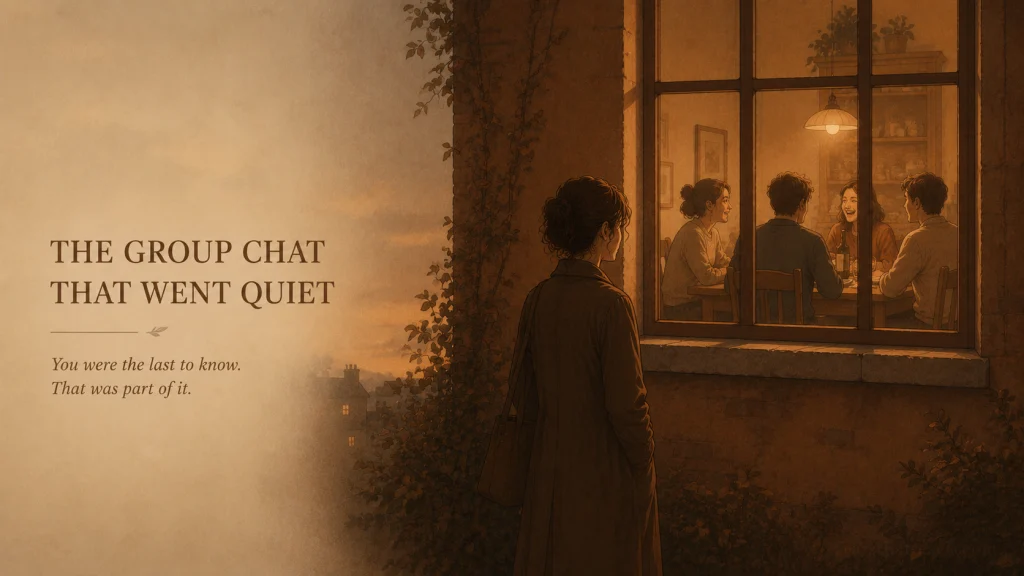
The Group Chat That Went Quiet
Years ago, in a hospice setting, I sat with a woman in her final weeks who kept returning to something that had happened months before her diagnosis. A group chat she had been part of for years had gradually gone quiet. Not all at once. A few people stopped responding to her messages. Then fewer plans included her. Then the chat went silent, and eventually she learned, from someone outside the group, that a new one had been started without her. No one had ever told her directly. No one had explained anything. The group had simply rearranged itself and left her outside the new arrangement.
What stayed with her was not the anger, though there had been some of that. It was the months of not knowing. The conversations she had with herself about what she might have done, what she had misread, whether she had imagined the distance growing. The slow accumulation of small signals that she kept finding reasons to explain away, until the explanation that she had been excluded became unavoidable. By the time she knew, she had already been grieving something she could not yet name.
I have thought about that conversation many times since, because what she described was not the experience of a single slight. It was the experience of a pattern, with its own arc and its own particular cruelty, which is that you spend most of it doubting yourself rather than understanding what is happening. That doubt is not incidental to the experience. It is part of the structure of it.

Why a Pattern Is Not the Same as a Single Incident
Most of the advice available for this experience makes no distinction between the two. Assume good intent. Reach out directly. Use an I-statement. Reflect on whether your own behavior has contributed. Those are not bad suggestions for a single missed invite. For a months-long pattern of exclusion by an existing group you considered yourself part of, they describe a different problem than the one you are actually having.
A single incident of being left out is usually what it appears to be: an oversight, a miscommunication, something that slipped. It is appropriately addressed by a direct conversation, and that conversation usually resolves it. The standard advice fits the standard problem.
A sustained pattern is something qualitatively different. It is not a miscommunication that a conversation will fix. It is the group expressing, through repeated behavior rather than direct statement, that the configuration of the group has shifted and you are no longer at its center. The reason no one says this directly is that not saying it is easier for them. You are left to decode the behavior, which takes time, which means you spend weeks or months in the interpretation stage, asking the wrong questions: what did I do, what did I miss, what do I need to fix?
Those questions are natural and understandable. They are also usually not the right questions, because the shift in the group’s configuration is often not primarily about something you did. Groups reorganize. Subgroups form. Friendships inside a larger group deepen between some people and not others, and the person who ends up at the edge is not always there because they caused something. They are sometimes just there because that is how the realignment happened to fall.
The Doubt Is Part of the Experience
One of the most consistent features of a sustained exclusion pattern, as distinct from a single incident, is the self-doubt it produces. When something happens once, you can assess it. When it keeps happening, the assessment gets harder, because you are simultaneously trying to interpret the pattern and trying to manage the distress of what the pattern might mean. The interpretation gets contaminated by the distress, which tends to produce explanations that center your own inadequacy rather than the group’s behavior. This is not a failure of perception. It is a predictable response to a situation in which the social environment is sending signals that are real but deniable, and in which no one is giving you direct information to work with.
Research on ostracism, including fMRI studies showing that social exclusion activates some of the same neural pathways as physical pain, helps explain why this kind of sustained, ambiguous exclusion is as disorienting as it is. The pain is real. The ambiguity of the cause makes it harder to process because it is harder to locate. Pain you cannot locate is harder to move through than pain with a clear source.

What a Pattern of Exclusion Tends to Look Like
Because the pattern develops gradually and is rarely announced, it can be hard to recognize while you are inside it. The markers tend to be cumulative rather than individually decisive. Any one of them has an innocent explanation. Together they have a different weight.
- You find out about plans after they have happened, or at the last minute, or through someone outside the group rather than through the group itself.
- Your messages in the group get fewer responses, or get responses from fewer people, than they used to.
- You notice that people in the group are spending time together in configurations that do not include you, which you learn about through social media or mutual connections rather than directly.
- When you are included, the dynamic feels different in a way you cannot quite name: more polite, less easy, as though your presence is being accommodated rather than welcomed.
- The frequency and quality of one-on-one contact with individual members of the group has decreased without explanation.
None of these signals is definitive on its own. The pattern becomes clear when they cluster and when they persist. The question that matters is not whether any single one of them happened, but whether something has changed in the group’s relationship to you, and whether that change appears to be continuing rather than resolving.
What Actually Helps When It’s a Pattern
The standard advice to have a direct conversation is not wrong, but it is worth being honest about what it can and cannot do. A direct conversation can clarify whether there is a specific issue that has gone unaddressed. It can surface something that was creating friction without your knowing. In some cases it changes things. In others, it produces a reassurance that is temporarily comforting but does not alter the pattern, because the pattern is driven by the group’s social preferences rather than by a specific grievance that can be resolved.
What tends to be more useful than trying to fix the situation is naming it accurately. You are not dealing with a miscommunication. You are dealing with a group that has reorganized in a way that does not include you at its center, and that is expressing this through behavior rather than through direct statement. That is worth acknowledging, because the effort to reinterpret the signals as something more benign, which is natural and understandable, tends to extend the period of self-doubt and delay whatever comes next.
What tends to come next, in the experience of people who have been through this, has its own arc: a period of genuine distress while the exclusion is being decoded, a period of detachment as the interpretation solidifies and the grief begins, and eventually a rearrangement of how much weight you are giving this group relative to other relationships and connections. That arc is not fast. It is also not the same as the arc for a single incident, which can often be resolved in a conversation. Expecting a conversation to short-circuit a pattern tends to produce repeated disappointment, because the conversation addresses something smaller than the thing that is actually happening.
Taking the experience seriously enough to expand your social investment elsewhere, rather than doubling down on a group that is signaling exclusion, is not giving up. It is a response to accurate information about where the warmth in your social landscape currently lives.
Final Thoughts: What the Pattern Is Actually Telling You
The woman I sat with in that hospice room did not need someone to tell her that she should have reached out with an I-statement months earlier. She needed someone to acknowledge that what had happened to her was real and had its own particular cruelty, and that the months of self-doubt she had experienced were a predictable response to an experience that was designed, by its ambiguity, to make her doubt herself. When I said something close to that, she was quiet for a moment, and then she said: that is the first time anyone has described it that way.
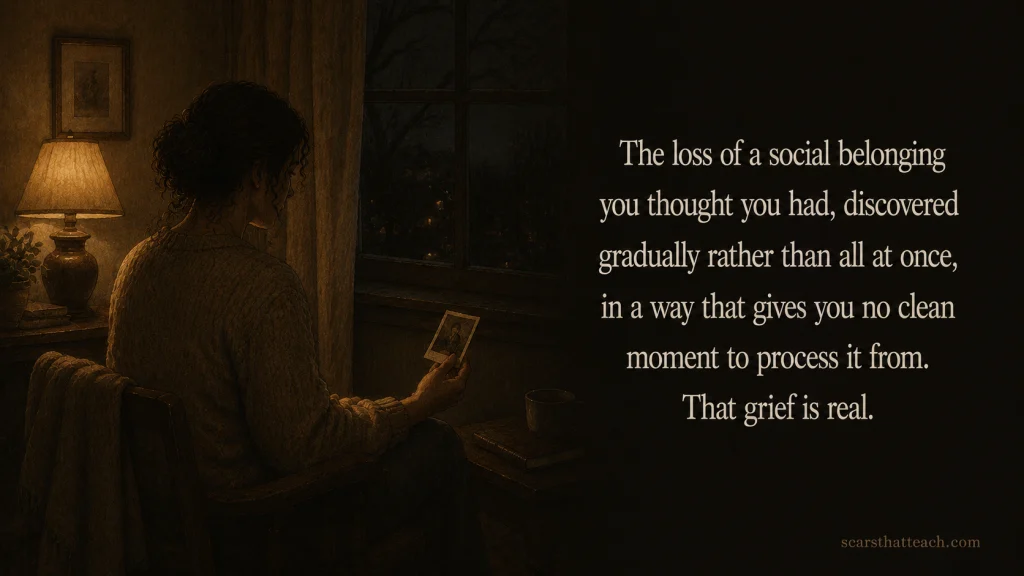
That is what the standard advice misses. It approaches the problem as though it is about communication, when for a sustained pattern it is about something closer to grief: the loss of a social belonging you thought you had, discovered gradually rather than all at once, in a way that gives you no clean moment to process it from. That grief is real. It deserves to be named as what it is rather than treated as something a better-phrased message would have prevented.
The patterns underneath experiences like this one, including the dynamics that produce fake friendships and what they tend to look like over time, are part of the larger conversation at fake friends and what they cost. For the questions about toxic dynamics and the people who carry them, the toxic people quotes and what they actually teach section covers some of that ground.
FAQs
😔 How do I know if my friend group is actually excluding me or if I’m imagining it?
The question to ask is not whether any single instance happened but whether a pattern is present and continuing. One missed invite is usually nothing. A recurring set of signals, finding out about plans late, feeling accommodated rather than welcomed, noticing that the group’s internal connections have deepened in ways that don’t include you, carries a different weight. If the pattern has persisted over weeks or months, you are probably not imagining it. The doubt you feel is a predictable response to ambiguous social signals, not evidence that the signals are not there.
🤔 Should I confront my friend group about leaving me out?
A direct conversation can help in some situations, particularly if there is a specific unaddressed issue that has been creating friction. For a sustained pattern, it is worth being honest about what a conversation can do. It rarely reverses a group realignment, because the realignment is driven by the group’s social preferences rather than by a grievance that can be resolved. A conversation may produce temporary reassurance. Whether it changes the pattern is a different question, and the answer is often no.
😤 Why does being left out by friends hurt so much?
Research on ostracism, including fMRI studies by psychologist Kip Williams, has found that social exclusion activates some of the same neural pathways as physical pain. The hurt is not a sign of oversensitivity. It is a real response to something the mind and body register as a threat to social belonging, which is one of the things humans are most wired to protect. Sustained exclusion, because it is ambiguous and ongoing, is harder to process than a single clear event, because pain without a clear source is harder to move through.
🔄 Why do I keep making excuses for my friends leaving me out instead of seeing it clearly?
Because the alternative interpretation, that the group is excluding you, is painful and has significant implications for a social belonging you value. The mind tends to favor explanations that do not require that conclusion for as long as those explanations remain plausible. This is not a failure of perception. It is a protective response. The problem is that it extends the period of self-doubt and delays the clearer assessment that would let you decide what to do.
💔 Is it worth trying to stay in a friend group that keeps leaving me out?
That depends on whether the group is responding to communication or whether the pattern is continuing regardless. If a direct conversation surfaces a specific issue and changes the dynamic, the group may be worth investing in. If the pattern continues after a genuine attempt to address it, you are receiving accurate information about where you stand, and continuing to invest heavily in that group tends to extend the pain rather than resolve it. Expanding your social investment elsewhere is not giving up. It is responding to what the situation is actually telling you.
😢 How do I deal with the grief of losing a friend group?
By letting it be grief rather than treating it as a problem to solve. Losing a social belonging you thought you had is a real loss, and the fact that the group still exists does not make the loss less real. What tends to help is naming it accurately, allowing the distress phase of the experience without extending it through continued investment in a group that has signaled exclusion, and gradually shifting your attention and energy toward connections that are actually reciprocal.
🌱 What should I do when I realize my friend group has been excluding me?
Start by naming what you are actually dealing with: a pattern, not an incident. That distinction matters because the responses are different. If a direct conversation feels worth attempting, attempt it once, genuinely, with realistic expectations about what it can change. Then assess the response. If the pattern continues, the most useful thing is to stop giving the group more weight than the evidence warrants and to build toward social connections that do not require you to reinterpret repeated exclusion as something else.