
Controlling behavior in relationships usually comes from the same place as control in general: an attempt to make something feel predictable enough to feel safe. The cost is not primarily that it damages the other person, though it can. The more immediate cost is that it makes genuine closeness structurally impossible. When one person is managing the other’s behavior, reactions, or image, the other person is not being allowed to be fully real. And you cannot be genuinely close to someone who is not allowed to be real.

Control and Surprise Cannot Live in the Same Place
The most profound loneliness I witnessed in my years of hospice work was not in people who were alone. It was in people who were surrounded by relationships and still felt unseen. And a pattern I noticed in a specific subset of those people was that they had, often without fully realizing it, arranged their closest relationships so that nothing in them could be truly surprising. They managed how their partner behaved in social situations. They corrected how their children presented themselves. They monitored, adjusted, preempted. The relationship was, in the practical sense, functioning. But it had a quality of flatness to it that they often described with confusion, because from the outside, it looked intact.
What I came to understand, across enough of those conversations to feel certain about it, is that control and surprise cannot live in the same place. Surprise is most of what makes another person real to you. When someone does something you did not predict, something that is genuinely theirs and not a product of your management, that moment is where closeness lives. Control eliminates that possibility. It keeps the relationship within a range you can tolerate, and in doing so, it keeps the other person from being fully themselves in your presence. You end up in a relationship with your own management of a person rather than with the person.
Most people who have this pattern do not experience it as control. They experience it as caring, or as trying to make things go well, or as being someone who pays close attention. The reframe from carefulness to control is one most people resist, because the self-image that goes with controlling behavior is usually not “I am controlling.” It is “I have high standards” or “I worry about these things” or “I know how this will go if I don’t stay on top of it.” Understanding what is actually driving the pattern tends to require getting beneath those framings.
What Drives the Need to Control in Relationships
Controlling behavior in relationships is almost always fear-adjacent. Not dramatic fear, in most cases. More like a low-level intolerance of unpredictability, a discomfort with not knowing how something is going to go, a need for the relationship to stay within a range that feels manageable. Managing the other person’s behavior is a strategy for producing that manageability. If I can anticipate and influence what they do, I can reduce the probability of outcomes that disturb me.
The disturbances that drive the control vary. For some people it is the fear of conflict, so they manage the other person’s behavior to prevent situations that could produce friction. For some it is the fear of embarrassment or judgment from others, so they manage how their partner or children appear. For some it is a deeper fear of loss or abandonment, so they try to keep the relationship within parameters that feel secure. In each case, the control is doing something real: it is trying to produce a feeling of safety in a context where safety does not feel reliably available without the management.
The problem is not the desire for safety. The desire for safety is understandable and not pathological. The problem is the method. Managing another person to produce your own sense of safety treats that person as a variable to be controlled rather than someone with their own interior life, their own legitimate choices, their own way of being in the world that does not exist primarily to make you comfortable. That treatment, even when it is not hostile, has costs for the relationship that accumulate over time.
Why It Often Doesn’t Feel Like Control
One reason controlling behavior in relationships is hard to recognize in yourself is that it is often indistinguishable, from the inside, from caring. Wanting the dinner to go well, noticing that your partner said something that might be misread, steering a conversation away from a topic that could cause problems, these feel like thoughtfulness. They feel like awareness. They feel like the kind of attention that good relationships require.
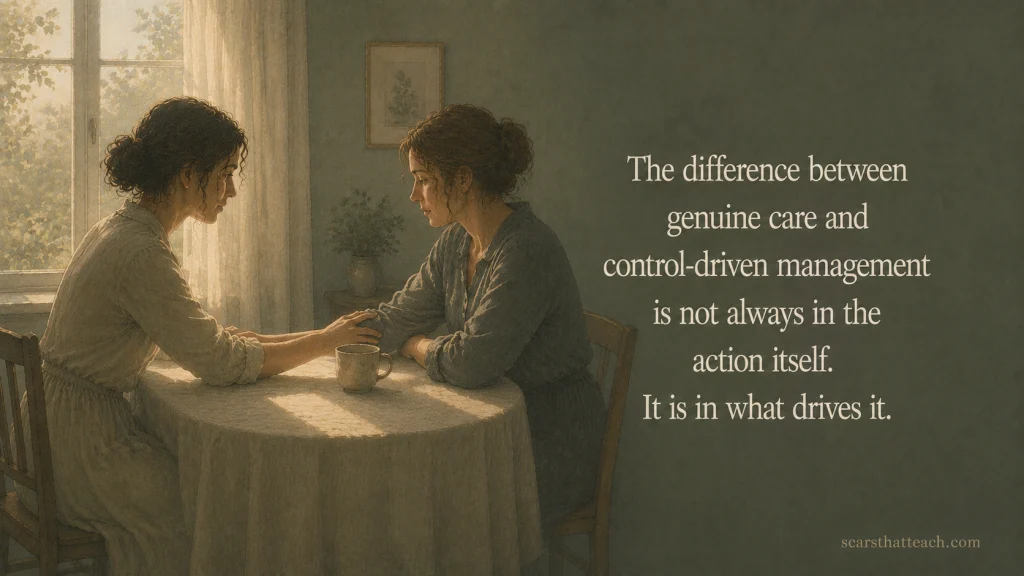
The difference between genuine care and control-driven management is not always in the action itself. It is in what drives it. Genuine care can tolerate an outcome that is different from what you preferred. Control-driven management cannot. If the outcome goes outside the range you were managing toward, and you feel anxiety, resentment, or a need to fix it, that is usually the signal that what you were doing was management, not care. Care can live with surprise. Management is specifically there to prevent it.
The Cost That Is Rarely Named
Most content on controlling behavior in relationships focuses on whether the pattern is present, and on the harm it does to the person being controlled. Both of those are worth understanding. But there is a cost that is less commonly named, and it is the one I have seen do the most quiet damage: when you control another person in a relationship, you lose access to them as they actually are.
The person you are managing is showing you their behavior within the range you have made acceptable. They have learned, consciously or not, what you want, what upsets you, what to avoid, how to be in your presence without triggering the management. What you are getting is a version of them that has been shaped by your control. It may be a version you prefer. But it is not them in full, and you know it, even if you cannot name it. The flatness that people with this pattern often describe in their relationships is partly that: the absence of the person’s full reality, which your management has made unavailable.
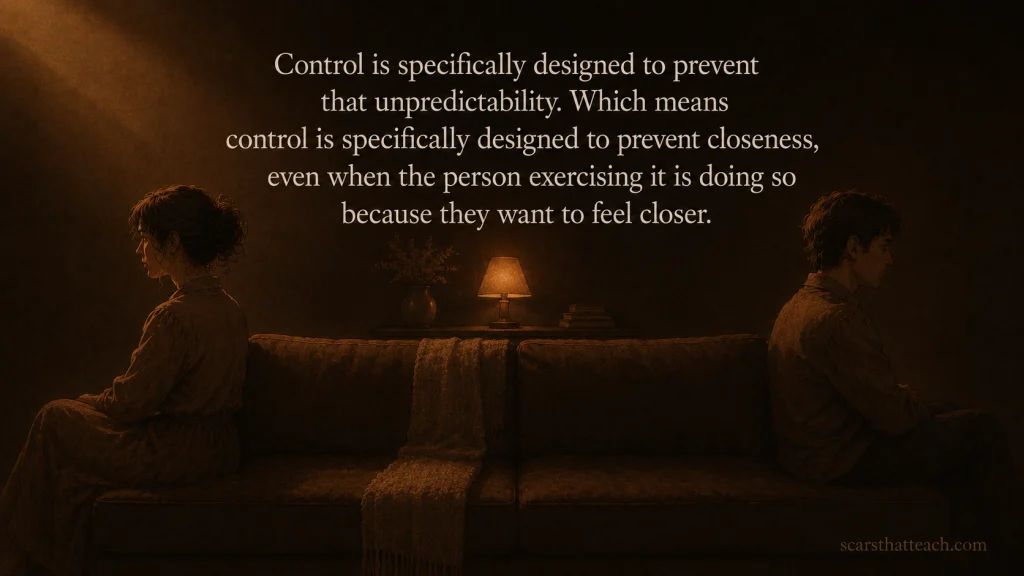
This is the mechanism that makes control an impediment to genuine closeness, not just an annoyance for the person being controlled. The closeness you want requires the other person to be actually present, actually themselves, actually unpredictable in the small ways that real people are. Control is specifically designed to prevent that unpredictability. Which means control is specifically designed to prevent closeness, even when the person exercising it is doing so because they want to feel closer, or safer, or more certain that the relationship will hold.
- The intimacy you feel in a controlled relationship is partly with your own management of a person. That is not the same as knowing them, and on some level you can tell the difference.
- Genuine closeness requires the other person to be surprising occasionally. Control eliminates that possibility, and with it, the experience of really knowing someone.
- People who are being controlled often respond by becoming less visible in the relationship, which tends to look like distance and is often misread as the thing the control was trying to prevent.
- The loneliness of a controlled relationship is usually felt by both people, not only the one being managed. The controller is also not getting what they actually want, which is genuine connection.
What Letting Go of Control in Relationships Actually Requires
The practical advice on this topic tends to be about behavior: stop correcting, stop monitoring, stop giving unsolicited feedback. That advice is not wrong. But it tends not to address the source, which is the feeling that drives the management in the first place. If the feeling underneath is anxiety about an outcome that feels unsafe, then stopping the controlling behavior without addressing the anxiety tends to produce a different set of managing behaviors rather than a genuine change. The management finds another expression.
What tends to actually shift is a change in the relationship to the feared outcome itself. Not eliminating the fear, which is usually not possible through effort, but loosening the belief that managing the other person is what prevents the feared outcome from occurring. Most of the things people are managing their partners to prevent are not actually preventable through management. The relationship does not stay intact because you have monitored closely enough. Conflict does not stay absent because you have steered carefully enough. What the management produces is the appearance of prevention, and the cost is the relationship’s aliveness.
The broader question of what drives the need for control more generally, outside the relational context, is covered in why you need to control everything. And what the actual shift toward less control looks like as a lived experience, not just a concept, is something what letting go of control actually means addresses directly.

Final Thoughts: What You Are Actually Trying to Protect
People who control in relationships are usually not trying to dominate. They are trying to preserve something. The relationship, or a version of it that feels safe, or a sense of themselves within it that they can hold without too much anxiety. The control is in service of something that matters. Understanding that does not make the control less costly. But it does make the person exercising it more understandable, and more available to ask the question the control tends to foreclose: what am I actually afraid of losing, and is this how I protect it?
The things most worth having in a relationship cannot be protected by management. They can only be made possible by enough trust to let the other person be themselves. That trust is not the same as certainty. It is closer to the willingness to tolerate uncertainty for the sake of something real. Control offers a version of certainty. What it costs is the realness. Most people, when they can see that trade clearly, would rather have the realness. Getting there is the work.
The full context of control, why it appears and what releasing it tends to look like across different areas of life, is part of the larger conversation at letting go of control. For the broader questions about what people carry and what it teaches them, the life lessons and what they actually cost section covers some of that ground.
FAQs
🤔 What counts as controlling behavior in a relationship?
Monitoring, correcting, managing how the other person behaves, appears, or speaks; steering conversations or situations to stay within a range you find safe; preempting the other person’s choices because you anticipate outcomes you want to avoid. The common thread is that the behavior is oriented toward keeping the relationship within a range that reduces your anxiety, rather than allowing the other person to be themselves and tolerating the uncertainty that comes with that.
😕 Why do I feel the need to control my partner even though I know it’s a problem?
Because the control is managing a feeling, usually anxiety or fear of a specific kind of loss, that does not go away just because you have identified the behavior intellectually. Knowing the pattern is a problem and having the underlying fear resolve are different things. The behavior persists because the feeling it is managing is still present. What tends to change the pattern is working with the fear, not just the behavior.
🔄 How is controlling behavior different from just caring about how things go?
Care can tolerate an outcome that is different from what you preferred. Controlling behavior cannot. If the outcome goes outside the range you were managing toward and you feel significant anxiety, resentment, or a need to fix it, that is usually a signal that what you were doing was management rather than care. The action can look the same from the outside. The difference is in what drives it and what it can live with.
💔 Can controlling behavior damage a relationship even if it comes from a good place?
Yes. The source of the control does not change its effect. The person being managed is not experiencing your intention. They are experiencing the management, which tends to make them feel unseen, restricted, or like they cannot be themselves around you. Over time they often respond by becoming less visible or less present in the relationship. The intention was to protect the relationship. The effect is often to hollow it out.
😤 Why does letting go of control feel so frightening even when I want to?
Because the control is managing a real fear, and releasing the control means allowing the feared outcome to be possible. The fear does not disappear when you decide to stop controlling. It becomes more present. What shifts over time is not the absence of fear but the loosening of the belief that management prevents the outcome you are afraid of. Most of the things people manage their partners to prevent are not actually preventable through management.
🧠 Is controlling behavior in relationships the same as being in an abusive relationship?
Not automatically, no. Controlling behavior exists on a spectrum. The self-protective pattern described here, managing a partner’s behavior out of anxiety and fear of disturbance, is different from coercive control, which involves systematic domination, isolation, or harm. Both can cause damage, but they are different in their nature and their required response. If you are trying to understand whether a specific situation is harmful, a professional is better placed to help with that assessment than a general explanation of the pattern.
🌱 What does actually letting go of control in a relationship look like?
Less like a decision and more like a practice of tolerating the anxiety that comes when you do not intervene. It usually starts small: noticing the impulse to correct or manage, and not acting on it, and observing what actually happens. Most of the time, the feared outcome does not occur. When it does occur, it is usually more survivable than the anxiety predicted. The practice builds a different kind of evidence base about what the relationship can actually hold without the management.