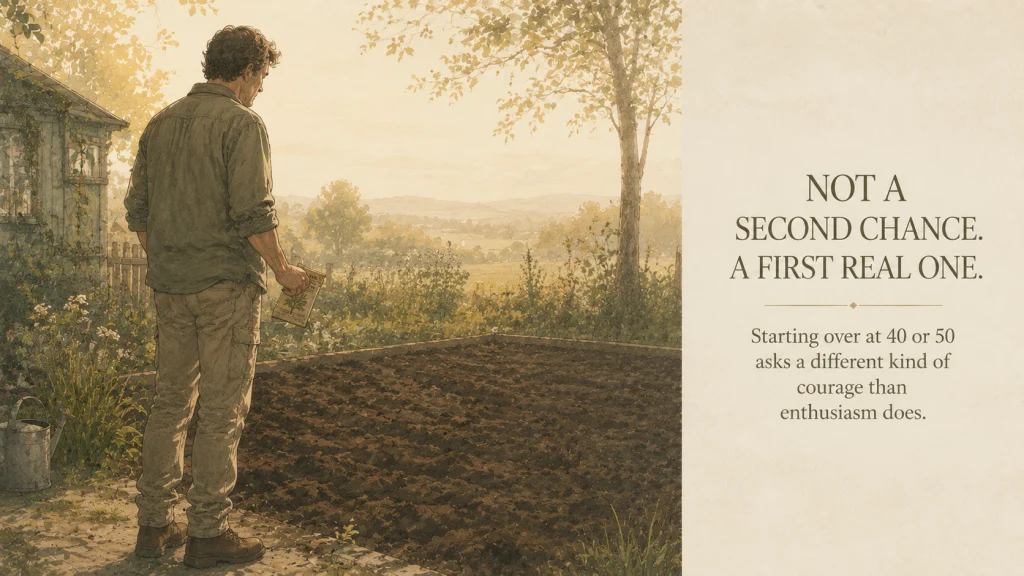
Starting over at 40 or 50 is not simply a harder version of starting over at 25. The person in midlife brings different raw material into a new beginning: more self-knowledge, less patience for directions that were never really theirs, and a clearer sense of what they are starting and why. That self-knowledge complicates a new beginning in some ways and strengthens it in others. Most of what gets written about midlife restarts addresses one side of that without the other. This piece tries to name both honestly.
The First Time They Knew What They Were Starting
People who are starting over at 40 or 50 are working, almost immediately, against a story that tells them the relevant time for this has passed. They have heard it from others. They have absorbed a version of it from a culture that tends to associate new beginnings with youth and treat midlife starts as either brave exceptions or quiet admissions of failure. Sometimes it arrives as concern from people who genuinely care about them. Sometimes it is just a voice that sounds like common sense but has never been examined carefully. It is a compelling story, partly because it is not entirely wrong. But it misses something specific, and the thing it misses is what I want to address here.
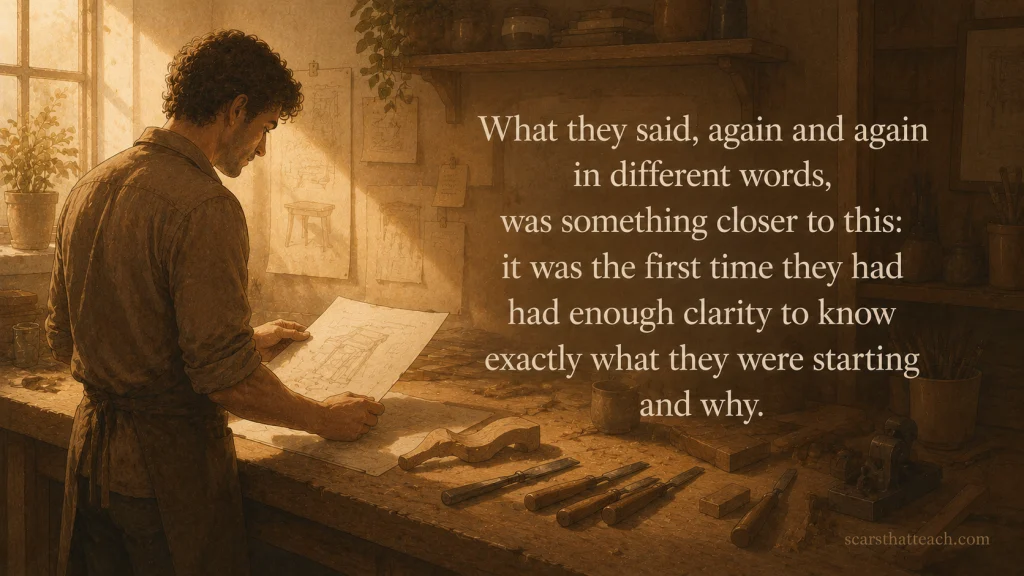
What I noticed, across years of sitting with people who had made major changes in their forties and fifties, was something I did not expect the first few times I heard it clearly. They almost never described what they were doing as a second chance. That framing is everywhere in the culture around midlife reinvention, but it did not match how these people actually talked about their experience. What they said, again and again in different words, was something closer to this: it was the first time they had had enough clarity to know exactly what they were starting and why. Not a retry. Not catching up. Something closer to a first genuine attempt at something they finally understood well enough to actually want.
That distinction matters, and I think it gets lost in most of what is written about this. It is also worth separating from the question of how to survive a start that was forced on you rather than chosen. If the practical mechanics of rebuilding after something has collapsed are what you need, how to start over after life falls apart addresses that ground more directly. What I want to look at here is the specific experience of the midlife restart: what is genuinely different about it, what is harder, and what is sometimes quietly better.
The Story About Too Late, and What It Gets Wrong
The image of midlife as a closing of doors is persistent, and it is not coming from nowhere. By forty or fifty, most people have accumulated real constraints: financial commitments that cannot simply be set aside, professional histories that pull in specific directions, family structures with their own weight and timing. The practical version of starting over available at forty-five is genuinely different from the one available at twenty-two, and anyone who tells you otherwise has probably not tried both. I am not going to pretend the constraints are not real.
But the constraints framing is not the full picture. Research on wellbeing across adulthood consistently finds that midlife is not a simple narrowing of what a person is capable of doing or building. People in their forties and fifties tend to have clearer self-knowledge than they did in their twenties. They are, on average, less susceptible to external pressure about what their choices are supposed to look like. They have a stronger filter for what actually matters to them versus what they have simply been told should matter. Those are not consolation prizes for having fewer years ahead. They are genuine structural advantages for starting something new, and they almost never appear in the same conversation as the constraints.
A midlife restart tends to come with a specific set of things that younger people beginning something new rarely have in the same form:
- A clearer sense of which values are genuinely yours versus which ones you inherited without examination
- A lower tolerance for starting something because someone else thinks you should
- Enough experience of difficulty to know what you can endure and what you genuinely cannot
- Less need for external validation at every stage of the process
- A shorter list of conditions that need to be in place before you can begin
None of those remove the difficulty. But they change its shape.
What Self-Knowledge Actually Does to a New Beginning
Here is the part that most writing on starting over later in life either skips or softens, and I think it is the most honest thing to say about this. The self-knowledge that comes with midlife is not simply an asset. It is also a weight that younger people starting over do not carry in quite the same way, and pretending otherwise does not serve the person who is in the middle of trying to begin something.
When you are twenty-five and starting something new, you do not fully know yet what difficulty you are signing up for. That ignorance is not entirely a disadvantage. It allows you to move with a confidence that is partly naivety, and naivety, under the right circumstances, can carry you through the early stages of something hard before the doubt has time to settle in. At forty-five, you know more. You know how these things tend to go. You have a sense of what the middle of a hard thing looks and feels like, how long the uncertainty lasts, what the specific moments look like when you have to decide whether to continue. That awareness is honest and useful over time. But in the early stages of a new beginning, it asks something specific of you: you have to choose the thing with your eyes open, which is a different kind of demand than simply beginning.
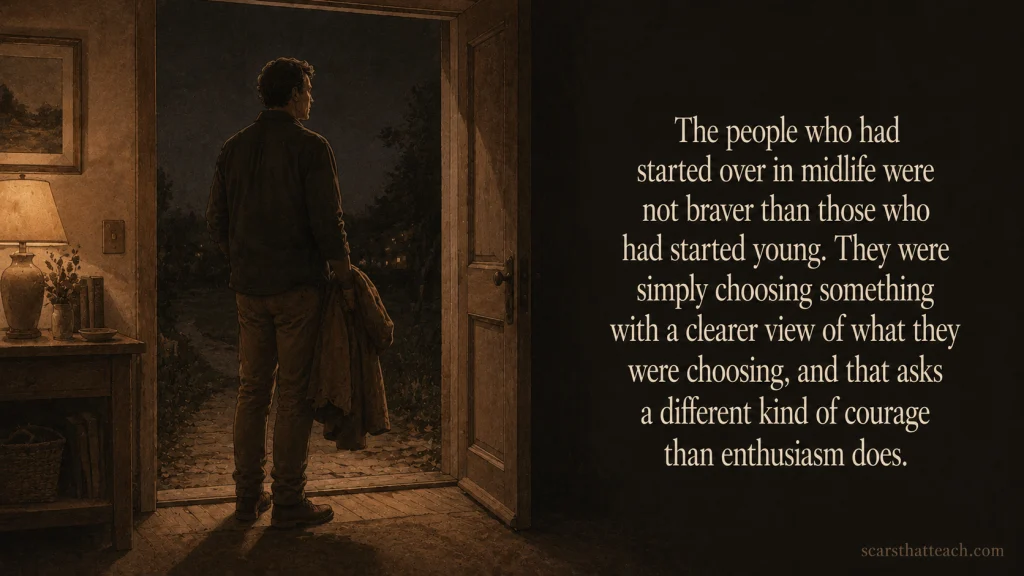
“The people who had started over in midlife were not braver than those who had started young. They were simply choosing something with a clearer view of what they were choosing, and that asks a different kind of courage than enthusiasm does.”
This is why people rebuilding life in midlife sometimes describe a particular kind of early paralysis that the standard advice about starting over does not quite address. They are not confused about what they want. They are not waiting for someone to give them permission. They are seeing the full shape of what they are about to do in a way they did not the first time, and that visibility, while ultimately an advantage, is a genuine weight at the beginning. Understanding that the weight is not a warning sign but a feature of this particular kind of start tends to matter more than most of what the culture offers on this subject.
If the specific difficulty of beginning again, at any point in life, is something you are sitting with, why starting over feels so hard looks at that dimension more directly.
What Gets Easier, and Why It Matters
The other side of that same self-knowledge is that it protects against specific mistakes that younger people commonly make when starting something new. This is not about midlife being better in some abstract sense. It is about what accumulated self-knowledge actually does when applied to a beginning rather than simply accumulated.
A twenty-five-year-old starting something new can start it partly to prove something, to a parent, a former employer, someone who did not believe in them. They can start it because the option looked available and seemed to fit a version of themselves they wanted to inhabit. They can begin without a fully formed sense of what they actually want from it versus what they have been told they should want. I am not saying this as a criticism. I say it because I watched it from the outside enough times to recognize the pattern. And the thing about those motivations is that they can carry someone quite far. They can also break apart under sustained difficulty in a way that leaves the person uncertain what they were actually building toward.
By the time someone is starting over at fifty, most of those borrowed motivations have been worn down to something more specific. They have had more chances to learn which of their drives are genuinely theirs and which ones were adopted from elsewhere. The start that comes from that kind of clarity is harder to sustain through the early stages, because it does not have the buoyancy of enthusiasm without awareness. But when it holds, it tends to be pointed at something real. A beginning pointed at something real, even a slower one, tends to outlast a faster beginning aimed at something that was never quite the person’s own.
The most common mistake I have watched people make with a midlife restart is treating that slower, more deliberate pace as a sign that something is wrong. They compare it to how starting something felt at twenty-five, find it less immediately exhilarating, and decide that either they or the plan are not right. The steadier pace and the sharper awareness of what they are getting into are not problems to be solved. They are the specific signature of beginning with more honest eyes, and they are worth recognizing as such rather than trying to fix.
Final Thoughts: Beginning Again With More Honest Eyes
The people I sat with who had made genuine new starts in their forties and fifties were not, as a group, more confident than people who had started young. They were often less confident in the early stages. What they had instead was a kind of precision: a sharper sense of what they were starting and why, a lower tolerance for the reasons that had driven earlier attempts and turned out not to hold. That is a different foundation than enthusiasm, and it builds differently. But it builds.
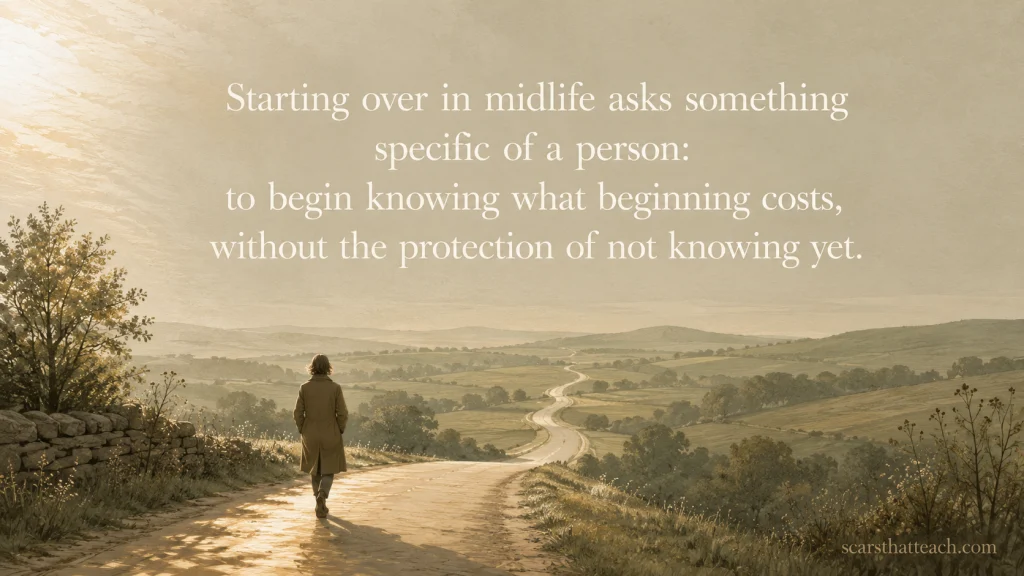
Starting over in midlife asks something specific of a person: to begin knowing what beginning costs, without the protection of not knowing yet. That is not a lesser version of starting over. It is its own kind of beginning, with its own particular demands and its own staying power when it finds the right ground.
If this connects to other questions you are sitting with about starting over, the broader terrain of what starting over actually involves looks at other angles worth reading. And if you want a different way into the subject, what people have written about failure and starting again sometimes clarifies things that a direct conversation cannot quite reach.
FAQs
🔁 Is it too late to start over at 40 or 50?
No, but that answer is less useful than understanding what starting over at midlife actually looks like. It is genuinely different from starting over at twenty-five, not simply harder. The self-knowledge, the clearer sense of what you actually want, and the lower tolerance for borrowed motivations are real advantages. So is the awareness of difficulty, which asks more of you at the beginning but tends to build something more durable.
😟 Why does starting over in my 40s feel harder than I expected?
Partly because you know more than you did the first time. You can see the shape of what you are about to do in a way a younger version of you could not, and that visibility is heavier than ignorance. That awareness is ultimately an asset, but in the early stages it asks something specific: you have to choose the thing with your eyes open, and that is a different kind of demand than simply beginning.
💼 What is genuinely different about starting over later in life?
The constraints are often more real: financial, professional, and family obligations do not disappear. But so are the advantages. Greater self-knowledge, less susceptibility to external pressure about what your life should look like, and a clearer filter for what you actually want versus what you have been told to want. A midlife start tends to be slower and more deliberate, and more likely to be aimed at something genuinely yours.
🧭 How do I know if starting over at 50 is the right move?
That is a question only you can answer, and it depends on details only you have access to. What I can say from years of watching people work through this is that the ones who found the most solid ground were usually starting toward something they could name clearly, not just away from something they wanted to leave. Clarity about what you are moving toward tends to matter more than certainty about when to go.
🌱 What actually gets easier about starting over in midlife?
The motivations get more honest. By midlife, most people have had enough experience to know which of their drives are genuinely theirs and which ones were adopted from elsewhere. Starting something from that kind of clarity is harder to sustain in the early stages, but more likely to hold over time and more likely to be pointed at something real rather than something borrowed.