
People who struggle with patience are usually not people who don’t care about it. Most of the frustrated reactions I heard over the years came from people who valued patience deeply and couldn’t understand why they kept failing at something they so clearly wanted to do. This piece looks at why patience is so hard from a psychological angle rather than a character one: what’s actually happening when expectation collides with reality, why tiredness and stress lower your capacity for patience independent of who you are as a person, and why none of this means you’re simply bad at something other people find easy.
It’s Rarely About Not Caring
Why is patience so hard, even for people who genuinely want to get better at it? The people who came to me most frustrated with their own impatience were almost never people who didn’t value patience. They were people who valued it a great deal, who had decided it mattered to them, and who genuinely could not understand why they kept failing at something they wanted so badly to be good at. That gap between wanting something and being able to consistently do it is exactly where most explanations of impatience fall short.
Most advice treats impatience as a flaw to correct through more effort or more willpower. What the research actually shows is closer to a mechanical explanation than a moral one. The psychology of impatience starts with understanding what’s actually happening in your head in the moment it breaks down, not with deciding you simply don’t have enough of some quality other people have more of.
Where Impatience Actually Comes From
Researcher Mark Travers, who has written on this for Psychology Today, frames impatience as something that arises when reality diverges from expectation. You build an internal model of how long something should take, how a conversation should go, how a process should unfold, and impatience shows up specifically at the point where the world stops matching that model. The line moves slower than expected. The person explains something for the third time. The project takes twice as long as the plan said it would. None of that is really about the line, the person, or the project. It’s about the gap between what your mind predicted and what’s actually happening in front of you.
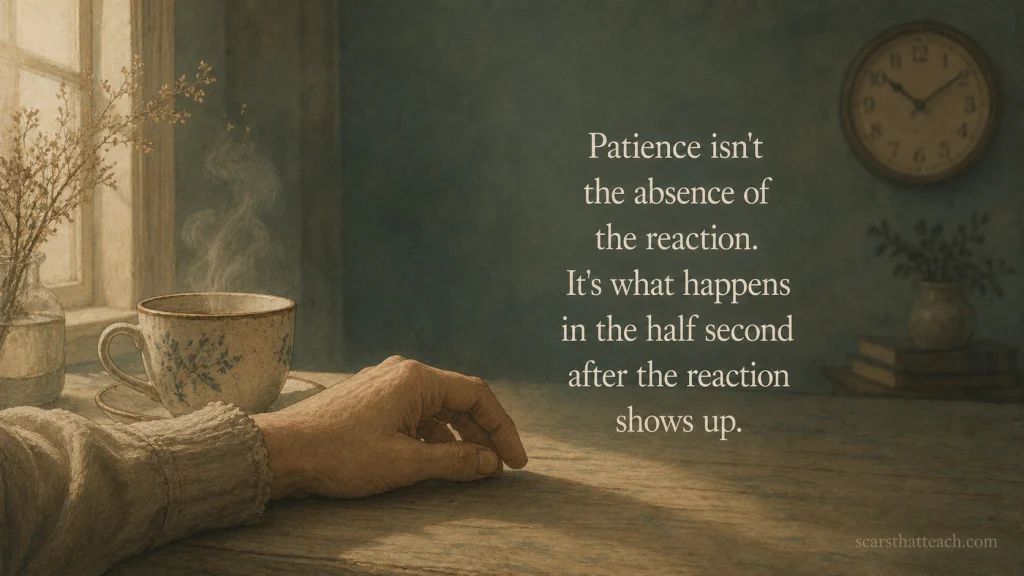
That framing explains why it is hard to be patient even for people who genuinely want to be: the mismatch isn’t something you consciously choose to feel bothered by. It registers almost automatically, the same way surprise does, before you’ve had a chance to decide how to respond to it. Patience, in that light, isn’t the absence of the reaction. It’s what happens in the half second after the reaction shows up, which is a much narrower and more specific skill than just being a patient kind of person.
Why Do I Have No Patience Some Days and Plenty on Others
Here’s the part most confirmed advice on this skips entirely. Researcher Sarah Schnitker’s work, reported on by NBC News, identifies a set of situational variables that lower a person’s capacity for patience predictably, independent of their character: being overtired, being ill, being hungry, being under stress, and even being physically overheated. None of those are personality traits. They’re states, and they come and go within the same person across a single week, sometimes across a single day.
That distinction matters more than it sounds like it should. Most people experience a short patience fuse on a hard day and conclude something about who they are, rather than something about the day. If you’ve ever wondered why you have no patience on some afternoons and plenty of it on others, with nothing about your values or your character actually changing in between, situational depletion is most of the honest answer. The capacity is real and it fluctuates, the same way physical energy fluctuates, and treating a low day as proof of a permanent flaw tends to make the next low day harder, not easier.
What Actually Lowers Your Capacity for Patience
A few situational factors show up consistently enough in the research and in what people described to me that they’re worth naming directly, since recognizing them tends to do more good than trying to white-knuckle through a low-capacity day:
- Being overtired, even mildly, measurably reduces how much mismatch between expectation and reality a person can absorb before reacting.
- Hunger lowers patience in a way that has nothing to do with character and everything to do with available resources to regulate a reaction.
- Physical stress, including being too warm or too cold, pulls attention away from regulating emotional reactions and toward managing physical discomfort.
- Illness, even something minor, narrows the bandwidth available for absorbing the gap between expectation and reality.
- General stress from an unrelated part of life tends to lower patience for things that have nothing to do with the actual source of the stress.
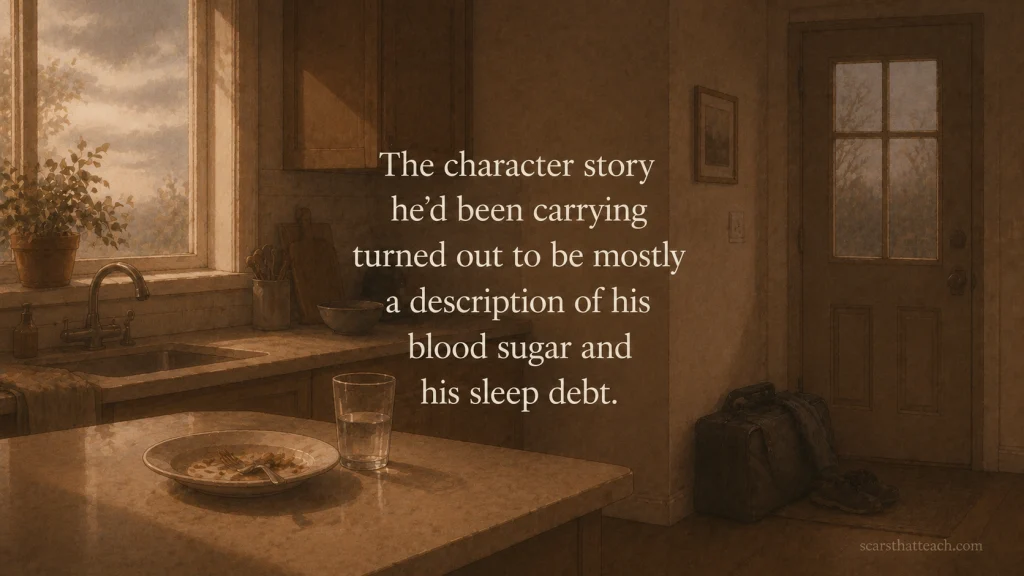
I sat with a man once, a composite drawn from a number of conversations rather than any single person, who described feeling ashamed every time he snapped at his kids after a long shift. He’d built an entire story about being a short-tempered person, until he noticed the snapping almost never happened on days he’d eaten lunch and slept reasonably well. The character story he’d been carrying turned out to be mostly a description of his blood sugar and his sleep debt.
Final Thoughts: This Isn’t a Diagnosis
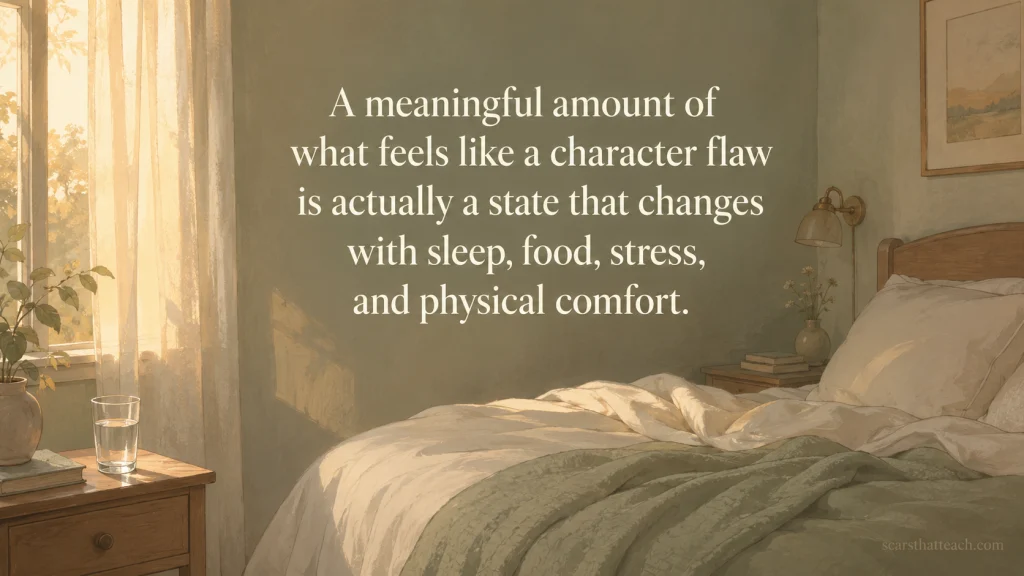
I want to be clear about the limits of this. Struggling with patience is not a disorder, and nothing here is meant to diagnose what’s going on for you specifically. It’s also not an excuse to stop caring about the moments where impatience costs you something real. What it is meant to do is take some of the shame out of the pattern, since a meaningful amount of what feels like a character flaw is actually a state that changes with sleep, food, stress, and physical comfort, all of which are at least partly within your control even when your temperament feels fixed.
If you’re looking for the practical side of this, what to actually do in the moment patience runs short, that’s covered separately under how to practice patience in the moments it matters most. And for the wider set of questions this one belongs to, there’s more under how people actually become more patient over time. If you’d rather sit with how other people have put this into words, there’s also a collected set of life lessons quotes worth returning to.
FAQs
🧠 Why is patience so hard, psychologically speaking?
Mostly because impatience shows up when reality diverges from an internal expectation, and that reaction happens almost automatically. On top of that, situational factors like tiredness, hunger, and stress lower your capacity to handle the mismatch, independent of your character.
😩 Why do I have no patience some days and plenty on others?
This usually points to situational depletion rather than a change in who you are. Sleep, hunger, stress, illness, and even temperature all measurably affect how much mismatch between expectation and reality you can absorb before reacting.
🌡️ Can being hungry or tired really affect patience that much?
Yes. Research on situational variables has found that hunger, tiredness, illness, stress, and overheating all lower patience capacity predictably, which means a short fuse on a hard day often has more to do with the day than with your character.
🩺 Is being impatient a sign of a disorder?
Not on its own. Struggling with patience is common and usually explainable through expectation mismatch and situational factors, not a clinical condition. If it’s significantly disrupting your life or relationships, a conversation with a professional is a reasonable next step.
🔧 What’s the difference between understanding impatience and fixing it?
Understanding the mechanism, expectation mismatch plus situational depletion, explains why it happens. Actually working on it, what to do in the moment it shows up, is a separate and more practical question worth looking at on its own.