
I have sat with people at the very end of long, ambitious lives, and I can tell you what almost never comes up: the goal itself. What comes up is whether they had built something they did every day that kept them moving, long after the original plan stopped making sense. The debate people frame as goals vs systems is not really a debate at all once you see what each one is actually for. A goal tells you where you are headed. A system is what gets you there, one ordinary day at a time. This is about what changes when you stop treating that distinction as trivia and start treating it as the reason you have been stuck.

The People Who Did the Most Good Rarely Planned the Furthest Ahead
Over two decades of sitting with people who were dying, I noticed something that took me years to say out loud, because it did not match the trophies and framed diplomas I saw on so many of their walls. The people whose lives had clearly mattered, the ones whose rooms filled with others who had been changed by them, were rarely the ones who had mapped out the furthest destination. They were the ones who had built a way of living that kept them moving in the right direction even after the original plan became irrelevant. A husband who had visited the same hospital ward every week for eleven years had never set a goal about it. He had simply decided, once, what a Wednesday looked like, and then he did that Wednesday over and over until it became who he was.
I bring this up first because it is the whole answer, and I do not want to bury it under three sections of throat clearing. The instinct to fix your life by fixing your goal is not wrong, exactly. It is just aimed at the wrong lever. A goal can tell you where you want to end up. It cannot walk you there. That is a different kind of work, and it is the work almost nobody teaches you to do, because it does not feel like progress while you are doing it. It feels like just another Tuesday.

Why the Goal Was Never the Thing Separating Anyone
The clearest version of this argument I have come across did not come from a hospice room. It came from James Clear, whose book Atomic Habits lays out a problem with goal-based thinking that I wish someone had explained to me decades earlier. Clear points out that everyone competing for the same prize is typically chasing the exact same goal. Every runner in a marathon wants to finish. Every candidate for a job wants the offer. If the goal itself were what separated the person who got there from the person who did not, then everyone sharing that goal would get the same result, and they plainly do not. So the goal cannot be the differentiator. Something else has to be doing the actual work.
What Clear calls the system is that something else: the collection of ordinary, repeated actions a person takes regardless of how they feel about the goal on a given day. I find that framing useful not because it is clever but because it matches what I watched happen in real families for twenty years. I sat with a woman once who had wanted, for as long as her children could remember, to write down her life story for them. She talked about that goal at nearly every visit. She never once talked about a quiet afternoon spent writing a single page of it. The goal was real to her. The system never existed. By the time I met her, the goal had become something closer to a low, constant grief than a plan.
Where the Usual Advice Gets It Backward
Here is where most of what you will read on this topic goes slightly wrong. It gets framed as a contest: goals versus systems, pick a side, one is outdated and one is the future. That framing is tidy, and it is also not quite honest about how a life actually moves. A goal without a system is a name for a place you never visit. A system without a goal is motion with nothing to show for it. Neither one alone does what a person actually needs, and treating them as rivals only delays the question that matters, which is what you are willing to repeat.
This matters most for a very specific kind of reader, and I suspect it might be you, since it is the situation I hear about more than almost any other. You have been clear on your goal for a long time. Years, maybe. You could state it in a single sentence without hesitating. And you have made almost no measurable progress toward it in all that time. If that is you, I want to say plainly that the problem was probably never a lack of clarity about what you want. The question that has been missing is not what do I want. It is what do I actually do on a typical Tuesday that moves me toward it. Most people can answer the first question instantly and go blank on the second.
None of this is exotic. It usually just sounds like this, if you are honest with yourself about it:
- You can talk about the goal in detail but go quiet when asked what you did toward it yesterday.
- Progress arrives in short bursts right after something reignites your motivation, then disappears within a week or two.
- You measure your life against the goal itself instead of against anything you are actually doing on a regular basis.
- The goal has grown heavier with time instead of closer, because every year it goes unmet adds weight without adding a plan.
If two or three of those sound familiar, the honest next move is smaller than it feels like it should be. It is not a new five-year plan. It is deciding on one repeatable action for the week ahead, small enough that skipping it would feel strange, and doing it whether or not you feel like it.
The Mistake I Watched People Make Without Knowing They Were Making It
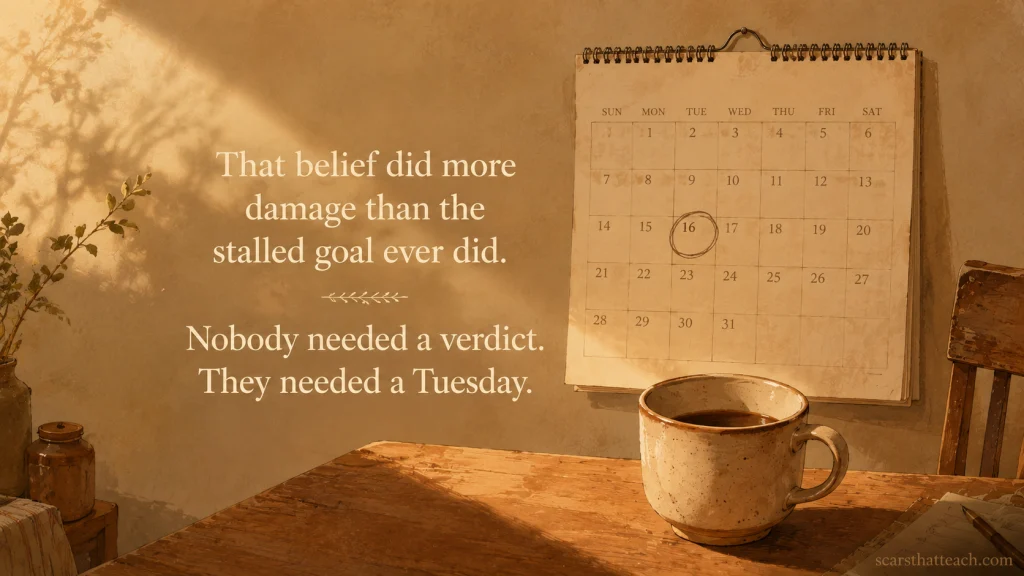
There is a pattern I saw often enough in those hospital rooms to stop thinking of it as a coincidence. People who had spent years frustrated with themselves over an unmet goal almost never blamed the lack of a plan. They blamed something closer to character: not disciplined enough, not motivated enough, not the kind of person who follows through. That belief did more damage than the stalled goal ever did, because it turned a solvable structural problem into a verdict about who they were. Nobody needed a verdict. They needed a Tuesday.
I think I understand why this happens, even though it took me a long while to see it clearly. A goal gives you something to feel right away, a small charge of relief just from picturing yourself having already reached it. A system gives you nothing to feel in the moment it asks something of you. It is unglamorous by design, the same small motion repeated on a day when nothing about it feels urgent or worth mentioning to anyone. Given a choice between imagining the outcome and doing the boring middle part, most of us will choose the imagining every time, and then wonder later why the outcome never showed up.
I think this is where the generic version of this advice consistently falls short. It tells you to focus on systems, not goals, as if that resolves the tension by itself, and then leaves you to figure out what a system actually looks like for your specific situation. A retired teacher I spoke with wanted, more than anything, to repair a relationship with an adult son she had not spoken to in three years. Her goal was clear and it was not going anywhere on its own. What changed things was not a bigger goal or a firmer resolution. It was one small, repeatable action: a short, low-pressure message sent on the first of every month, with no expectation attached to it. That was the whole system, almost embarrassingly modest. Three years of wanting the reconciliation had produced nothing. Five months of that one monthly message brought her son back to the phone.

Final Thoughts: The Goal Still Matters, It Just Cannot Do the Walking
None of this means the goal was a waste of your time. Direction matters. A person with no destination in mind and no reason to keep going is not better off than the person stuck on a goal they cannot reach. What I am asking you to consider is smaller than that. It is not abandoning what you want. It is separating the question of where you are headed from the question of what you will actually do about it on an ordinary day, the kind when nothing is pushing you forward. That second question is the one that has probably gone unanswered the longest, and it is the one worth sitting with this week, not the goal itself. If you want to go further into where goals tend to break down before they even get started, I have written about why most goals fail before they start, and if you are ready to build the goal itself in a way that has a system already built into it, I have laid out how to set goals you will actually keep. Both sit inside the wider collection of writing I keep on questions about setting and following through on goals, and the underlying discipline that makes any of it possible is something I have written about more broadly in what steady follow-through actually requires.
FAQs
🧭 What is the actual difference between goals and systems?
A goal is the destination, a single outcome you are aiming at. A system is the repeated, ordinary action you take toward it regardless of how motivated you feel that day. One sets direction. The other creates progress.
❓ Why do people say systems matter more than goals?
Because everyone chasing a prize usually shares the same goal, so the goal itself cannot be what separates the people who get there from the people who do not. What separates them is what they actually did on ordinary days, which is the system.
🔁 Can you have a goal without a system?
Yes, and it is more common than most people admit. It looks like knowing exactly what you want for years while having nothing specific you do about it on a regular basis. That gap is usually where the frustration lives.
🛠️ How do I turn a goal into a system?
Ask what you would need to do on a typical Tuesday, whether or not you felt like it, for that goal to move forward. Make that action small enough to repeat without relying on motivation, then repeat it.
⚖️ Is it bad to set goals at all?
No. A goal gives you a direction worth walking in, and without one a system has nothing to serve. The trouble only starts when the goal is doing all the work and nothing is actually happening underneath it.