
Why we avoid thinking about death is not, at its root, a cultural habit we could simply choose to drop if enough people decided to talk about it more openly. The avoidance runs deeper than convention. Psychologists who study terror management theory describe it as a defense the mind builds against a fact it cannot resolve, and that defense has real costs, even when it also has real uses. This piece covers what is actually happening underneath the silence around mortality, and what gets harder later because of how thoroughly most of us manage it out of view now.
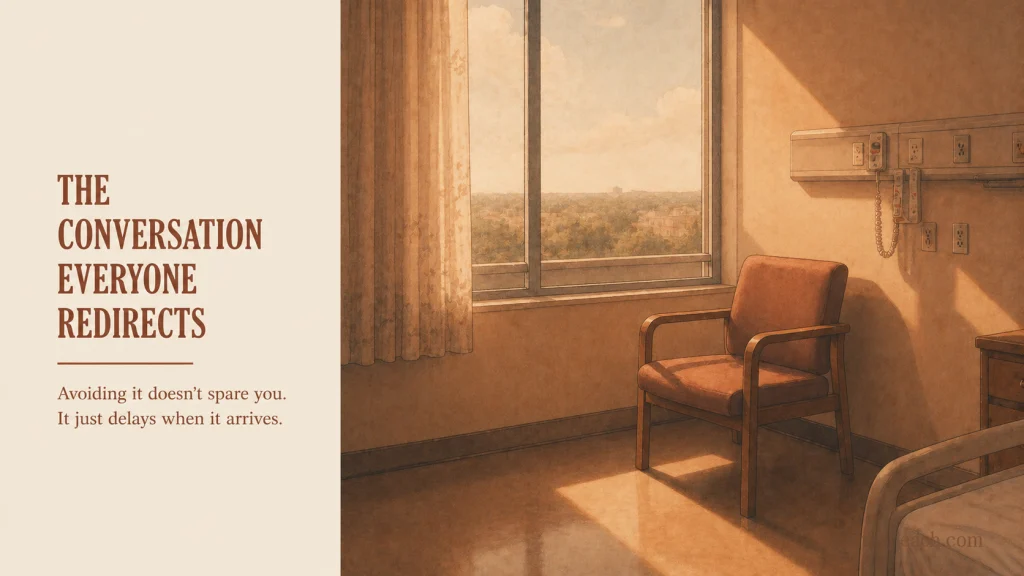
Why We Avoid Thinking About Death
In twenty years of sitting with dying people, the thing I noticed most about the wider world was how rarely death ever came up in it. Here was a fact that would eventually be true of every single person in every room I had ever sat in, and somehow it was managed out of nearly every conversation those same people had with each other. Friends visiting someone in hospice would talk about the weather, about a television show, about anything at all except the thing that had brought them into the room. It was not coldness. Most of them loved the person dying in front of them. It was something closer to a reflex, one so automatic that most people never noticed themselves doing it.
I used to think this was simply a cultural failure, a society too squeamish to say the word out loud. I no longer think that. The avoidance runs deeper than manners, and understanding where it actually comes from changes how you might relate to it in your own life.
What Terror Management Theory Says Is Actually Happening
Researchers in social psychology developed a framework called terror management theory to explain this pattern, building on the work of cultural anthropologist Ernest Becker, who argued in 1973 that a great deal of human activity is organized, often without our awareness, around managing the fact that we will die. The theory proposes that humans share the instinct for self-preservation with every other living thing, but unlike most other living things, we are also aware that death is certain and that its timing is unpredictable. That awareness generates a kind of existential anxiety that the mind cannot simply think its way out of, so it develops defenses instead. The most common conscious defense is the simplest one: not thinking about it. Not discussing it. Treating it as a topic that belongs only in specific, contained settings, a hospital room, a funeral, a single difficult conversation, rather than something that gets to live anywhere near ordinary life.
I want to be precise about what this means, because it is easy to hear “defense mechanism” and assume something is wrong with people who avoid thinking about death. Nothing is wrong with them. The defense exists because the alternative, sitting with unmanaged awareness of your own mortality at every moment, would be genuinely difficult to function under. The avoidance is doing a job. The question worth asking is not whether the job is illegitimate. It is what the job ends up costing once it runs unexamined for an entire lifetime.

What the Avoidance Actually Costs
Most writing on death avoidance treats it as something close to a social convention, a topic people simply prefer not to bring up, the way they might avoid talking about money at dinner. The research on terror management theory points to something more specific than that, and the costs that come with sustained, unexamined avoidance are documented rather than speculative. Researchers studying the effects of defensive avoidance, including work by Vail and colleagues in 2012, have found that pushing mortality completely out of awareness does not simply leave a person neutral. It tends to leave them less prepared, not more, for the moments when mortality cannot be avoided any longer.
I watched this play out constantly, in rooms where families were suddenly forced to make decisions about a loved one’s care that they had never once discussed while there was still time to discuss them calmly. A daughter who did not know whether her father wanted aggressive treatment at the end, because the subject had never come up in thirty years of a close relationship. A husband who had never asked his wife what she actually wanted for her own funeral, because the question had always felt like inviting something neither of them wanted to invite. These were not failures of love. They were the direct, predictable cost of a defense that had done its job too well, for too long, leaving no room for the conversation when the room was finally, urgently needed.
A few of the specific gaps I watched families run into, again and again, when the subject had never once been raised:
- Whether a loved one wanted aggressive medical intervention or comfort-focused care near the end.
- Who they wanted making decisions on their behalf if they no longer could.
- What they actually wanted for a funeral or memorial, rather than what the family guessed.
None of these are complicated questions to ask in calmer times. They become almost impossible to ask gently once a crisis is already underway.
What Avoidance Quietly Prevents
There is something else the avoidance costs, one that is harder to name because it is not a crisis. It is an absence. Awareness of mortality, when a person can hold it without being overwhelmed by it, tends to produce a particular kind of clarity about what actually matters to them. I watched people arrive at that clarity only once they were forced into direct confrontation with their own death, and I watched many of them say some version of the same thing: they wished they had not waited until the end to see their life this clearly.
That clarity is available earlier than most people assume, but the avoidance keeps it permanently out of reach for anyone who never lets the subject in. This is not an argument for dwelling on death constantly, which would simply trade one kind of difficulty for another. It is an observation that complete avoidance forecloses something that occasional, manageable contact with the subject tends to open up.
This Is Not a Character Flaw
None of this means avoiding the topic makes someone weak, in denial in some clinical sense, or doing something wrong. The defense is close to universal, and it exists for understandable reasons. Most people who avoid the subject are not avoiding it out of cowardice. They are avoiding it because the mind is built to protect itself from something it cannot resolve, and that protection has genuine value, especially in ordinary daily life, where constant awareness of mortality would make it difficult to function at all.
What I am suggesting is something narrower and, I think, more useful: that the avoidance deserves to be noticed rather than left entirely automatic, and that a small amount of deliberate, manageable contact with the subject, on your own terms, before a crisis forces the contact on someone else’s terms, tends to leave people steadier rather than more afraid.

Final Thoughts: Letting the Subject In a Little, On Your Own Terms
I am not asking you to dwell on death, and I would not recommend it if you tried. What I am suggesting is much smaller: notice the next time the subject comes up and your instinct is to redirect the conversation, and ask yourself, just once, what would happen if you let it sit there a moment longer instead. Not forever. Not even for very long. Just long enough to see what it might tell you about what you actually want from the life you are still living.
For a closer look at what that kind of reflection can actually do for a person, my piece on what facing your own mortality actually changes goes further into that question. And for a wider view on the kind of clarity hard truths can offer, the broader collection on life lessons worth carrying into the hardest conversations covers ground this piece only touches on.
FAQs
🧠 Why do people avoid thinking about death?
According to terror management theory, awareness of mortality creates a kind of existential anxiety the mind cannot fully resolve, so it builds avoidance as a defense to manage that anxiety instead.
🚫 Is avoiding thoughts about death unhealthy?
Not inherently. The avoidance is a normal, common defense. The concern is less about whether it exists and more about what gets left unprepared when it runs completely unexamined.
💬 Why is death such a taboo topic in conversation?
It is not purely social convention. Research suggests the discomfort is psychologically driven, not just a matter of manners, which is why redirecting away from the subject tends to feel automatic.
⚖️ What does avoiding thoughts about mortality actually cost?
It often leaves people less prepared for decisions that have to be made suddenly, such as end-of-life care, and it can quietly prevent the clarity that some reflection on mortality tends to produce.
🕯️ Should I try to think about death more often?
Not constantly, and not in a way that overwhelms you. A small, manageable amount of reflection on your own terms tends to help more than either complete avoidance or constant dwelling.