People who have lived the longest tend to say the same things about relationships, and it is not what you might expect. When Karl Pillemer interviewed over 1,500 older Americans for the Cornell Legacy Project, and when the Harvard Study of Adult Development tracked lives across eight decades, the pattern that emerged was not about grand gestures or the right partner. It was about presence, and how quietly and routinely most people withheld it. The elderly advice on relationships that surfaces most often is not a lesson in how to love. It is a lesson in where attention actually went, and what it cost.
The Sentence That Kept Coming Up
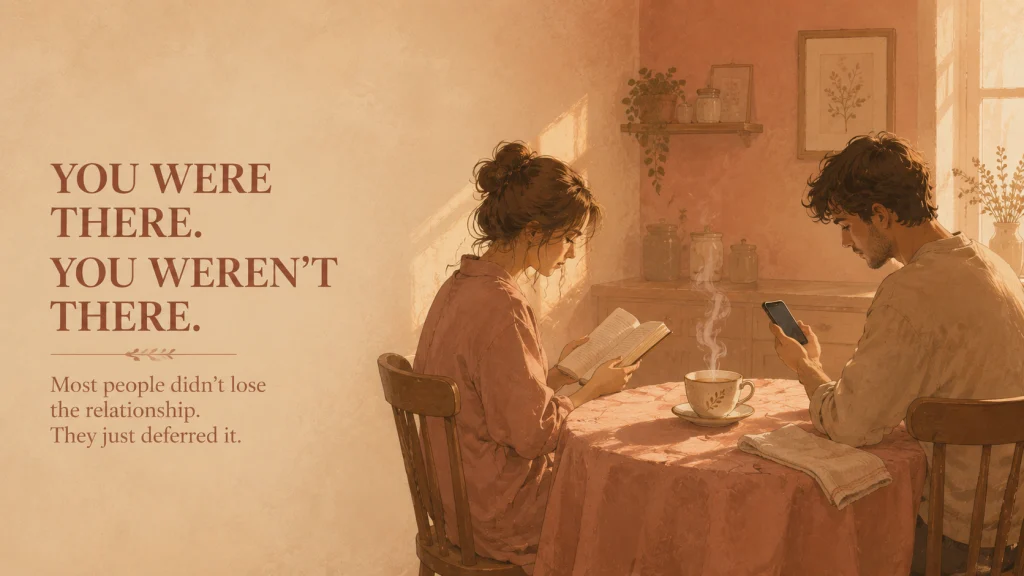
I did not keep a tally, but if I had, the sentence I heard most often from people in their final weeks of life was not about love or forgiveness or the meaning of it all. It was some version of this: I thought there would be more time. Not more time with a job or a city or a project. More time with a specific person: a parent who died before the conversation happened, a child who stopped calling, a friend who eventually stopped trying. The relationship was not over. In most cases, it was just deferred. Continuously, quietly deferred, in the way that things get deferred when you are busy and the other person is still alive and there is no particular urgency yet.
That pattern is worth sitting with, because it does not look like neglect from the inside. It looks like a reasonable week. It looks like: I will call on Sunday. I will visit when things slow down. I will say the thing I have been meaning to say once we have more room to talk. The relationship stays on the list. It just never gets to the top of it. And then at some point the window closes, through death or distance or the slow withdrawal that happens when people stop feeling like a priority, and the deferral becomes permanent. What I noticed, in room after room, was that most people did not realize how far down the list the relationship had slipped until it was already too late to move it back up.
What the Research Found, and What It Did Not Say Clearly Enough
Karl Pillemer, a gerontologist at Cornell University, spent years systematically interviewing older Americans, eventually gathering accounts from over 1,500 people, specifically to find out what they had learned about living well. He was, by his own account, tired of research that treated older people as a problem to be managed. He wanted to know what they actually knew. The Legacy Project, which resulted from that work, found that relationships consistently surfaced as the central concern. Not success, not wealth, not even health in the abstract. The depth of relationships was what people returned to, again and again, when asked what had mattered.
The Harvard Study of Adult Development, which has followed participants across more than eighty years, arrived at the same place from a different direction. Robert Waldinger, the study’s current director, has described its conclusion as both simple and easy to miss: good relationships keep people healthier and happier, and the quality of those relationships at midlife turned out to be a better predictor of physical health in later decades than cholesterol levels. The study also introduced what it calls “social fitness,” meaning that relationships, like physical health, require ongoing attention and maintenance rather than a baseline commitment made earlier in life and then left to run on its own.
Both bodies of research point to something that sounds obvious until you try to apply it honestly to your own life. Most people believe they are prioritizing their relationships. They are not consistently measuring that belief against where their time actually goes.
Depth, Not Breadth
One of the clearer findings from Pillemer’s work is that older people do not wish they had known more people. They wish they had gone deeper with the ones they already had. This is a meaningful distinction. A lot of the effort people put into relationships at younger ages goes into expansion: more contacts, more connections, more options, rather than into the slower, less measurable work of actually understanding someone and letting them understand you. The elderly advice on relationships that comes out of this research is not a call to network differently. It is something closer to the opposite: fewer people, more honestly, for longer.
That shift is harder to make than it sounds. Going deeper with someone requires staying present in conversations that are not convenient or interesting every time. It requires bringing things to the surface that it would be easier to leave there. It requires tolerating the friction that comes with genuinely knowing someone, rather than knowing a version of them that only appears when conditions are comfortable. That friction is not a sign the relationship is failing. In most cases, it is a sign it is real.
The Specific Thing That Gets Lost
There is a pattern I watched closely enough to stop calling it a coincidence. People who had what they described as full, demanding lives, careers they were committed to, children they were actively raising, obligations that genuinely required their attention, often came to the end of those lives with a particular kind of regret. Not a regret about failed devotion. They had devoted a great deal. The regret was about presence. They had been in the room but not quite there. They had provided but not always shown up in the way the other person actually needed. They had loved the person, sincerely, while being mentally somewhere else for a significant portion of the time they were together.
This is different from neglect, and it matters to say so. The people carrying this kind of regret were not people who had abandoned their relationships. They were people who had maintained them at a level of consistent partial attention, under the assumption that depth could be deferred along with everything else. That the real conversation could happen later. That the person would still be there when things eased up, and that easing up was coming. It often did not come. Or it came, and by then the habit of partial attention was too established to break.
Waldinger has observed that it is easy to get isolated, to get caught in the current of work and obligations without noticing how long it has been since you were genuinely present with someone. The isolation he is describing is not dramatic. It is the ordinary kind, where you are technically in contact with people but the contact has become shallow enough that it does not actually sustain anything.
“Most people did not lose their important relationships all at once. They lost them in small, unremarkable increments, over years, until the distance felt too large to cross.”
What older people say, looking back, is that the increments were not unremarkable at all. They just seemed that way at the time.
What People Consistently Get Wrong About This
The most common mistake I watched people make, and this includes caregivers, adult children, spouses, people I sat with for years before they reached the end of their lives, was treating their important relationships as stable structures rather than as living things that required active tending. The assumption was that because the relationship was not in crisis, it was fine. That because they loved the person, the person knew it. That because there had been no rupture, there was nothing to repair.
This is a version of the mistake the Harvard study is pointing at when it describes “social fitness.” We do not think of relationships as something that needs regular maintenance in the way we think of health or finances. We tend to address them reactively: when something goes wrong, when someone pulls away, when the distance becomes impossible to ignore. By that point, rebuilding requires significantly more effort than maintenance would have, and sometimes the window for it has already closed.
- Assuming the other person knows how much they matter. Older people are consistent on this point: most of them did not say the thing enough. Not because they did not feel it, but because it seemed unnecessary to say out loud what both people already understood. The other person often did not understand it as clearly as assumed.
- Waiting for the right moment to have the hard conversation. The right moment rarely arrives on its own. The thing that needed to be said, the unresolved tension, the old wound, the thing kept unsaid out of consideration for the other person, tends to stay unsaid until the opportunity to say it is gone. Several people I sat with described watching that window close and understanding, in retrospect, that it had been open for years.
- Measuring relationship quality by the absence of conflict. A relationship with no friction is not necessarily a close one. It may just be a careful one. Real closeness tends to include enough honesty that things surface occasionally, and enough trust that they can be worked through. People who had avoided all conflict in a long relationship often found, near the end of it, that they had also avoided the depth.
- Treating quantity of contact as a substitute for quality of attention. Being in frequent contact with someone is not the same as being present with them. Many people I spoke with maintained relationships through routine check-ins: regular calls, occasional visits, consistent surface-level contact, while allowing the actual quality of attention in those interactions to become increasingly thin over time.
None of these are failures of intention. They are failures of habit, mostly. The intention to be present, to say what needs to be said, to go deeper rather than wider, is often genuinely there. It just does not translate into consistent behavior without some deliberate effort to close the gap. And the gap, as it turns out, is rarely where people think it is.
It Is Almost Never About the Grand Gesture
One of the things that strikes me, having spent as much time as I have listening to people describe what they wished had been different, is how rarely the regret is about something large. The missed anniversary, the failed marriage, the estrangement that went on too long: those appear, and they carry weight. But underneath them, more often than not, is something smaller and more ordinary. A single conversation that never happened. A habit of deflection, or busyness, so gradual that neither person noticed it becoming the norm.
What older people point toward, when they talk about what sustained a relationship across decades, is not a dramatic course correction. It is something closer to a recalibration of daily attention. The Harvard study found that people who stayed meaningfully connected over their lifetimes were not people who made sweeping romantic gestures or restructured their lives around their relationships. They were people who made small, consistent choices to actually show up, in the conversation that was happening rather than the one they would get to later, over many years. That consistency, accumulated over time, is what the elderly describe when they describe a relationship that sustained them.
This is worth saying directly, because the cultural version of what a good relationship looks like tends to emphasize the high points: the commitment, the devotion, the sacrifices made in moments of crisis. What older people emphasize, looking back, is the texture of ordinary time. Whether the other person felt genuinely heard in the average Tuesday conversation. Whether the attention was actually there, or just technically present while everything else ran in the background. The phrases people reach for to describe what they most valued, from across decades and radically different lives, tend to be quiet ones, the kind collected in life lessons quotes worth returning to. You can also find more on the broader patterns that shape how people look back in what elderly people say matters most.
A Note on What This Does and Does Not Mean
Pattern recognition is not prescription. What I observed across two decades of this work reflects tendencies, things that came up again and again across different people, different relationships, different circumstances. It does not describe every situation, and it does not tell you what to do about your specific one.
There are relationships where more presence would not have changed the outcome. Relationships where the distance was not caused by inattention but by something real and irreconcilable. Relationships where the honest choice is less contact, not more. The wisdom that comes out of this research is not an argument that every relationship is worth saving or that every distance should be closed. It is an argument for being honest with yourself about where the distance actually came from, and whether the assumption that there is still time is one the evidence in front of you actually supports. The broader context for this sits in what I think of as the core of what elderly people have to teach, which is less about relationships specifically and more about the gap between what we say we value and where our time actually goes.
That gap is the thing. It is the thing that almost everyone I sat with at the end of their life had something to say about, and the thing they most consistently wished they had caught earlier. Not because there was a simple fix. Because catching it early means you still have options for what to do with it.
Final Thoughts: What “Not What You Think” Actually Means
People who ask about relationship wisdom from the elderly tend to expect something about love, or loyalty, or choosing the right person. What actually surfaces, across decades of systematic research and the rooms I spent my career in, is harder to package and less comfortable to sit with. The pattern is not about who people chose. It is about whether the people they chose could feel it in the ordinary texture of daily life, over time.
It is about attention. Where it went. How often it was divided. Whether the people who mattered most could feel it when it was there. That is not a lesson with a clean takeaway. It does not resolve into a list of things to do differently starting tomorrow. What it does is give a clearer frame for the question worth asking, which is not “am I devoted to the people I love?” Most people are. The question is whether the people they love can feel that in the ordinary texture of the time they spend together. The answer to that one, for most people, is worth sitting with.
FAQs
❓ What do elderly people say about relationships?
They say, more consistently than almost anything else, that they wish they had been more present in the ordinary moments: not just devoted, but actually there. The advice is less about choosing the right people and more about the quality of attention you bring to the people already in your life.
💬 What do old people say they regret most about relationships?
The regret that surfaces most often is not about specific fights or betrayals. It is about time that was technically shared but not really present: conversations that were half-listened to, visits that happened while attention was somewhere else, the slow accumulation of partial contact that eventually became the whole relationship.
🔍 What does the research say about relationships and happiness in old age?
The Harvard Study of Adult Development, now spanning more than eighty years, found that the quality of a person’s relationships in midlife predicted their physical health in later decades more reliably than most biological measures did. The finding is not that relationships are nice to have. It is that they are structurally central to how well people age.
🕰️ Is it too late to improve relationships in middle age?
The research says no, and so does what I watched over twenty years. The people who made meaningful changes to how present they were in their relationships, even late, even after long stretches of distance, consistently described it as worth doing. The window closes eventually. In middle age, it is usually still open.
🧩 Why do people let important relationships drift even when they value them?
Because the drift is gradual and the relationship never formally ends. There is no moment where it feels urgent to address it. The assumption that there will be more time, and that the other person understands without being told that they still matter, tends to hold until it cannot anymore.
💡 What is the most important piece of old people wisdom on love and friendship?
If there is one thing that comes up more than any other, it is this: say what needs to be said while you still can. Not because it will fix everything, but because carrying the unsaid thing after the window closes is significantly harder than the conversation itself would have been.