Most people use joy and happiness as if they mean the same thing, but they describe something meaningfully different. Happiness tends to be circumstantial, tied to what is happening right now. Joy runs underneath that, steadier and less dependent on the day going well. The distinction matters because chasing the wrong one can leave you genuinely confused about why enough never feels like enough.
Joy vs Happiness: Two Different Things We Keep Treating as One
The people I sat with at the end of their lives were not always the ones who reported the happiest lives. I noticed that early, maybe five or six years into hospice work, and it stayed with me for the next decade and a half. Some of them had had genuinely difficult lives, marked by loss and limitation and circumstances that would have broken a lot of people’s understanding of what a good life looks like. And yet there was something underneath their days that I can only describe as steady. Not happiness, exactly. Something that did not depend on the day going well.
The confusion between the two is not a minor one. When someone says they want more happiness, they usually mean something closer to joy, without knowing it. They are not asking for more good days. They are asking for something that holds even when the days are not good. Those are different things, and they are built through different means. When people spend years pursuing the wrong one, it is not because they were careless. It is because nobody told them clearly that the two words point in different directions.
What Each One Actually Is
Happiness, in the way most people mean it, is tied to what is happening. You get good news and you feel happy. The weather is perfect and you feel happy. The dinner is excellent, the conversation lands right, the day goes the way you hoped: happiness. Psychologists call this hedonic wellbeing, and the name is instructive. It tracks the moment. It is high positive affect, low negative affect, and a general sense that things are going well right now. There is nothing wrong with it. It is real and it matters. The problem is that it is constitutionally dependent on circumstances being favorable, and circumstances are not always favorable.
Joy operates differently. It is closer to what researchers call eudaimonic wellbeing, meaning engagement and a sense that what you are doing with your time connects to something that matters to you. Carol Ryff’s model of eudaimonic wellbeing, developed over decades of research, identifies dimensions like purpose in life, personal growth, and warm relationships as its core components. These are not things that happen to you. They are things you participate in, build, and maintain. Which is why joy tends to persist in a way that happiness does not. It is not dependent on the day being good. A person can have joy during a genuinely hard period of their life. That is not a metaphor or wishful thinking. It is what the distinction is actually describing.
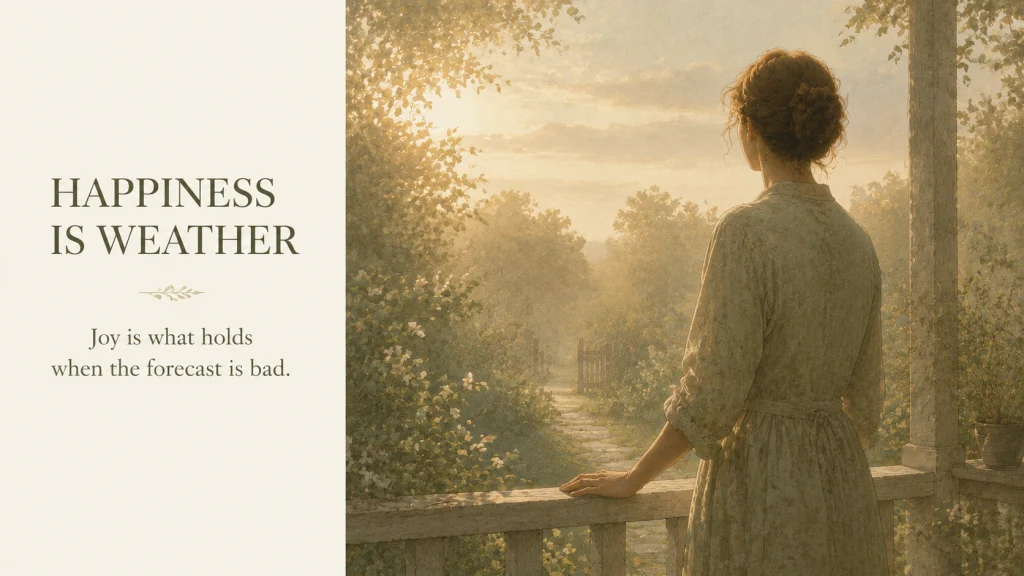
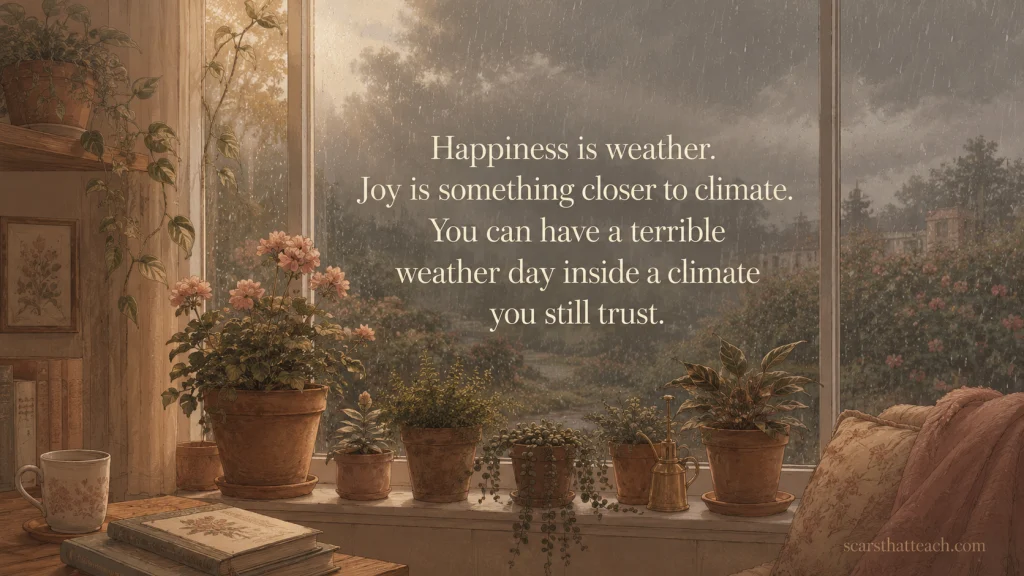
The clearest way I found to hold the two together is this: happiness is weather. Joy is something closer to climate. You can have a terrible weather day inside a climate you still trust.
Why Happiness Fades and Joy Does Not Have To
There is a psychological mechanism that explains part of why this matters, and it is worth knowing about because most people experience it without having language for it. It is called hedonic adaptation. The short version: we adjust to positive changes faster than we expect. A raise, a move to a better apartment, a relationship finally going well. These things produce genuine positive emotion, and then that emotion fades as the new situation becomes the baseline. This is not a character flaw. It is how the brain processes novelty and change. It normalizes what it receives.
The research on this is consistent. Sonja Lyubomirsky and her colleagues found that circumstantial changes (the raise, the promotion, the move) tend to produce happiness that erodes over time as adaptation sets in. What holds up better are intentional activities: things like expressing gratitude, pursuing meaningful goals, maintaining close relationships. The sustainable happiness model, as Lyubomirsky and colleagues described it, suggests that activity-based wellbeing is harder to adapt away from than circumstance-based wellbeing, precisely because good activities can be varied and renewed in ways that circumstances cannot.
What this means practically is that the things people most commonly pursue in the name of happiness (a better situation, more money, the right circumstances finally aligning) are exactly the things most vulnerable to adaptation. And the things closer to what I am calling joy (purpose, connection, engaged activity that means something) are more resistant to that same process. Research on intrinsic motivation and meaning suggests that meaning does not normalize the way pleasure does. People who describe their lives as purposeful tend to maintain that sense of purpose over time, whereas people who describe their lives as primarily pleasurable show more fluctuation as circumstances shift. This connects directly to why we stop noticing what is good, since adaptation is the mechanism underneath both problems.
I watched this play out in rooms across two decades. The people who seemed most at peace were rarely the ones who had arranged their circumstances best. They were the ones who had found something to care about that did not require the circumstances to be perfect.
Where People Most Commonly Get This Wrong
The most common mistake I have seen people make is treating the two as interchangeable and then optimizing for the easier one to measure. Happiness has a readout. You feel it or you do not. It is legible, immediate, and something that other people can observe. You smile. You say you are doing well. You report a good week. Joy is harder to point to, slower to arrive, and often present even when the surface does not show it. So when someone asks themselves whether they are doing well, they often answer the happiness question without realizing they have not touched the joy question at all.
- Pursuing circumstances instead of activities. Someone leaves a job they find meaningless for a higher-paying one they find equally meaningless, and then wonders why the raise did not fix the feeling. The circumstances changed. The engagement did not.
- Mistaking the absence of unhappiness for the presence of joy. A life can be comfortable, relatively free of serious hardship, and still feel empty in a way the person cannot name. Comfort is not the same thing as meaning.
- Waiting for the right conditions. A pattern I saw often enough to stop being surprised by it: people who had deferred what mattered most to them until the timing was better. Until the kids were older, until the career was stable, until the situation settled. The situation rarely settled in the way they needed it to. What ran underneath their days was never quite built, because it kept being next.
- Conflating social proof with genuine feeling. People do things because they are supposed to make you happy. The vacation, the celebration, the milestone comes and goes, and they then feel quietly confused when they do not produce the thing they were promised. This is partially adaptation, and partially the difference between pursuing what looks like happiness from the outside and building what actually sustains from the inside.
None of these are failures of character. They are predictable errors given how rarely anyone explains that the two things are different and that they work through different mechanisms.
What I Noticed at the End of People’s Lives
Sitting with someone at the end of their life changes what you listen for. People stop maintaining the version of themselves they have been performing for decades. They talk about what actually mattered, and what they wish had mattered to them earlier. What I heard, more times than I can count, was not regret about happiness they had missed. It was something closer to regret about meaning they had not built.
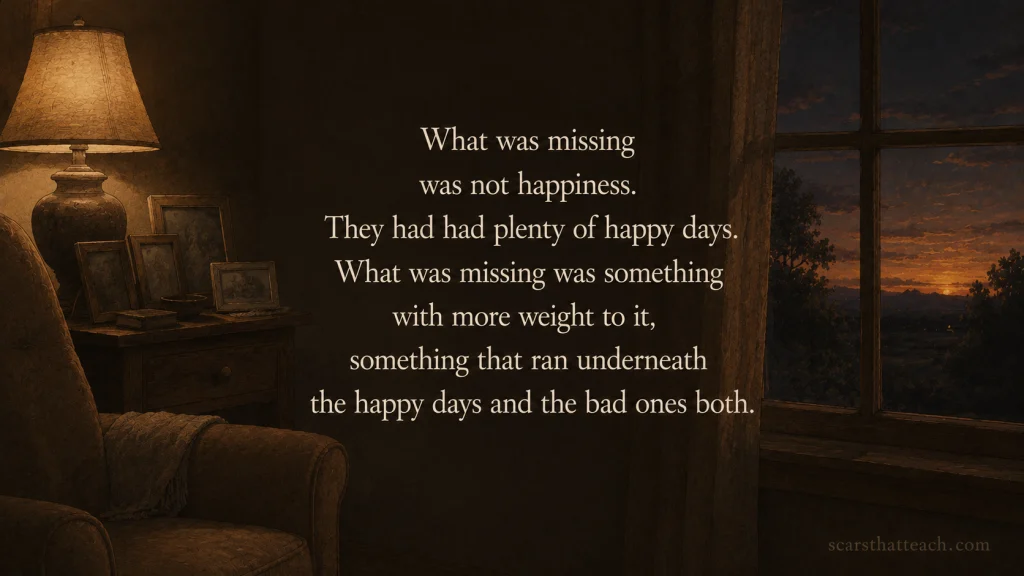
There is a composite pattern I saw across many families, different rooms, different circumstances: a person who had spent the majority of their adult life doing things that looked fine from the outside. A stable job, a reasonable marriage, a house that fit the expectations of their community. And who arrived at the end of their life with the quiet, difficult realization that they had not really known themselves well enough to want the right things. Not a dramatic failure. Just a slow accumulation of choices made in the direction of acceptable rather than alive. What was missing was not happiness. They had had plenty of happy days. What was missing was something with more weight to it, something that ran underneath the happy days and the bad ones both and made the whole thing feel like it had been worth inhabiting.
That is what I mean when I talk about joy. It is not a feeling you get. It is something you build, or fail to build, across a life. And one of the things that makes it harder to build is that nobody distinguishes it clearly from happiness until it is very late to distinguish anything. This is part of what I write about here at finding joy in everyday moments, which takes up the practical question of how to locate that deeper register when the surface has been taking all your attention.
The Relationship Between the Two
None of this is meant to dismiss happiness. Positive emotion matters. Enjoying your life, having good days, laughing, finding pleasure in ordinary things. These are not trivial. The research from positive psychology is consistent on the point that people flourish most when they have access to both hedonic and eudaimonic wellbeing, not when they sacrifice one for the other. The argument is not that happiness does not matter. It is that happiness alone is not a complete answer, and that treating it as one is where the confusion tends to take root.
The distinction between joy and happiness is also not a strict opposition. Joy does not require suffering, and happiness is not suspect. What the distinction points to is a difference in durability and in what produces each one. Happiness is more tightly coupled to circumstances. Joy is more tightly coupled to engagement, meaning, and relationship. A person who has both, good circumstances and something meaningful built into how they spend their time, is in the best position. The point of understanding the difference is not to choose one over the other. It is to understand what you are actually after when you feel like something is missing, so you are not spending years searching in the wrong place.
I think about a conversation I had with a woman in her late seventies who had lived what, by most visible measures, had been a very full life. She had traveled widely, worked in a profession she had chosen deliberately, maintained close friendships into old age. She was not a person who had made the mistake of deferring everything. And still she said something that has stayed with me: “I was happy most of the time. I am not sure I was always glad.” The difference between being happy and being glad is roughly the distinction I am pointing at. Gladness is the longer register. It does not require the day to be going well. It is what is left when the weather clears and you look around and recognize, without needing to perform it for anyone, that this was worth it. For more on the specific ways this plays out day to day, the broader context of reflections on happiness and meaning touches on much of what underlies this distinction.
What the Distinction Actually Changes
Knowing that joy and happiness are different is only useful if it changes something about how you pay attention. It does not need to change everything. A few questions are enough to start with.
The first is simply this: when something feels like it is missing, which register is it in? Is the problem that your circumstances are genuinely bad and you need them to improve? Or is the problem that your circumstances are adequate and something still feels empty? These require different responses. Fixing circumstances is useful when circumstances are genuinely the problem. It does not address the feeling of emptiness that shows up inside reasonably good circumstances, and that is where most people get stuck, applying a circumstantial solution to what is actually a meaning problem.
The second is about where your intentional effort goes. Lyubomirsky’s research on sustainable wellbeing points specifically to activities grounded in gratitude, connection, and meaningful goals as the ones that hold up over time without adapting away. These are not passive experiences. They require showing up repeatedly, in ways that are varied enough to stay alive. A relationship that matters to you does not sustain itself. A sense of purpose does not persist on autopilot. The engagement has to be renewed. This is also part of why small things tend to bring more lasting joy than large ones: small things are renewable, and they resist the flattening effect that novelty brings.
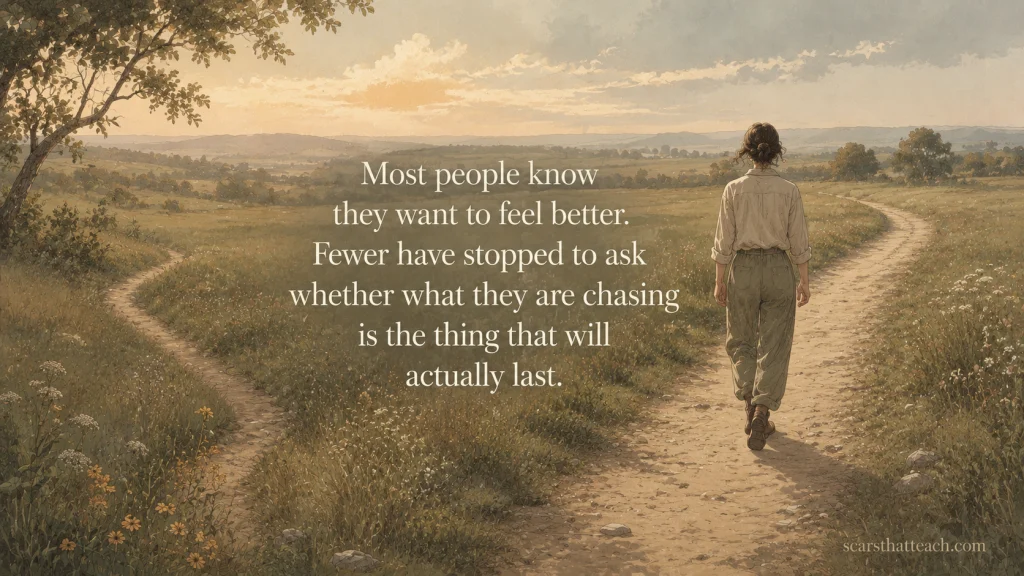
The third is about what you are actually measuring when you check in with yourself. Most people, when they ask themselves whether they are doing okay, are taking a happiness reading. They are assessing the recent weather. A joy reading is harder to take, slower, and requires sitting with a different question: is there something underneath the surface of my days that still feels like it belongs to me? Most people know they want to feel better. Fewer have stopped to ask whether what they are chasing is the thing that will actually last. That is a harder question to live with than the happiness question. It is also, in my experience, the more useful one.
Final Thoughts: What You Are Really Asking When You Ask This Question
Most people who end up reading about the difference between joy and happiness are not looking for a vocabulary lesson. They are asking something more personal than that. They are asking why enough has not felt like enough, or why a life that looks right from the outside does not feel right from the inside, or what exactly the thing is that seems to be present in some people’s lives and absent from their own.
The distinction I have tried to draw here is one way of answering that. Happiness tracks the moment. Joy tracks something more durable. Happiness depends on circumstances. Joy depends more on meaning, connection, and engaged activity. These are things that can be built and tended, and that do not adapt away in the same way that circumstances do. The research supports this. Two decades of watching people reckon with what their lives had added up to supports it too.
None of that means joy is easy to build. It is not. And it does not mean happiness is unimportant. It is not. What it means is that when you feel like something is missing, it helps to have some clarity about which thing you are actually looking for. The search goes differently depending on the answer.
FAQs
💬 What is the difference between joy and happiness?
Happiness tends to be tied to circumstances. It rises when things go well and falls when they do not. Joy is closer to a baseline that holds even when circumstances are hard. The distinction is not just philosophical; they are produced by different things and they last for different lengths of time.
🔁 Why does happiness fade so quickly?
The brain adapts to positive changes, a process psychologists call hedonic adaptation. A raise, a better situation, a milestone. These produce real positive emotion that fades as the new normal sets in. Joy is harder to adapt away from because it is rooted in engagement and meaning rather than in circumstances.
🧭 Can you have joy without being happy?
Yes. Joy and happiness are not the same reading. A person going through a genuinely hard period can still have purpose, connection, and a sense that what they are doing with their time matters. Those hold even when the surface does not. That is roughly what joy describes.
🤔 Why do people confuse joy and happiness so often?
Because they can look the same from the outside, and because happiness has a clearer readout. You feel it immediately or you do not. Joy is slower, harder to point to, and often present in people who are not visibly doing well. Most common advice conflates the two, which makes the confusion easy to sustain for a long time.
🌱 How do you build more joy in your life?
Research points consistently toward engagement, meaningful relationships, and activities grounded in purpose rather than novelty. These are not passive experiences. They require showing up repeatedly. The difference is that they hold up over time in a way that circumstantial changes do not.
📌 Is it possible to have both joy and happiness at the same time?
Yes, and that combination is worth aiming for. Positive psychology research is clear that people flourish most when they have access to both, good circumstances and meaningful engagement together. The point of understanding the distinction is not to choose one over the other, but to know which one you are actually missing when something feels off.